From a distance, an offshore wind farm looks almost peaceful. The difficult part happened earlier, when crews had to stand a steel tube upright in open water and drive it deep into the seabed, blow after blow.
That is what makes IQIP’s Hydrohammer IQ8 so striking. The Dutch company lists it at 700 metric tons, about 1.54 million pounds, with more than 7,500 kilojoules of energy per blow, yet public updates for major 2026 foundation campaigns name earlier IQIP and Menck machines rather than the IQ8.
A hammer built ahead of demand
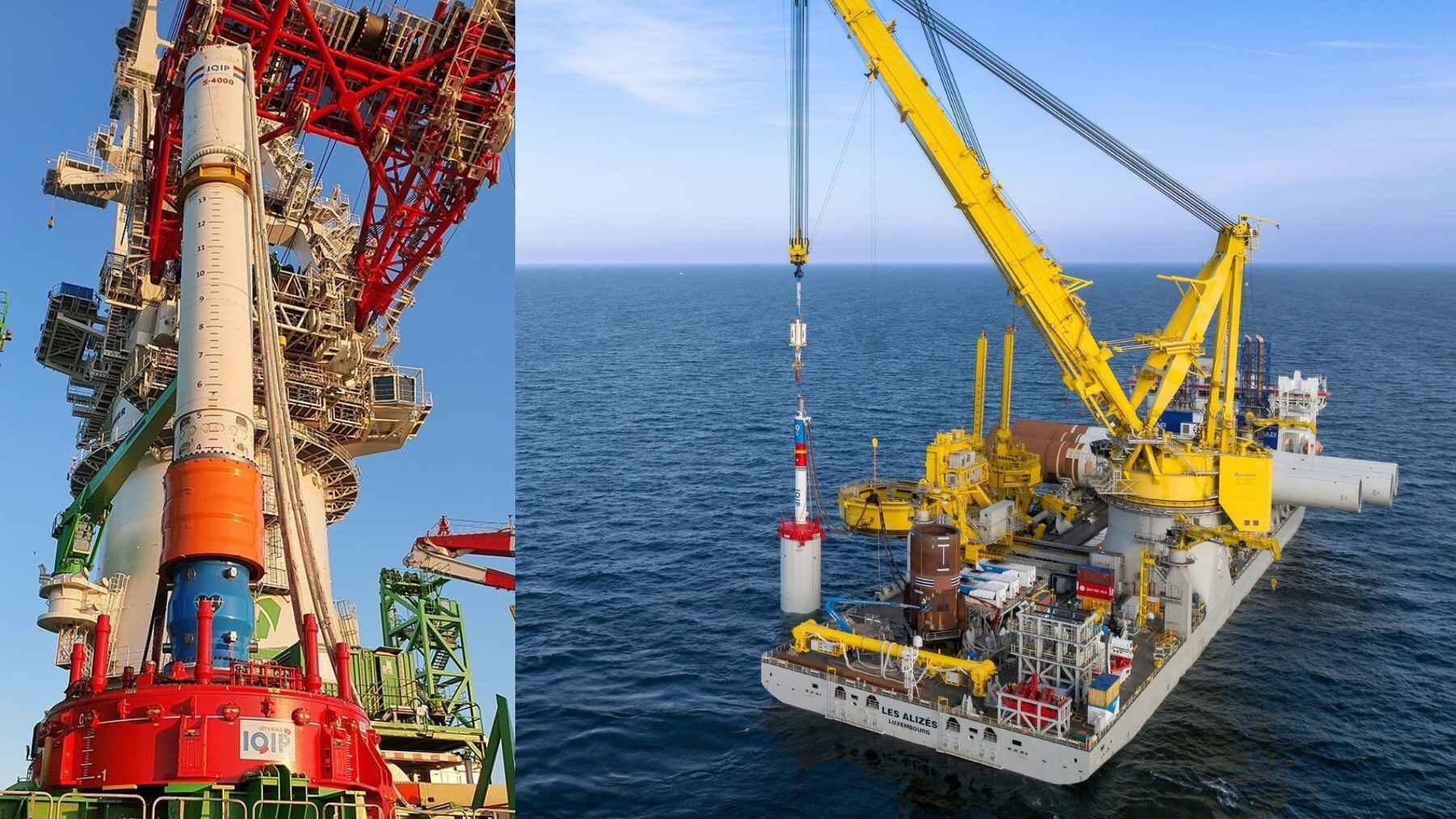
The IQ8 is 23.6 meters long, or roughly 77 feet, and requires hydraulic oil flow of 9,900 liters per minute. IQIP says it can run continuously at full rated capacity and reach 120 percent output when difficult soil demands more force.
Its predecessor, the 525-ton IQ6, delivers 6,600 kilojoules, while the smaller IQ4 and IQ2 reach 4,800 and 3,600 kilojoules. IQIP chief executive Robert Diepenbroek summed up the engineering race in eight words, saying, “As turbine sizes grow, so do the monopiles.”
Why the steel tubes keep growing
A monopile is the enormous steel foundation beneath many offshore turbines. Bigger rotors place greater loads on that foundation, while deeper water, variable soil and stricter installation tolerances can all raise the energy needed to reach final depth.
Inch Cape off Scotland shows how far the scale has moved. Its monopiles reach 102 meters, about 335 feet, measure up to 11.5 meters across and weigh around 2,300 metric tons each, more than 5 million pounds of steel hanging from a crane before installation begins.
Scotland pushed the IQ6 hard
All 54 Inch Cape monopiles were installed by June 11, 2026, using Jan De Nul’s heavy-lift vessel Les Alizés. IQIP says the IQ6 operated at record capacity and used booster mode to achieve final penetration in challenging soil.
The campaign also introduced a remotely operated upending tool rated for 3,500 tons. That matters because each monopile arrives lying horizontally and must be rotated upright, a slow and hazardous-looking maneuver that the system performs without workers standing beside the connection point.
Older hammers remain on duty
At Hornsea 3 off England, Cadeler installed the first of 197 monopile foundations in May 2026. The 2.9-gigawatt project uses foundations averaging 1,670 metric tons and 90 meters long, while Menck is supplying an MHU4400S hammer with equipment sized for monopiles up to 11 meters in diameter.
Germany’s Nordlicht I began offshore foundation work on July 1 with monopiles weighing up to 1,290 metric tons and stretching 80.5 meters. DEME is installing 68 foundations there, while its wider contract for Nordlicht I and II covers 112 monopiles driven with IQIP’s IQ6 and the company’s PULSE noise-reduction system.
The record has an asterisk
IQIP calls the IQ8 the world’s most powerful hydraulic impact hammer, and its published blow energy exceeds 7,500 kilojoules. Menck owner Acteon, meanwhile, describes the 6,250-kilojoule MHU6000W as the world’s largest impact-driving wind hammer, so the apparent contradiction comes down to wording and equipment category rather than the raw energy figure.
In practical terms, both companies are preparing for foundations that are wider, heavier and harder to install. The important contest is not the label on a brochure but whether the equipment can avoid pile refusal, keep an expensive vessel working and place the foundation within tight limits.
The underwater cost
Impact piling sends repeated, high-intensity sound through the water. The UK government identifies offshore wind pile driving as a key marine-noise concern, while research involving the University of St Andrews has examined hearing risk and documented avoidance of wind-farm areas by harbor seals during piling activity.
That is why more power cannot be the industry’s only answer. PULSE uses two pistons and a fluid-filled chamber to lengthen the impact and reduce noise at its source, and it is being paired with the IQ6 on the Nordlicht campaign.
A quieter method reaches the seabed
IQIP is also developing EQ-Piling, which replaces a sharp impact with a longer force pulse from a seawater-filled tank released onto buffer cylinders. The company says the system stretches the impact duration by 15 to 20 times, reducing underwater noise and fatigue in the steel while still driving a large monopile to depth.
In May 2026, a full-scale monopile reached its target depth at EnBW’s Dreekant site in Germany, with DEME operating the system and the project team collecting data through hydrophones, geophones and accelerometers. IQIP rated the technology at TRL 9, although broader commercial performance will become clearer only after repeated project deployments.
What the IQ8 really signals
The IQ8 is not replacing every hammer already at sea. Instead, the 2026 projects show a familiar industrial pattern, with proven equipment completing today’s contracts while a larger model is positioned for the next jump in foundation size and soil difficulty.
At the end of the day, offshore wind now faces two demands that pull in opposite directions, with foundations needing more force while marine ecosystems and regulators need less noise, so the winning technology may be the one that controls energy most carefully rather than simply hitting hardest.
The latest official statement was published on IQIP.