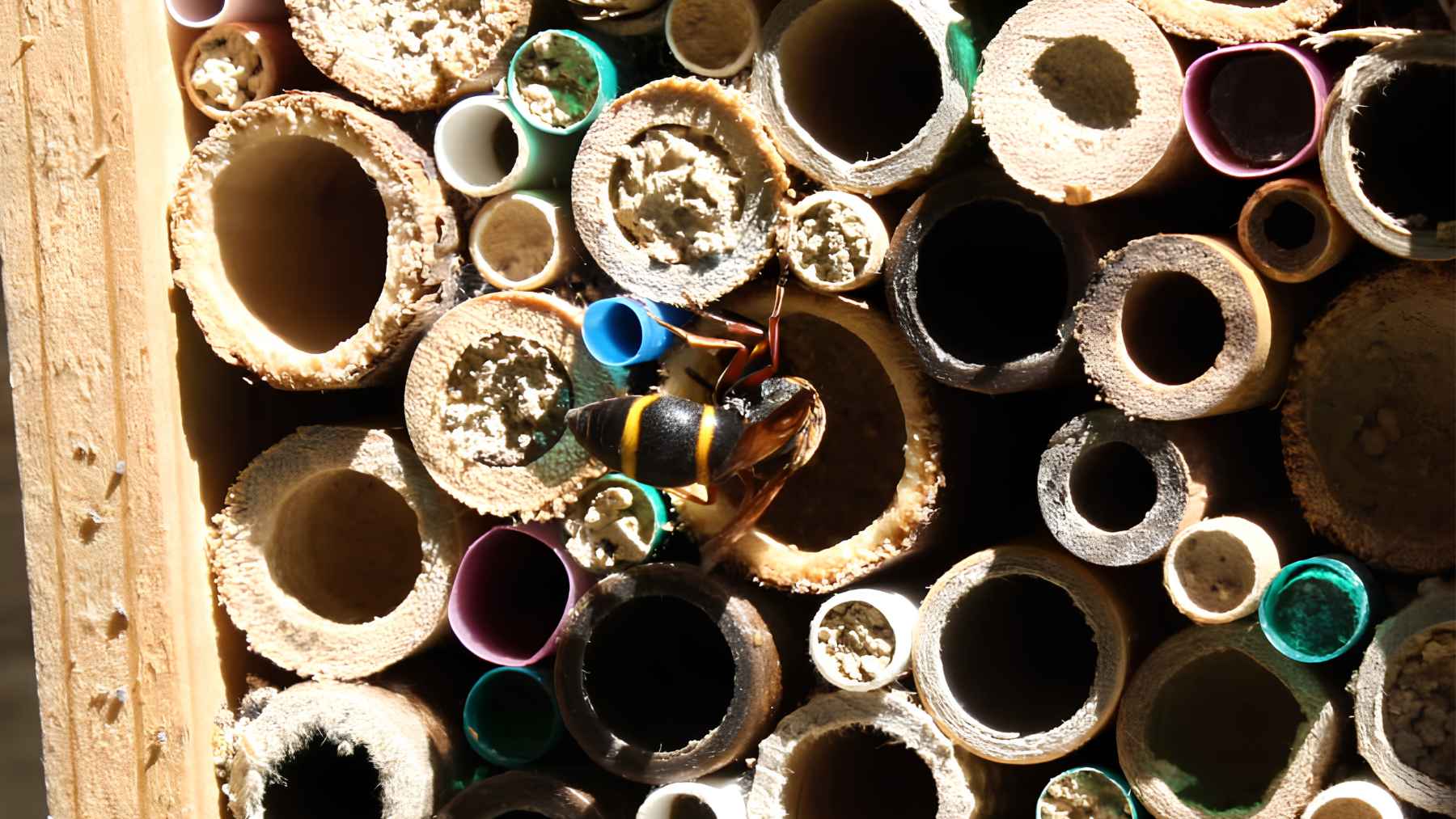
In Toronto after an experiment they discovered that bee hotels, which are sold as a way to help nature, can also end up changing and altering all the dynamics of the ecosystem of insects in the place.
During 2011 and 2013, urban ecologists J. Scott MacIvor and Laurence Packer put out 200 bee hotels per year, but the curious thing was that the most common guests turned out to be native wasps. This means that native bees represented only 28 percent of the inhabitants.
Why bee hotels seemed like an easy fix
If you are still thinking that honeybees only are the ones that live with their queen, workers and a hive full of them, well, let me tell you that many of them are wild species that live completely differently. Most females look for a hole alone, build their own nests and take care of their offspring without help.
Specifically speaking, the idea of bee hotels is to imitate the natural refugees and their holes. Here is where the female lays her egg with some pollen and nectar. Then, she closes the entrance with mud or some leaves and the process is repeated until the tunnel has no more space.
The big problem sometimes is that most North America’s native bee species nest in the ground, and a very small percentage searches for holes in dead wood or hollow stems. This really raises the question if actually bees hotels end up helping a big or small group of pollinators.
A citywide experiment opened every room
The researchers placed hotels in different places such as residential gardens and city parks. Each of them had 30 cardboard tubes with different sizes to see how all those options worked in the different locations.
At the end of each season, what the team did was collect the tubes, store the offspring during winter, and identify the insects when they came out. There, they found 31 species of pollinating bees, 5 that were parasitic, and thousands of wasps.
The wasps were the finding, not the failure
The authors explained that the hotels seemed to help wasps populations more than native bees. And that only sounds disappointing only if you just see the box as a product for one use and not like a small piece of habitat.
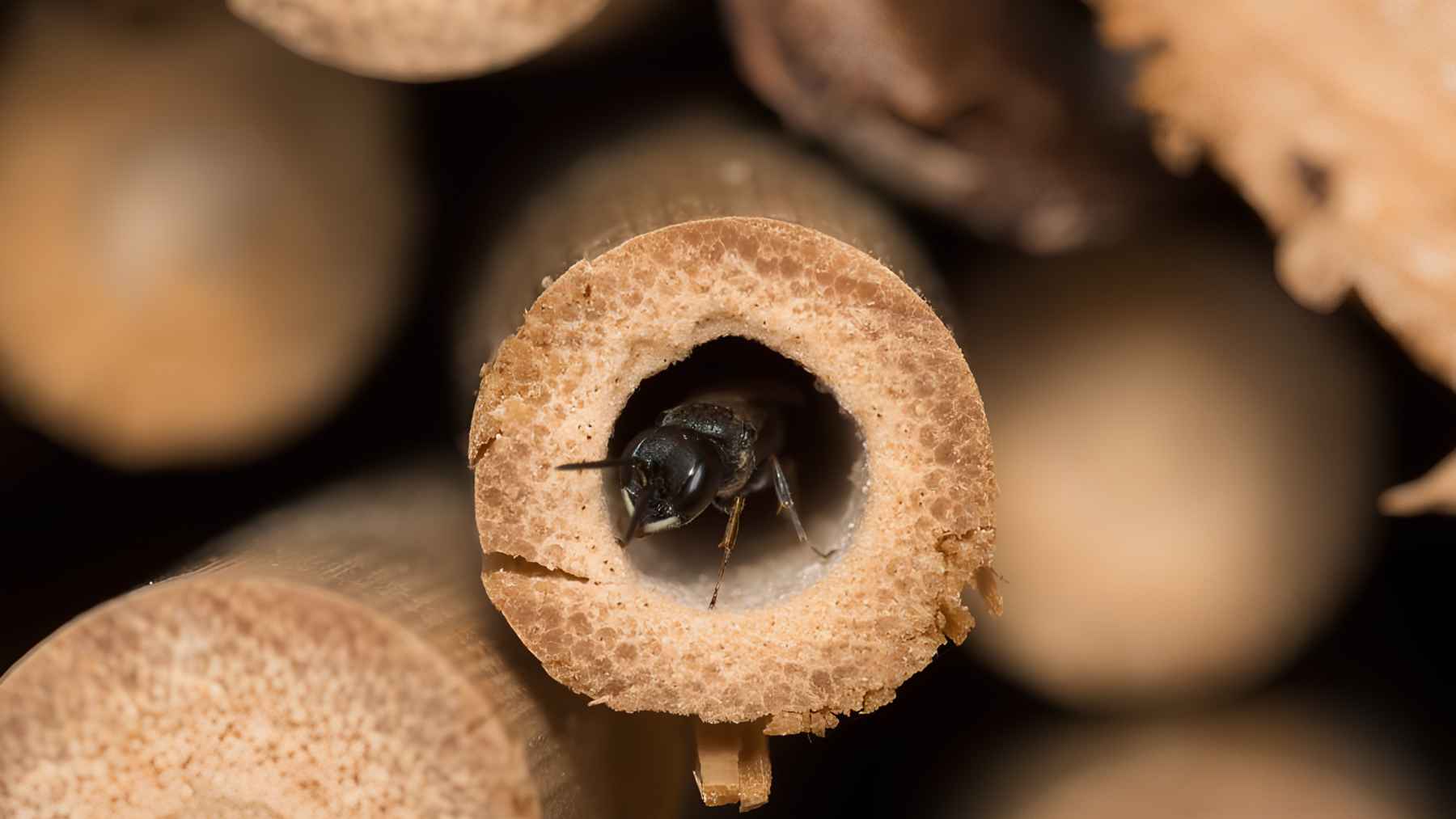
Many solitary wasps use those same holes and mud or grass to divide their nests. Also, many of them hunt garden insects that can be considered pests, so actually, it is not that bad to have them in your home.
So, the question here is whether the hotel helped or hurt the bees. And the thing is that the study could not answer that with a lot of accuracy, and many experts reminded us that there is not a lot of clear evidence if these hotels are really good or bad. What could be demonstrated in the experiment is that when you put up a shelter, it can really change who lives there.
Crowded nesting sites can carry hidden costs
Seen from a close distance, all those tubes really near one another can seem tidy and modern, but actually, this makes it easier for the parasites and predators.
Native bees in the Toronto study suffered much more parasitism than the ones brought from the outside. Experts warned that the dense nests can increase the risk of parasites, diseases and mold, although the experiment did not prove that all of the boxes cause these problems.
The key point is in maintenance. Official guidance recommends using tubes that can be taken cleaned, that have strong walls and are closed at one end. One bee hotel should not just be a decoration that hangs and is forgotten forever.
A better pollinator plan starts outside the hotel
For most native bees, the best help is in the ground and not hanging on a wall. Things like the dry stems, old wood. diverse native flowers, and protection from pesticides can help a lot more species that will never use a paper tube.
Sometimes it can be seen as something untidy, but in a garden where every single plant is cut and all is buried beneath thick mulch, it ends up destroying the places where wild bees actually need to make their nets.
Why this older experiment still matters
This study was published in 2015, so it is not last-minute news, but bee hotels are still very popular in garden shops. The thing here is what happens with them when the wildlife moves in, and specifically, what happened with the wasps was not a failure, and yes the most useful data point!.