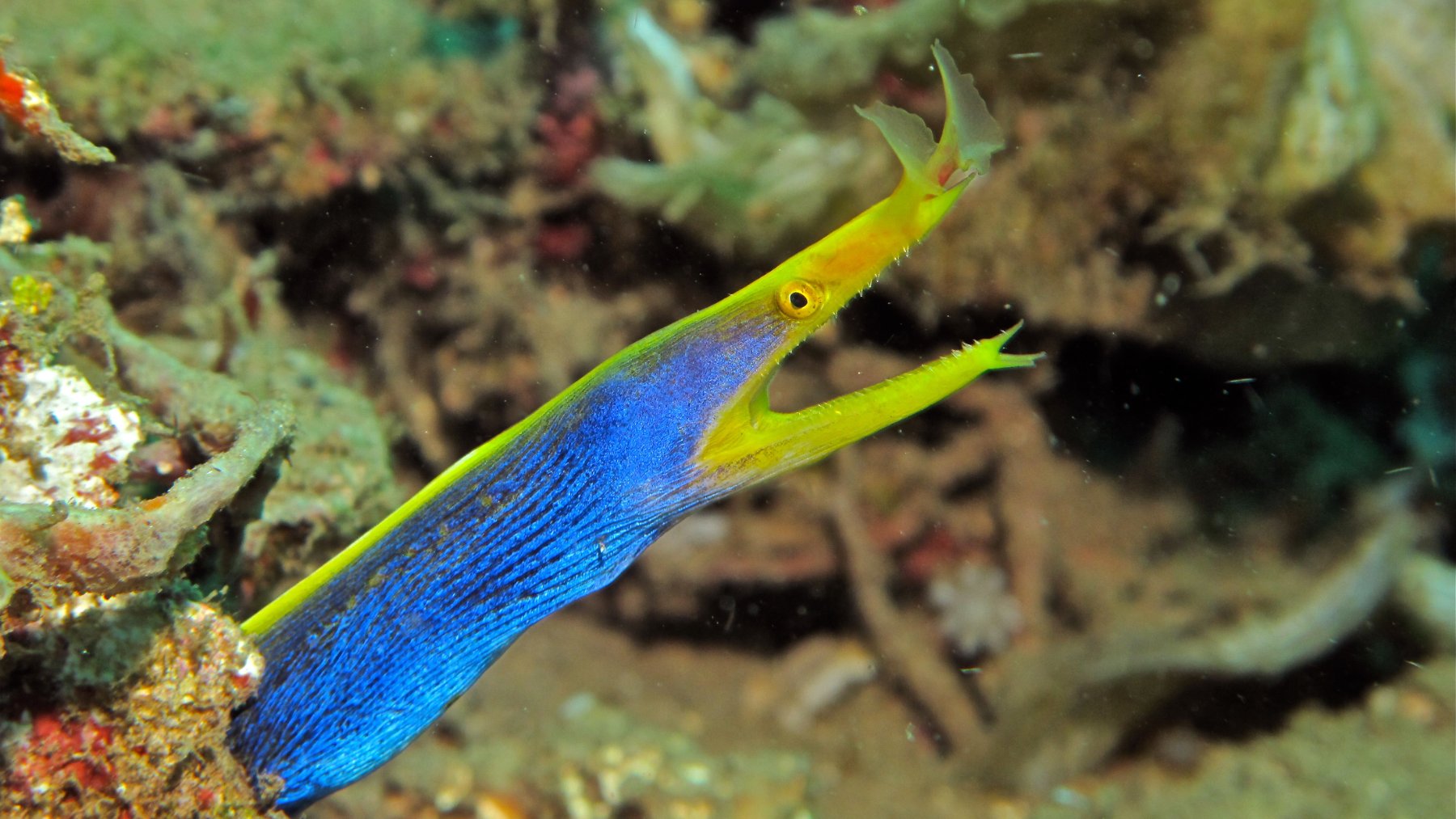
An underwater photographer in Mauritius caught a shy reef fish doing something divers do not often get to watch. In footage shared in 2025, Ian Haggerty recorded a bright blue-and-yellow ribbon eel swimming outside its burrow, its slender body undulating through the water.
That exposed, free-swimming view was what made the encounter special. Haggerty was diving with the scuba center Ocean Spirit when he spotted the fish, describing the experience as “a rare treat” because ribbon eels spend much of their time hidden.
Why swimming in the open caught his attention
The appeal is easy to understand from Haggerty’s description. He compared the eel’s movement to “a silk scarf,” capturing how different the animal looks when its flowing body is visible rather than concealed in its burrow.
The Australian Museum provides the habitat context, noting that ribbon eels are usually seen in burrows in sandy or rubble-covered areas beside coral reefs. A glimpse of one near its hiding place is therefore a different experience from watching the whole animal move through the water.
Some of the story remains out of view. The account does not establish why this eel left shelter or how often it swims in the open. A memorable observation is not the same thing as a population survey, so “rare to witness” should not be confused with evidence that the species itself is scarce.
Meet the fish behind the flowing shape
The ribbon eel’s scientific name is Rhinomuraena quaesita, and the Australian Museum places it in the moray eel family. The museum highlights its greatly enlarged front nostrils as a key identifying feature, giving its face an appearance almost as distinctive as its colors.
It can also be longer than a quick glimpse suggests. The museum lists a maximum length of about 4.3 feet (1.3 meters), although that species maximum should not be mistaken for a measurement of the individual filmed in Mauritius.
A predator hidden beside the reef
Fishes of Australia, hosted by Museums Victoria, records the species across the tropical Indo-west Pacific. Its listed depth range extends from 1 to 57 meters (roughly 3 to 187 feet), putting its habitat well beyond a single island or one particular stretch of shallow reef.
According to FishBase, ribbon eels feed on small fish and often remain hidden in sand or rubble, sometimes with only the head showing. That adds another dimension to Haggerty’s scarf-like comparison, because this elegant-looking animal is also a predator, not simply a colorful spectacle for passing divers.
Those bright colors come with a changing life story
Blue and yellow are only part of the ribbon eel’s wardrobe. The Australian Museum describes juveniles and subadults as black with a yellow dorsal fin, adult males as blue with yellow around the snout and lower jaw, and females as predominantly yellow.
Haggerty added another striking claim, saying, “They can change from male to female as they age!” Smithsonian Ocean also describes a male-to-female transition, known as protandry, but the scientific picture deserves some care.
FishBase notes that this proposed sex change has been inferred from coloration but remains unconfirmed. Separately, a Vienna Zoo study published in Zoo Biology in 2015 found that captive ribbon eels’ color variations did not reflect sex or sexual maturity. Those findings caution against using a colorful video alone to establish an individual’s reproductive stage.
Watching reef wildlife without disturbing it
For anyone hoping to enjoy a similar encounter, giving the animal space matters more than getting closer. NOAA’s wildlife-viewing guidance recommends keeping hands off marine animals, avoiding attempts to attract them with food, and backing away when they show signs of disturbance.
The same care applies to the surroundings. NOAA warns that touching reefs and stirring up sediment can harm corals, making the apparently empty space around a photo subject worth protecting too.
In practical terms, the better picture is not worth crowding a fish into changing its behavior. NOAA also encourages visitors to choose wildlife-viewing operators that follow responsible practices, a useful question to raise before booking an excursion rather than after entering the water.
What makes the Mauritius encounter worth watching
The strongest part of Haggerty’s account is the simple observation at its center. A fish normally associated with burrows was seen moving freely, giving viewers a look at its body and motion that a photograph of its head could not provide.
There is no need to turn that moment into a claim about a new species or a scientific breakthrough. Haggerty’s original footage and accompanying statement were published on Instagram.