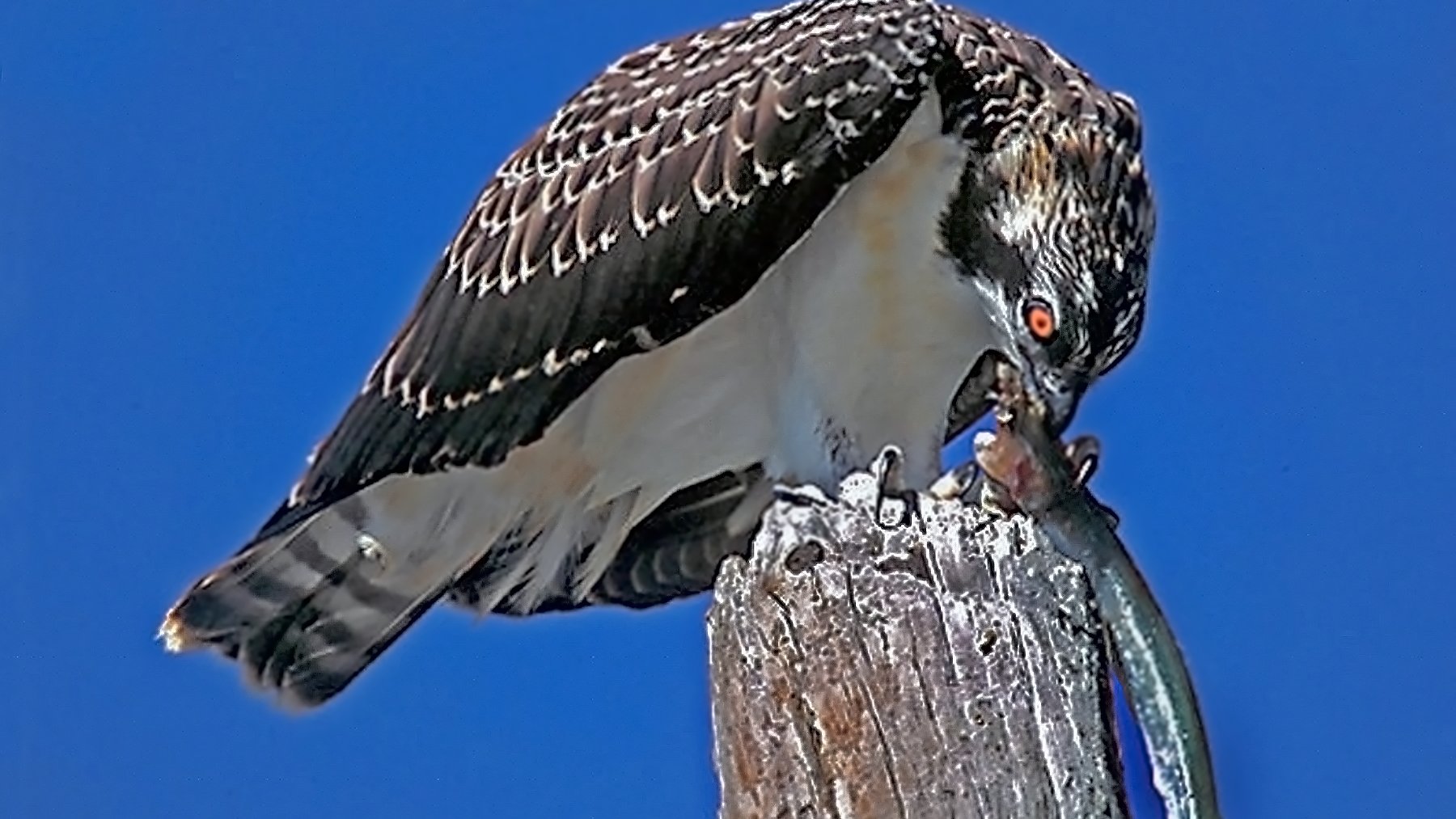
A nighttime rescue at Mount Sinai Harbor, New York, ended with a young osprey returning to its family. After residents reported an animal struggling along the shoreline, Jaeger’s Run Animal Rescue helped bring the bird into temporary care before releasing it back where it belonged.
But the fledgling’s family had not disappeared. That detail makes this more than a feel-good rescue story, because a young bird outside its nest is not necessarily abandoned. For anyone who has stopped during a beach walk to check on wildlife, the tricky part is knowing when help is actually needed.
A flashlight reveals a difficult situation
Lisa Jaeger and raptor expert Bobby Horvath searched the marsh after sunset, locating the osprey on a branch. It may have fallen from its nest or left too soon.
Family members remained nearby, but the rescuers worried about predators reaching the youngster close to the ground. They decided to intervene rather than leave it exposed.
Jaeger placed a net over the osprey, then secured it with gloved hands when it did not react. Despite its youth, the bird already had a wingspan of about four feet.
Getting a young osprey back to its family
The osprey sheltered at a rescue center until bad weather passed. A few days later, the team returned it to the beach and reunited it with its family.
Returning a bird to the correct location is part of the work, not an afterthought. Raptor rehabilitation guidance recommends recording exactly where a youngster was found and making every effort to reunite its family.
Human care is not meant to replace a wild upbringing. The New York State Department of Environmental Conservation warns that inappropriate care can leave animals overly attached to people and poorly prepared for release, even when the people involved are trying to help.
Big wings do not mean full independence
So how can a bird with such an impressive wingspan still need support? According to New York’s environmental agency, young ospreys typically begin flying at about eight weeks old and remain around the nest for roughly another two months. Leaving the nest is a stage of development, not an instant switch to adult life.
Ospreys are specialized fishing birds, and the Cornell Lab of Ornithology says live fish make up about 99 percent of their diet in North America. Their hunting grounds include marshes, rivers, lakes, and coastal waters where fish are accessible near the surface.
Their long, hooked talons help them seize slippery prey, and they may submerge completely during a dive, according to New York’s environmental agency. Those powerful feet also explain why a seemingly quiet young osprey is not a bird to pick up casually.
The environmental story behind the rescue
For ospreys, a safe future depends on more than getting through one difficult night. New York’s environmental agency identifies Long Island as one of the state’s two main breeding areas, alongside the Adirondacks, making these birds an important part of the region’s wildlife story.
Their history also shows how damage to the environment can reach a nest. Between New York City and Boston, active osprey nests fell from an estimated 1,000 in the 1940s to about 150 in 1969, according to the agency, as DDT-related eggshell thinning reduced breeding success.
Populations rebounded after the United States banned DDT in 1972, and artificial nesting platforms also helped support recovery, according to Cornell. But threats have not vanished, including entanglement in discarded fishing line and other material brought into nests. A piece of litter left near the water can become a problem well above it.
When should you call for help?
Seeing a young bird alone can be unsettling, but distance is often the best first response. The U.S. Fish and Wildlife Service explains that many feathered fledglings are still being cared for by parents nearby and should be given space rather than automatically removed.
A visibly injured bird needs a different response, especially if it has a drooping wing, breathing trouble, or difficulty standing, according to Tufts Wildlife Clinic. Keep children and pets away and contact a licensed wildlife rehabilitator for instructions. Do not offer food or water or attempt to handle a large raptor without expert guidance.
For Jaeger, the encounter also brought a moment of appreciation. “I’m so grateful to be able to see these beautiful creatures up close,” she wrote in a social media post.
The rescue team’s follow-up update was published on Facebook.