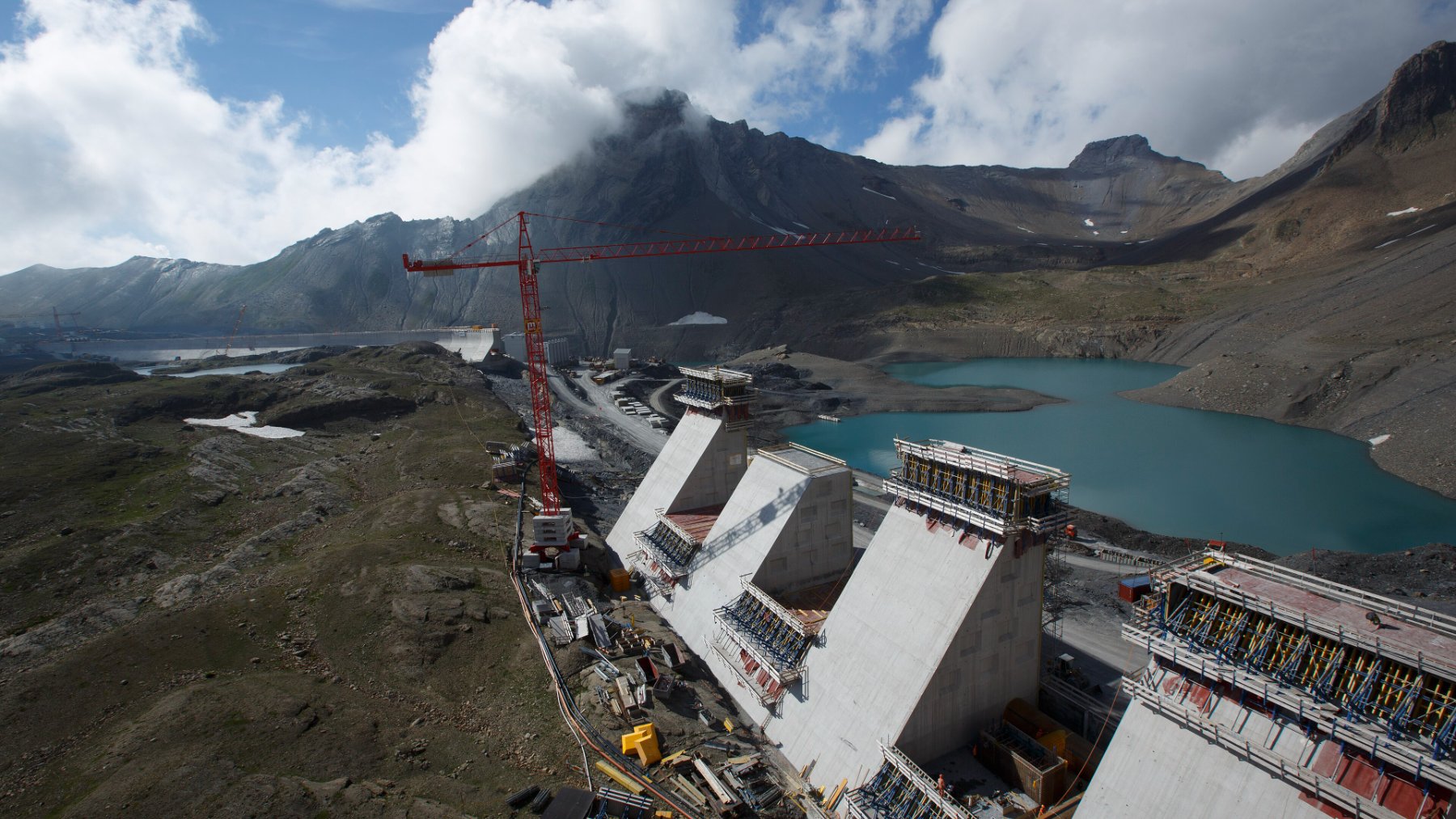
High in the Swiss Alps, 4,872 solar panels hang from the Muttsee dam with an unusual feature hidden behind them. A gap of about five feet separates the panels from the concrete, leaving room for technicians to inspect the structure rather than sealing it behind a wall of solar equipment.
Measurements from October 2022 through September 2023 show that the plant generated 43% of its electricity during the winter half-year. But the June 2024 study in Frontiers in Energy Research also exposes the limits of its double-sided panels.
The space behind the panels is there for safety
The clearance measures approximately 1.5 meters, and its purpose is practical rather than decorative. Inspectors need access to the dam to document cracks and check its condition, including after emergencies such as an earthquake.
“A fissure map is prepared at least every five years,” project manager Christian Heierli explained in an Axpo account of the installation. A maintenance passage with railings runs behind the upper section of panels, allowing the concrete structure to remain accessible.
The panels are “bifacial,” meaning both sides generate electricity, but the nearby wall limits rear illumination. Researchers measured an annual rear-side optical gain of about 1.5%, not snow’s total contribution to production. Reflected sunlight can also reach the front.
What the first measured year actually showed
The EPFL-led team measured 1,434 kilowatt-hours per installed kilowatt over the year, including 616 during October through March. Compared with a lowland plant near Payerne, that was 68% more annually and 3.8 times as much in winter, per installed kilowatt.
Those comparisons cover one year, not a guaranteed long-term advantage. The researchers noted unusually weak January-to-May results at the reference sites, which helped inflate the winter ratio.
Why does winter output matter? Axpo identifies Switzerland’s seasonal electricity shortfall as a central reason for building alpine solar plants. Electricity produced during that period can help meet demand when domestic generation otherwise falls short.
Mountain sunshine comes with difficult construction
Muttsee sits roughly 8,200 feet above sea level, where there is less of the fog that often blankets lower elevations. Cold conditions help solar panels operate efficiently, while the dam’s orientation favors winter sunlight.
The panels are mounted at angles of 51 or 65 degrees, helping snow slide off instead of covering their surfaces. Engineers also left the lowest section of the dam without modules so falling snow would have somewhere to accumulate.
Getting the equipment into place was another matter, because no delivery road reaches the dam. Materials had to arrive by helicopter, and a lifting crane was dismantled in the valley, flown up in pieces, and reassembled at the site. Good sunlight did not make this an easy construction job.
Existing infrastructure gave the project a head start
Developed by Axpo and IWB, AlpinSolar has been fully operational since late August 2022. The project reused an existing dam and a 16-kilovolt grid connection, avoiding the need to dedicate a new open site to its panels.
The electricity also had a buyer before the installation began operating. Discount retailer Denner signed a 20-year agreement for its output, linking a remote mountain project to the everyday business of running stores and offices.
That combination matters when considering whether the project can be repeated elsewhere. An available wall, an existing grid connection, and a long-term customer remove some hurdles, but they do not remove the challenges of building high in the mountains.
Strong winter output does not guarantee subsidy eligibility
Switzerland’s Solar Express framework offered eligible large solar projects support covering up to 60% of qualifying investment costs. Its thresholds include at least 10 gigawatt-hours of annual production and 500 kilowatt-hours per installed kilowatt during the winter half-year.
Muttsee’s measured winter yield exceeds that seasonal threshold, but its roughly 3 gigawatt-hours of annual output falls well below the size requirement. It illustrates a distinction between demonstrating that alpine solar works and meeting the conditions of a particular funding program.
The dam’s solar plant has another job to do
In August 2025, Axpo announced that AlpinSolar would participate in Swissgrid’s PV4Balancing pilot. The arrangement allows the plant to reduce output when the grid has surplus electricity, with several solar installations grouped together to provide that service.
That adds another consideration beyond how many kilowatt-hours the panels generate, namely whether their output can respond to the grid’s needs.
The official announcement was published on Axpo on August 21, 2025.