Asian elephants can abandon a familiar way of reaching food when it stops working, according to a new study in Thailand. In tests with 16 animals, researchers found evidence of inhibitory control, the ability to hold back an unhelpful response and switch to one that succeeds.
Published September 9, 2026, in PLOS One, the research offers a closer look at how elephants adjust to changing circumstances. The most revealing moment came when scientists moved the route to a fruit reward, forcing the animals to overcome a habit they had just learned.
A fruit reward with no straight route
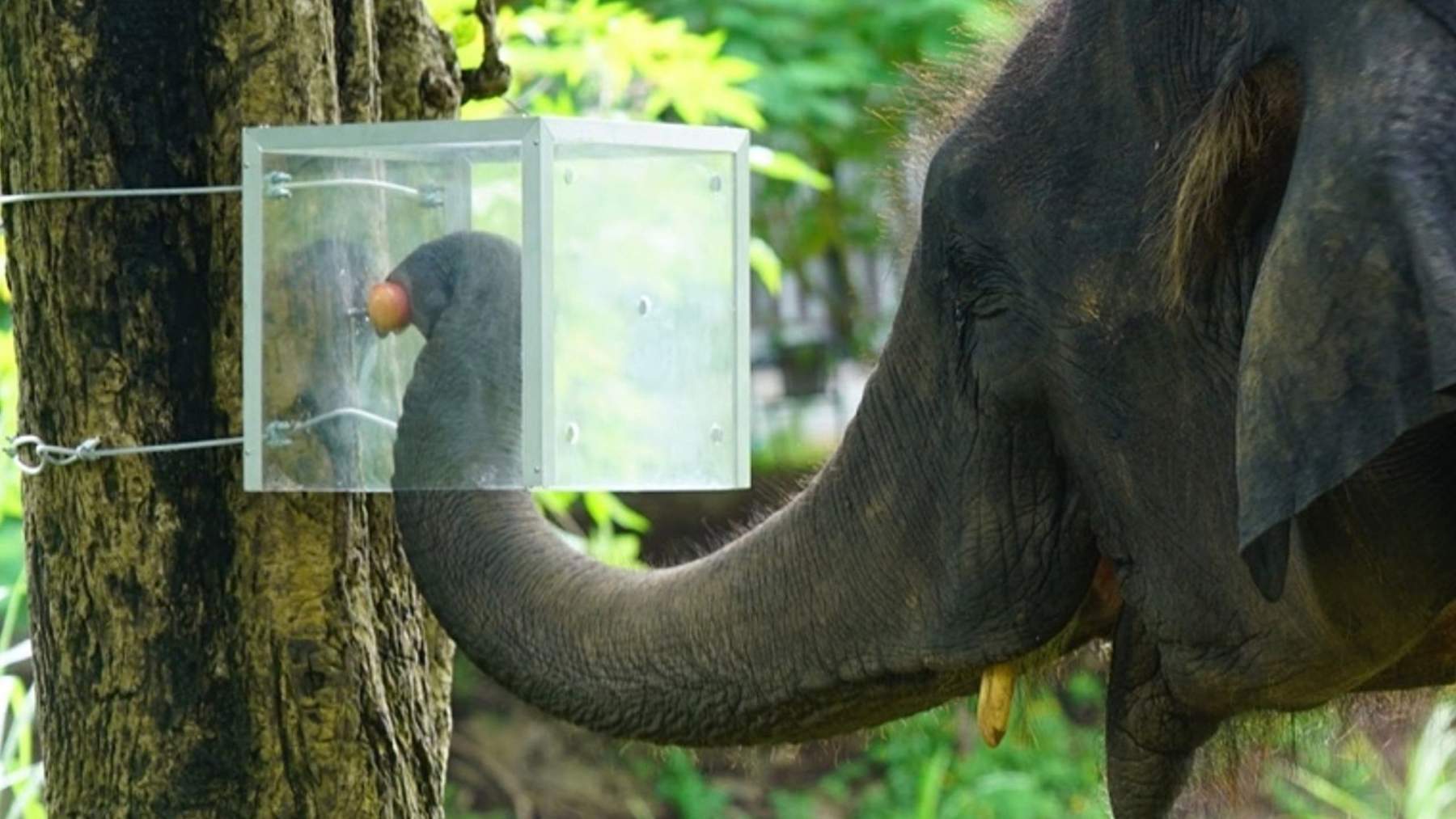
Sydney Hope of Hunter College and colleagues tested Asian elephants at Thailand’s National Elephant Institute. Their setup presented a practical problem for an animal with a long, flexible trunk, how to retrieve fruit when a barrier blocked the direct approach.
First, the elephants learned to reach around an opaque box and put their trunks through its opening. Researchers then substituted a transparent box with small holes in the front, allowing the animals to see and smell the reward while the usable opening remained elsewhere.
Would that tempting view distract them from the route they already knew? The elephants continued reaching around the barrier, showing that they could successfully use the indirect approach even with food visible in front of them. But the next stage would tell the researchers more.
Moving the opening revealed the old habit
The team rotated the box so that the opening was in a different position. Initially, the elephants returned to the place that had previously provided access, even though reaching there no longer worked. They then adjusted and found the new entrance.
The study’s measurements captured that disruption. After a rotation, the average time from first touching the box to getting the trunk into its opening rose from about 2.2 seconds to 8.2 seconds. Performance improved over repeated attempts with the opening in the same position.
Think of reaching for a light switch after someone has rearranged a room. A familiar movement may come first, but getting the result requires changing course. For these elephants, the useful finding was their ability to stop repeating an action that no longer delivered the fruit.
Why the transparent box needs a careful reading
Success with the clear box alone leaves an important question unanswered. The authors caution that seeing and smelling the fruit may never have triggered a strong impulse to reach straight ahead, so the animals could simply have continued a practiced movement.
The rotation trials supplied the clearer evidence because they exposed an initial mistake followed by adjustment. That sequence supports the researchers’ interpretation of inhibitory control, while leaving open questions about how broadly the ability operates in everyday elephant life.
“This ability may be important for elephants’ social interactions or for other aspects of cognition, such as problem-solving,” Hope said in a CUNY statement. Those possible connections give researchers something to investigate next, including whether this kind of behavioral flexibility helps elephants coordinate with companions or tackle unfamiliar challenges.
Older elephants took longer to change course
Age added another layer to the findings. Older elephants were slower to adapt when the opening moved, suggesting that suppressing a previously successful response might become more difficult later in life. The result raises a question about aging that this experiment cannot settle on its own.
The participants ranged from 4 to 60 years old, but the small sample leaned toward younger animals. A wider spread of ages would help researchers determine how consistently the pattern appears. For now, the authors treat cognitive decline as a possible explanation requiring further study.
The distinction matters because a slower response in one task says little about an animal’s full range of abilities. Researchers still need to establish how performance in this particular situation relates to the other demands elephants face. One food puzzle is only a small window into a complex animal’s behavior.
What a food puzzle could mean for conservation
The practical stakes extend beyond a testing site. Asian elephants encounter farms and settlements across landscapes shared with people, and crop damage can put both communities and animals at risk. Understanding how elephants respond to obstacles could help researchers develop better ways to reduce those encounters.
The conservation implication is a research direction, rather than a demonstrated benefit of this experiment. The team proposes that studying how elephants learn routes around barriers could inform strategies for human-elephant coexistence. Testing those ideas in the field would be essential before claiming that a particular approach protects crops or prevents conflict.
For now, the experiment offers evidence that elephants can change a learned response when circumstances demand it, a useful starting point for understanding how they navigate a changing world. The study was published in PLOS One.
Photo: CUNY Graduate Center