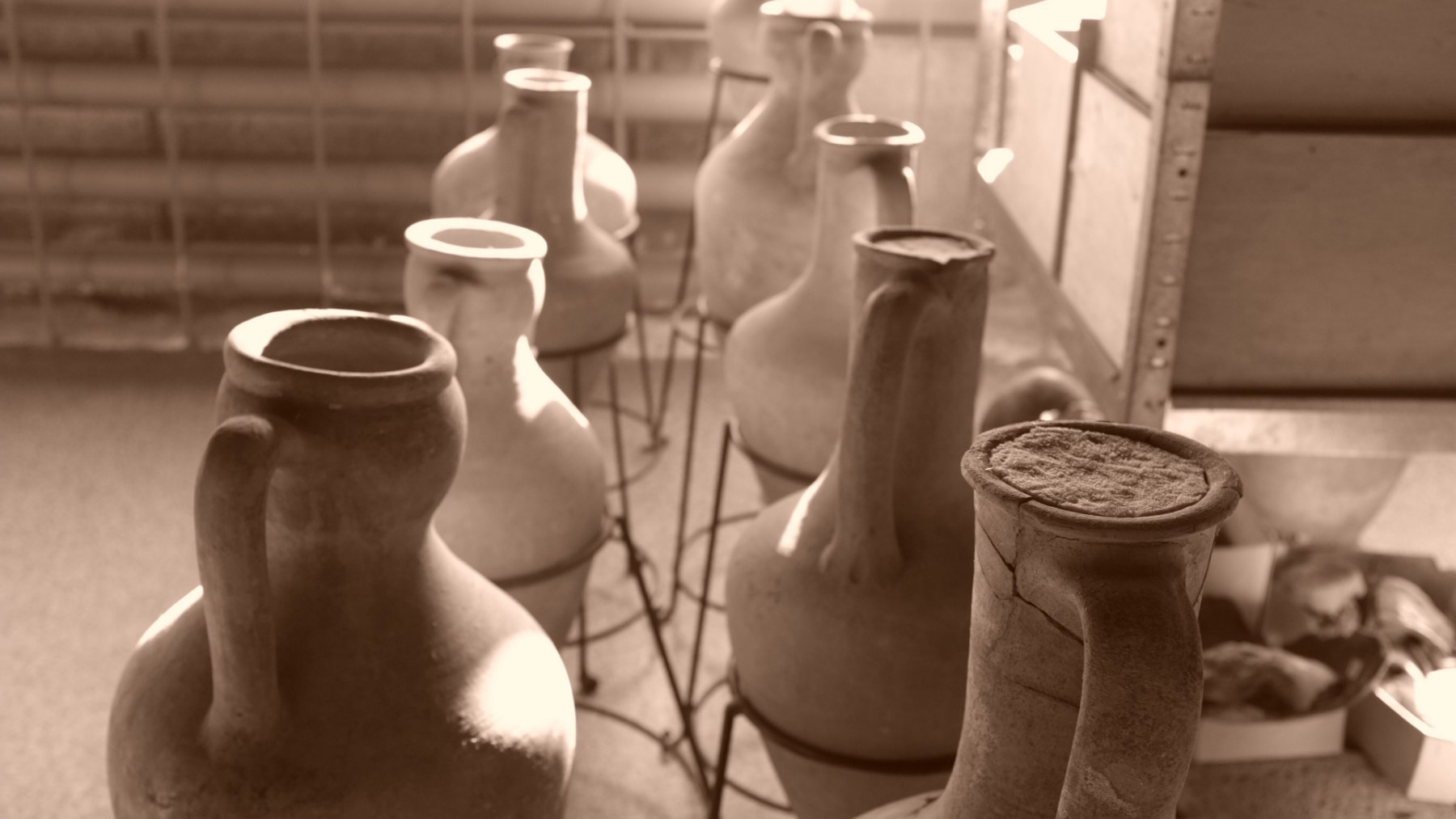
A shipwreck discovered during surveys for an offshore wind farm is bringing an ancient cargo back into scientific focus. Found in 2023 off Monasterace in southern Italy, the site contains more than 300 amphorae (two-handled ceramic jars) and dates to the fifth or fourth century BC. It lies about 1,640 feet (500 meters) below the surface, according to the University of Calabria.
The university is now detailing its role in Altofondale, a project to investigate and protect the wreck. Researchers will examine its ceramics to trace where they were made, understand ancient manufacturing techniques, and assess their condition after centuries underwater. Their findings will help answer a practical question about conservation, namely how to study this cargo without losing the evidence it carries.
A clean energy survey revealed an ancient cargo
According to Italy’s local archaeological authority, the discovery came during preventive archaeology conducted as part of feasibility studies for an offshore wind installation. The survey report prompted heritage officials to begin protection procedures and notify the relevant Carabinieri cultural heritage unit. The encounter linked planning for future energy production with an unexpectedly distant past.
That connection offers a practical lesson about the seabed. An area being considered for modern infrastructure can also contain archaeological evidence, making surveys an opportunity to identify what needs protection before construction decisions advance. In this case, the investigation opened a separate program of archaeological research financed by Italy’s Ministry of Culture.
What the ceramics could reveal
The University of Calabria’s contribution is coordinated by Mauro Francesco La Russa, director of its Department of Biology, Ecology and Earth Sciences, known as DiBEST. In the announcement, La Russa described the task as studying the ceramics to “reconstruct their provenance and identify their production contexts” (translated into English). His team will also investigate how the objects were manufactured.
How can an old jar reveal where it came from? Historic England’s guidance on pottery analysis explains that mineral grains inside fired clay can be compared with the geology of possible production areas. Chemical composition provides another way to compare pottery groups, while traces of shaping and firing can reveal choices made by ancient craftspeople.
These established approaches illustrate the kinds of questions ceramics can help answer. At Monasterace, identifying the cargo’s origins remains a research goal. The university has described what its researchers intend to investigate, without announcing a confirmed production site for the ceramics.
Investigating a wreck far below the surface
An official project notice published in July 2025 specified a survey using a remotely operated underwater vehicle, or ROV. Its planned tasks included photogrammetric recording and the recovery of one to three archaeological objects for material and deterioration analysis. That is a targeted sampling operation, giving researchers pieces to examine alongside a detailed record of the site.
Photogrammetry uses overlapping photographs to reconstruct shapes and spatial relationships, allowing a site to be measured from images. In its May 2026 update, the archaeological authority described site investigation, cargo analysis, photographic mapping, and sample recovery as ongoing activities. The stated purpose was to prepare later recovery stages and choose suitable restoration procedures.
Why surviving underwater is only part of the story
A ceramic object can survive for centuries at sea and still need careful treatment after recovery. Research on underwater pottery from Kerpe Bay in Turkey illustrates one reason, showing how salts trapped in ceramic pores can crystallize and cause surface losses or tiny cracks. The study published in Propontica explains why conservators assess porosity and salt content before choosing a desalination treatment.
The condition of the Monasterace finds will require separate testing. The Kerpe Bay study helps explain why examining a pot’s material can be just as important as identifying its age or shape. DiBEST’s planned assessment of the ceramics after prolonged marine exposure will provide evidence for decisions about their care.
What happens next at Monasterace
Altofondale was presented to residents and local institutions on September 5, 2026, at Porto delle Grazie in Roccella Ionica. The initiative forms part of the Culture Ministry’s strategic program for major cultural heritage projects. Its scope brings research, recovery, restoration, and public appreciation into the same effort.
The scientific challenge is to connect what the ceramics reveal about their makers with what they need to survive after recovery. That work could turn a distant seabed discovery into a better understood part of the region’s past.
The university’s official announcement was published on September 8, 2026, on the University of Calabria website.
Photo: Badiamand / Wikimedia Commons (CC BY 4.0)