Early in the morning, during the last week of every month from September 2023 to August 2024, a team of wildlife graduates from Jahangirnagar University, led by experienced dolphin researchers, set off down the middle of the Buriganga River in an engine-driven country boat about 39 feet (12 meters) long, three of them watching the water from a raised platform on the front deck and a fourth keeping track of the Ganges river dolphins that came up for air.
In most months they found dolphins in a river that skirts the southern edge of Dhaka and has lost most of its native fish. “When we found [the dolphins], we were amazed at how it was possible. Because the river is not livable for fish,” study coauthor Md. Aminur Rahman told Mongabay.
Counting dolphins that barely show a fin
Sumaya Khatun ran the survey for her master’s thesis in Jahangirnagar’s zoology department, and she’s the first of five authors on the paper, all from that department, Rahman and the zoology professor Mohammad Abdul Aziz among them.
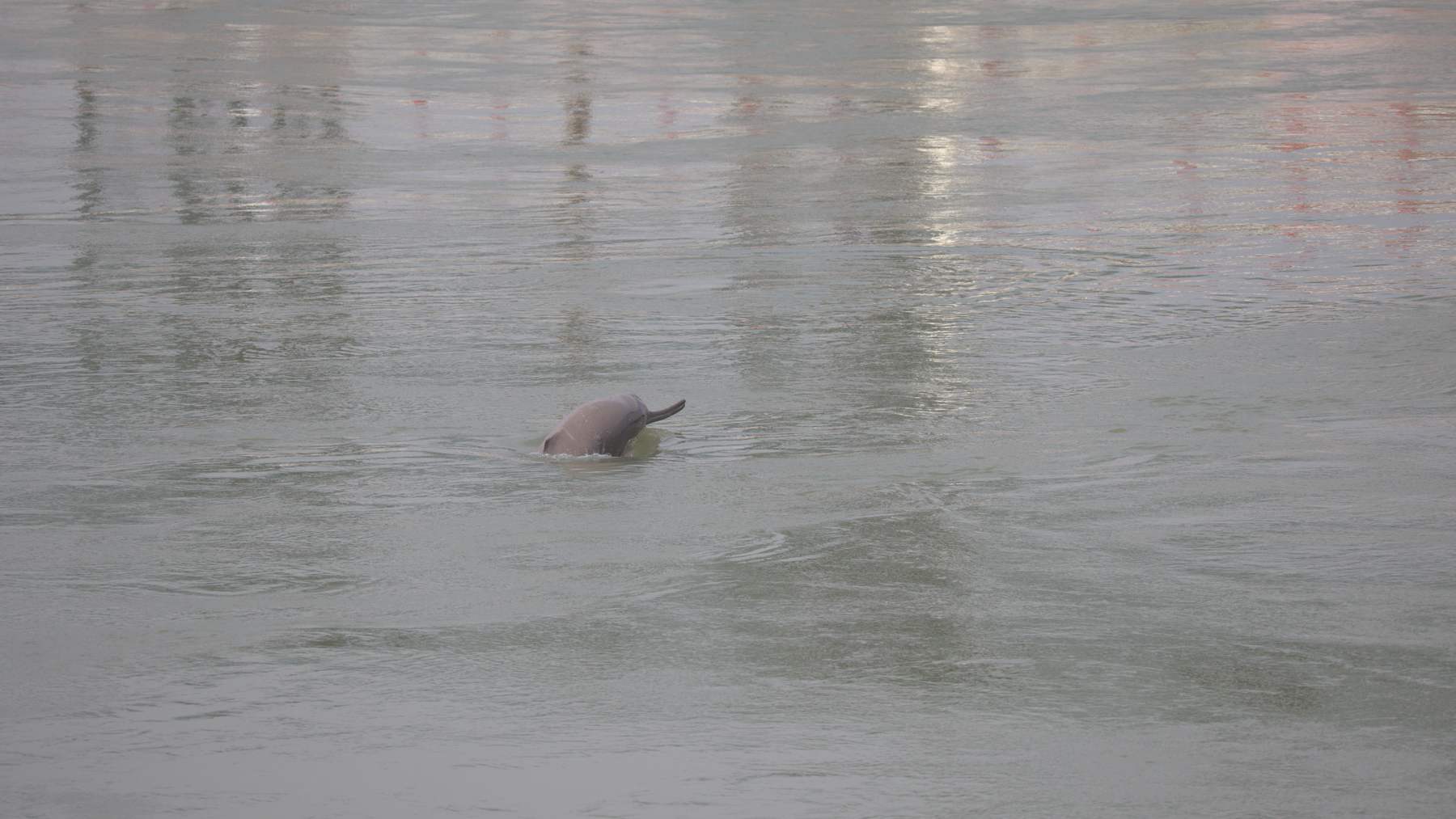
Ganges river dolphins aren’t easy to count, since they’ve got a tiny dorsal fin and they’re up and gone in a moment, so whenever a group surfaced the crew stopped the boat, and afterward they went back through their videos to check the numbers.
They ended up with 57 sightings over 16.8 miles (27 kilometers) of river. Once a statistical model had filled in the dolphins they’d likely missed, that came to 19.79 animals, a number the authors call “remarkable” for “this degraded river system.”
Calves turned up in winter and spring
The groups they saw had anywhere from two to seven dolphins. Nearly 16 percent of the animals were calves, picked out by their size, and Mongabay called that a sign of “active reproduction despite severe ecological degradation.” Most of those calves showed up between November and January or between April and June.
December 2023 was the best month. In October 2023, and again in July and August 2024, the crew didn’t see a single dolphin, and the authors think the animals may have headed downstream toward the Dhaleswari River during those months.
The paper says its observations “further suggest that reproduction and recruitment within the Buriganga dolphin population remain notable despite the presence of multiple habitat-related stressors,” but it also reports 0.18 dolphins per kilometer, below the 0.29 and 0.48 recorded on the same stretch in earlier surveys, “indicating a potential decline in relative abundance over the past decade.”
Tannery waste and oxygen near zero
Beauty Akter and Syed Hafizur Rahman, environmental scientists at Jahangirnagar University, went through the published research on the river in a 2025 review and found that its lead, cadmium, chromium, arsenic and mercury come mostly from tanneries, dye works, city garbage and untreated sewage. Dhaka alone generates around 4,500 metric tons of solid waste a day, they note.
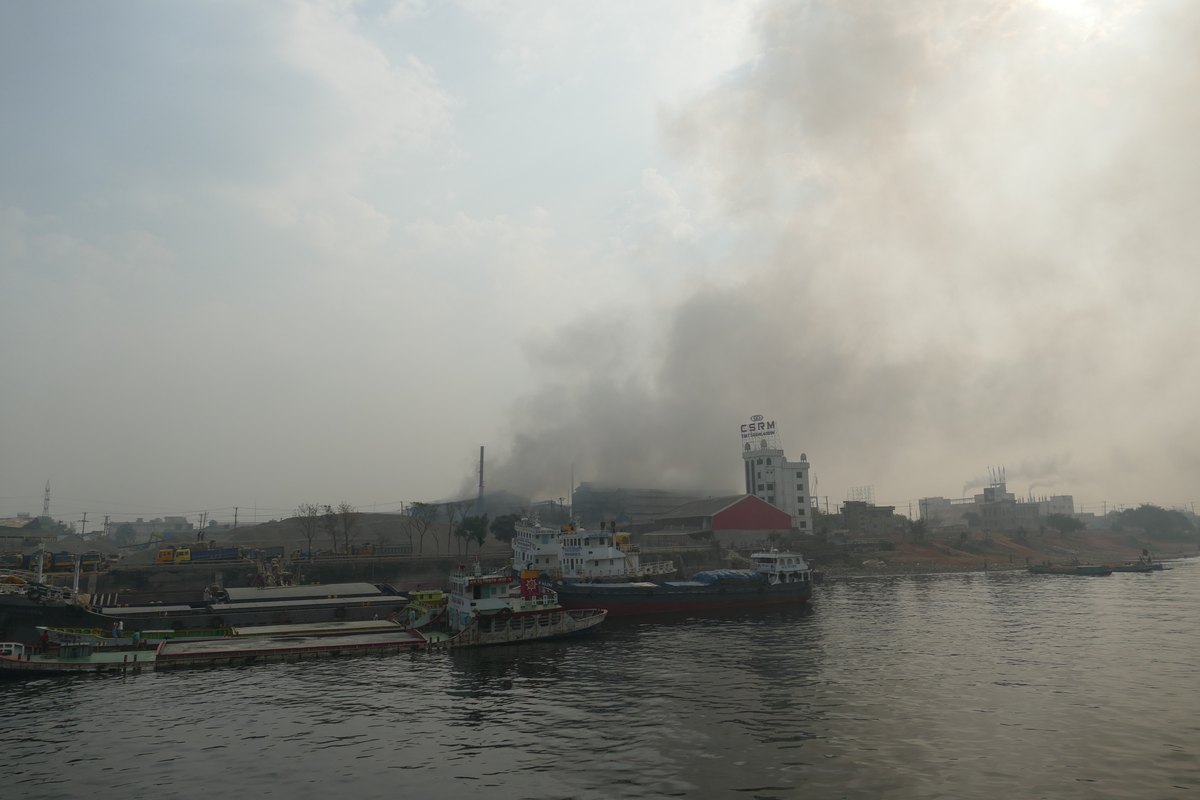
The same review cites dry-season readings of dissolved oxygen, the oxygen that fish pull from the water through their gills, of 0.0 milligrams per liter at Mirpur Bridge. “Since the Environmental Quality Standard (ECR) calls for a minimum of 5 mg/L, none of the measured DO levels complied,” Akter and Rahman write, warning that the river “is on the verge of biological collapse.”
On the dolphin survey, oxygen measured by Winkler titration averaged 1.06 milligrams per liter and fell to between 0.1 and 1.5 in the segments that take continuous tannery effluent, far below the 4 milligrams per liter that fish generally need, a shortage that drives fish away or kills them, as in the oxygen-starved dead zones of Lake Erie.
“The Buriganga is not a usual place for dolphins, where native fishes have largely vanished. Leaving the river full of invasive suckermouth catfish [Hypostomus Plecostomus, locally called sakar fish],” Rahman told Mongabay.
The dolphins may be eating an invader
Dolphins breathe air at the surface, and in the study’s models neither oxygen nor water temperature had a statistically significant effect on where they turned up, although the authors still suspect that “chronically depressed DO levels likely contribute to reduced prey availability.”
What the dolphins eat is the open question, because fishing on the Buriganga was “virtually absent, perhaps due to the nonavailability of fish,” the paper says. Aziz has a candidate in mind.
“The Buriganga’s condition is not suitable for most fish, yet some [types of] catfish are still present. Some catfish can breathe both in water and by taking air from the surface, and suckermouth catfish are among the most pollution-tolerant species. Right now, the Buriganga is full of suckermouth catfish. We believe the dolphins are hunting these fish,” Aziz told Mongabay.
Md. Zahangir Alom, country director of WCS Bangladesh, described the same thing on the rivers around the capital when he spoke at a Forest Department event in October 2025. “Dolphins in these rivers are mainly facing a food crisis. They are surviving on sucker fish,” he said, as reported by The Daily Star.
Muhammad Shahjahan, a fisheries management professor at Bangladesh Agricultural University, says a study of the Buriganga found dissolved oxygen and other measures of water quality “all at levels where fish cannot survive.” “That is why it can almost be said that there are no fish,” he was quoted as saying in a bdnews24.com report published by The Financial Express in September 2026, adding that only the introduced sucker fish “has been found.”
The study did not analyze what the Buriganga dolphins actually swallow, so this change in their diet is still a hypothesis.
Launches crowd the dolphins out of the port
Deeper water drew dolphins and boat traffic kept them away, the models showed, and the three segments around Sadarghat, one of the busiest river ports in the country with some 665 vessels a month, gave the team one sighting in a whole year, near Hasnabad in December 2023.
“Elevated underwater noise associated with such heavy vessel traffic might significantly disrupt the acoustic environment, impairing the echolocation-based navigation and foraging of dolphins,” the authors write, referring to the sounds the animals send out and the echoes they listen for.
“If we want to conserve the dolphins in the Buriganga, the priority must be to stop the pollution. The number of vessels on the river is also excessive now. These vessels severely disrupt the dolphins’ natural movement,” Aziz said.
The team asks for boats to stay under about 3 miles per hour (5 km/h) and underwater noise under 120 decibels where the dolphins gather, and for conservation zones from Kholamora to Bosila and from Pagla down to the Buriganga-Dhaleswari junction at Fatulla.
Few dolphins left around Dhaka
The national baseline survey that Alom led for WCS Bangladesh and the Bangladesh Forest Department estimated 2,082 Ganges river dolphins in 45 rivers in 2024 and 2025, and 2,307 once a 2002 count from the Sundarbans was added. Along 190 miles (305 kilometers) of the Buriganga, Turag, Bongshi, Surma and Kalni rivers, the survey team counted only 27.
“Illegal fishing in the rivers has increased, and the widespread use of illegal types of fishing nets trap and kill these dolphins. Back in 2013, we found dolphins in the Turag River during our study, but they are no longer seen there,” Aziz told Mongabay.
Monirul H. Khan, another zoology professor at Jahangirnagar who wasn’t part of the Buriganga study, told Mongabay in 2023 that dolphins run a high risk of getting tangled in gillnets when they come up to breathe. “It becomes impossible for them to avoid the fishing nets,” he said, and researchers elsewhere are now testing ways to keep dolphins out of fishing nets.
Syeda Rizwana Hasan, then the government’s environment adviser, made the same link at the event where the national figures came out. “When river water becomes polluted, it threatens both dolphins and humans. Keeping rivers clean is crucial for the survival of both,” she said.
What the boat could not see
There’s plenty the survey couldn’t pin down, and the authors say so. They didn’t count fish, didn’t test the water for pollutants and didn’t record underwater noise, and they name “the absence of fish abundance and water pollution data” as the biggest gap in the work.
Next time they’d like to try capture-recapture methods and environmental DNA, the bits of genetic material animals leave in the water, to pick up more of the dolphins in the Buriganga’s murky water.
Nobody on the boat could tell one dolphin from another, either, so the estimate of about 20 can’t say whether it was the same animals all year. Aziz thinks they move around. “The Buriganga dolphins sometimes move downstream through the Dhaleshwari River into the Meghna River and then return. Most of them stay around the Buriganga’s Bosila area,” he said.
When Bangladesh declared three new wildlife sanctuaries for freshwater dolphins in the Sundarbans in 2012, Brian D. Smith, director of WCS’s Asian Freshwater and Coastal Cetacean Program, said in a WCS statement that “as biological indicators of ecosystem-level impacts, freshwater dolphins can inform adaptive human-wildlife management to cope with climate change.”
The full study was published in the Journal of Asia-Pacific Biodiversity.
Photo: Anant.wildlife / Wikimedia Commons (CC BY 4.0)