Alfredo Moser was fixing cars in Uberaba, Brazil, when the 2002 blackouts left his workshop dark in the middle of the day. His answer was a plastic bottle of water pushed through a hole in a roof tile, the first version of what is now called the solar bottle bulb.
“I was at my niece’s and I saw a 600 ml pet bottle of water over the kitchen table. The sun lit it up and made a reflection on the wall,” Moser told the Brazilian site Believe.Earth in 2017. “Next day, when I arrived at my repair shop, I fit the bottle of water into a hole I made on a roofing tile and the light took over the dark room.”
The idea started with a rescue problem
Moser traces it back to the 1970s, when he worked as a car mechanic for a telecommunication company in Brasília and worried about how long rescues took after plane crashes in the Amazon.
“Talking about it with my boss, he told me that by putting a little water in a white bottle and placing it in the grass, the light of the sun passing through the liquid would set the grass on fire,” he told Believe.Earth. “I kept this idea in mind for a long time, filing it away to use in the future.”
When the power cuts came, he told the BBC in 2013, “The only places that had energy were the factories – not people’s houses.”
He kept tinkering after that first bottle. “From that moment on I began improving on the concept, putting a little bleach into the bottle in order not to darken the liquid, to allow the light to pass through it. I noticed that the sun dried and crumbled the bottle cap, so I put a polyester black film tape to protect it,” he told Believe.Earth.
Talking to the BBC while he filled an empty 2-liter bottle, he went through the method. “Add two capfuls of bleach to protect the water so it doesn’t turn green [with algae]. The cleaner the bottle, the better,” he said. “You fix the bottle in with polyester resin. Even when it rains, the roof never leaks – not one drop.”
Lab tests found 50 to 70 percent of the light gets through
The most detailed measurements come from Argentina. The work was led by Luis Issolio of the Department of Lighting, Light and Vision at the National University of Tucumán, with Federico Buriek, both of the Institute for Research in Light, Environment and Vision, which the university runs with the national science council CONICET.
“The solar bottle bulb has become a very important source of light in poor regions and/or in those that have difficult access to power,” the authors write. They put a 1-liter (34-ounce) soda bottle full of water into a hole in a white box that stood in for a roof, then lit the box to imitate cloudy and sunny skies with the sun at different angles.
“The results show a performance varying from 50 to 70%, according to the position of the bottle and the characteristics of solar radiation, together with a distribution of light that greatly improves the one given by a hole in the roof, thereby reducing up to 32 times its maximum intensity,” they report.
In plain terms, the bottle lets through somewhat less light than an open hole of the same size, but it spreads it around the room instead of throwing one harsh spot on the floor. Part of the light bends as it passes through the water and part bounces down the inside of the bottle, which the paper compares to a waveguide, a tube that channels light.
The 60-watt comparison depends on the sun
“An engineer came and measured the light,” Moser told the BBC. “It depends on how strong the sun is but it’s more or less 40 to 60 watts.”
NPR’s 2011 report from Manila put it at about 55 watts of light, and Litro de Luz, the Brazilian branch of the movement, compares the original Moser lamp with a 60-watt incandescent bulb. Those are comparisons of brightness on a good day, since the bottle produces no electricity at all.
The Argentine authors write that the light “will depend on the size, shape and position of the bottle, as well as on the characteristics of the incident light determined by the latitude, the solar availability, the season and the time of the day.”
A Philippine foundation took the bottle to Manila
Illac Diaz, executive director of the MyShelter Foundation in the Philippines, was building houses from recycled materials when he heard about Moser. “So we filled them with mud and created walls, and filled them with water to make windows,” he told the BBC. “When we were trying to add more, somebody said: ‘Hey, somebody has also done that in Brazil. Alfredo Moser is putting them on roofs.'”
MyShelter started making the lamps in June 2011 under the name Liter of Light. By 2013 the BBC counted 140,000 Philippine homes with Moser lamps and about 15 other countries using them, from India and Bangladesh to Tanzania, Argentina and Fiji.
Reporter Simone Orendain followed an installation in a poor Manila neighborhood for NPR in December 2011. Workers cut holes for 1-liter soda bottles, filled them with purified water and two caps of bleach, and held each one with a small metal brace.
Sheila Royeras lived there in one cement room with her husband, her mother and two young daughters. “Because of [the high price of] electricity sometimes we don’t eat,” she said. “If we don’t pay that bill on time, electricity is cut.”
“It’s safer. It’s healthier. It’s brighter. And the funny thing is the light bulb actually comes from the place you’d least expect it, which is the trash bin,” Diaz told NPR. “So it’s the cheapest light bulb in the world.”
He estimated families would save an average of $10 a month. After three bottles went into her roof, Royeras said, “Maybe by the time we get the next electric bill, I’ll have some extra money to buy food.”
At night the bottle needs a battery
The plain bottle stores nothing. The Tucumán paper says “the main disadvantage of this light source is that its true potential is only exploited during daylight hours.”
Liter of Light later added a night kit with a small solar panel, a rechargeable battery and an LED. “The Liter of Light is a combination of Alfredo Moser’s daylight and the social business of LED nighttime upgrade,” Diaz told Asia Society in 2014.
The group teaches people to build and fix their own lights, much like other projects that turn recycled parts into cheap lighting. “Off-the-shelf solar lights have limits in the fact that the product has a lifespan of two years, and then when batteries or parts fail, it is thrown away and the process starts all over again,” Diaz said.
A UNESCO profile says the movement “has spread to 32 countries, involving 2,800 young volunteers.” UNESCO describes that work as teaching communities to build their own solar lights, phone chargers and streetlights from local parts.
Roof work, upkeep and other limits
The people who fit them make it sound easy. “You punch a hole in a piece of metal roofing, you slip in a bottle apply some sealant, then fill it with filtered water, add some bleach and install it on the roof […] its that simple,” a local installer nicknamed “Solar Demi” told Inter Press Service in 2012.
In India, Srinivas Chaitanya of My Shelter Foundation India told the Deccan Chronicle in 2014 how his volunteers set them. “We put one-fourth of the bottle above the roof and three-fourth is below the roof,” he said. “The sunlight hits the top of the bottle and changes direction into the house because of varying densities between air and water.”
It won’t last forever, though. The Tucumán researchers write that “the duration of this type of light source is five years, after which period it is necessary to change the water in the bottle and replace the bleach to keep it clean.”
Their own numbers come with a caveat, too. Stray light in the test box “may result in a little increase in the efficiency values,” they write.
When South Africa’s Informal Settlement Network brought a Liter of Light team to Johannesburg settlements in April 2014, the SA SDI Alliance, which the network belongs to, wrote that many residents burn fuel at home for light and heat and “are forced to rely on open fires, gas and paraffin appliances or candles as sources of light, warmth and energy.”
In a Hyderabad slum, resident Rama Krishna told the Deccan Chronicle what life looked like before the bottles. “My daughters had to complete their homework before sunset. We used the same lamp to cook, eat, study, manage my kirana shop etc.,” he said.
“We used to take this bottle for granted… now we can’t live without it,” a resident of Sitio Malagaya in the Philippines told IPS.
“There was one man who installed the lights and within a month he had saved enough to pay for the essential things for his child, who was about to be born. Can you imagine?” Moser told the BBC.
He hasn’t gotten rich from it. “It’s still the same. I have no financial gain from this, just a few invitations for lectures. And I feel so fine about that,” he told Believe.Earth. Diaz put it this way to the BBC: “Alfredo Moser has changed the lives of a tremendous number of people, I think forever.”
The full study was published in the Journal of Light & Visual Environment.
“I want people to have comfort without spending money. And energy is expensive,” Moser told Believe.Earth.
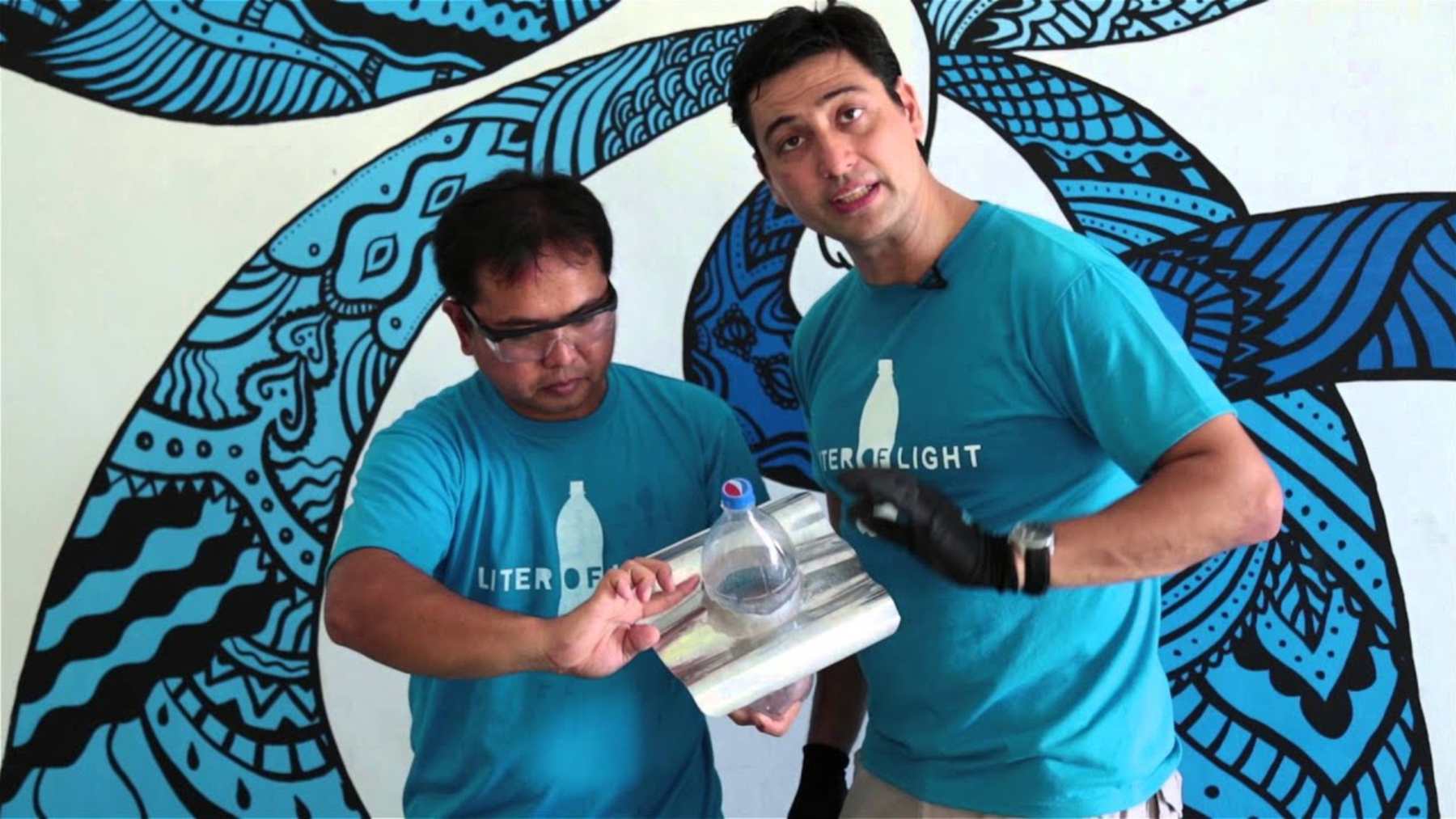
Image: Liter of Light / YouTube