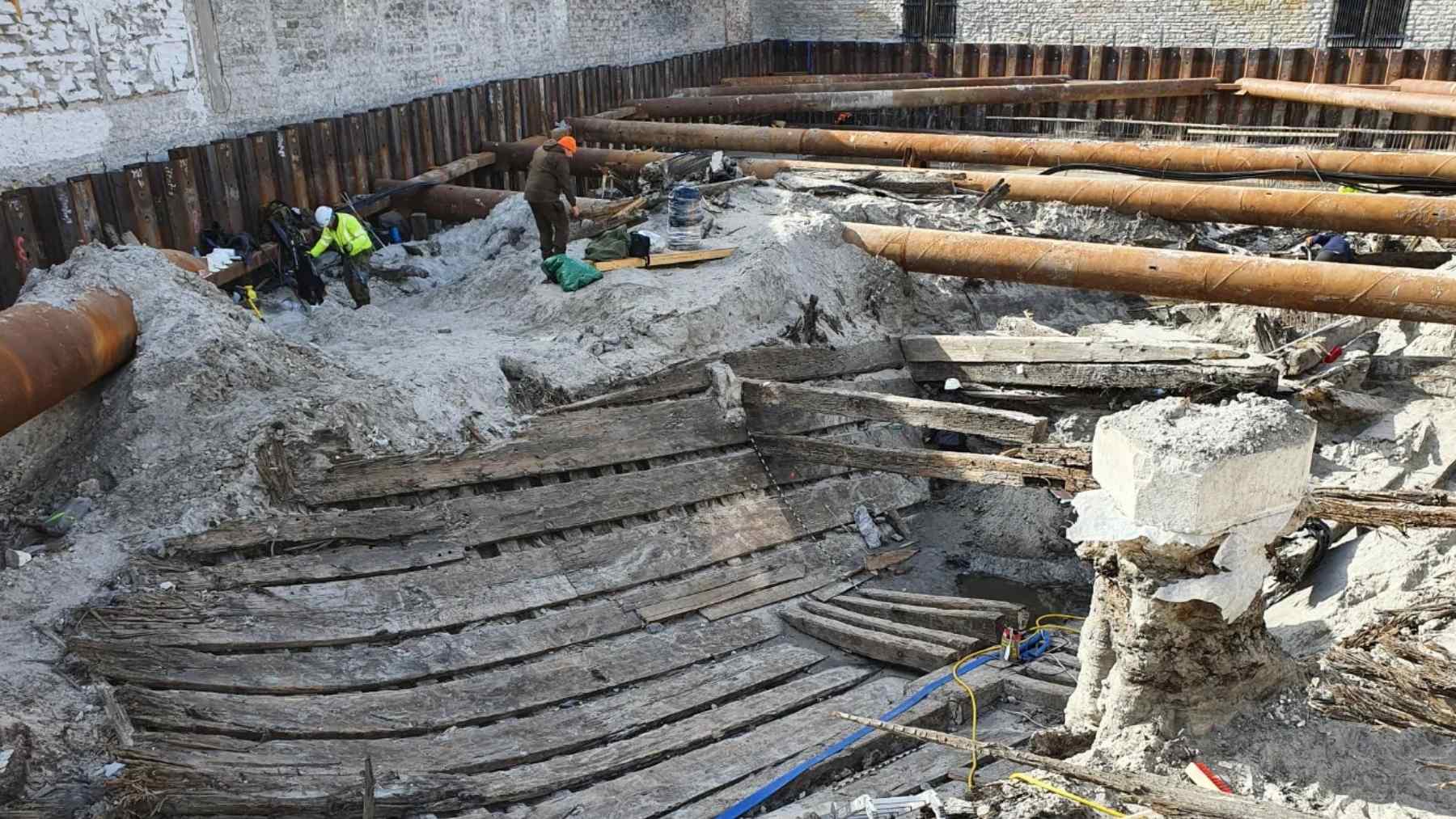
How much history can hide under a city street? In Tallinn, Estonia, the answer turned out to be an entire medieval merchant ship, buried beneath modern construction ground and preserved well enough to challenge what researchers thought they knew about Baltic seafaring.
Workers first uncovered the wreck at Lootsi Street in 2022, only about 5 feet below the surface. The vessel, now known as the Lootsi cog, stretches about 80 feet long, nearly 30 feet wide, and roughly 13 feet tall, making it one of the most striking medieval ship finds in Europe in recent memory. New tree-ring research now suggests the story is even richer than the discovery itself.
A ship under the street
The find began like so many urban discoveries do, with construction equipment and a schedule to keep. Crews preparing the foundation for a new office building struck timber in ground that had once been close to Tallinn’s harbor.
That timber was not random debris. It belonged to a large oak cargo ship from the age of Baltic trade, when Hanseatic merchants moved goods across cold northern waters much like freight trucks move goods across highways today. Only this one had been sealed in sand and soil for centuries.
Moving the wreck was no small task. The Estonian Maritime Museum says the ship was transported to the museum in four pieces, where archaeologists and Finnish conservators are now cleaning the hull, monitoring humidity, and removing finds from the wood without letting it dry too quickly.
The compass still works
The most surprising object so far may be a dry compass, believed by the museum and Estonian public broadcaster ERR to be the oldest surviving dry compass in Europe. Even more remarkably, its needle still functions after more than six centuries.
A dry compass uses a magnetized needle that pivots over a compass rose without liquid inside the case. For medieval sailors, that kind of device could mean the difference between guessing a route and reading the sea with more confidence.
The ship also contained tools, weapons, leather shoes, and the remains of two ship rats. That may sound like a small detail, but it matters. Rats, shoes, and everyday tools turn the wreck from a wooden object into a lived-in workplace, the kind of cramped floating world where sailors ate, repaired gear, and watched the weather with real fear.
A sudden escape
Priit Lätti, an archaeology researcher at the Estonian Maritime Museum, has suggested the ship was not simply abandoned. The scattered condition of its contents points to something faster and more chaotic.
“People had to get off the ship in a hurry,” Lätti told ERR. That one line changes the mood of the discovery. Instead of a vessel carefully emptied and left behind, researchers may be looking at the aftermath of an accident near the harbor.
Anyone who has ever rushed out the door and left things behind knows the feeling, even if the stakes here were much higher. A medieval crew facing a sinking ship would not stop to collect loose shoes, spoons, tools, or small cargo. Survival came first.
Tree rings tell the route
The newest study focuses on dendrochronology, the science of reading tree rings to date wood and trace where it came from. In practical terms, each plank carries a natural barcode from the forest where the tree grew.
The research, led by Aoife Daly and colleagues, reports that the main structure used oaks felled in the winters of 1370 to 1371 and 1371 to 1372, while parts of the upper structure and some loose timbers used trees felled in winter 1373 to 1374. That suggests the ship may have been relatively new when it sank.
Earlier museum information placed the wood around 1360, which is still broadly within the same 14th-century world of Baltic commerce. The newer work adds more detail rather than erasing the broader picture. For the most part, this was a ship born from several winters of cutting, hauling, shaping, and assembling oak.
Not a simple cog
The ship is officially called the Lootsi cog, but specialists have not settled every question about its design. That is where the story gets interesting.
Classic cogs were the cargo carriers of northern Europe, but this wreck does not fit the textbook perfectly. Reports from the excavation describe unusual sealing materials and plank arrangements that appear more advanced or simply different from what researchers expected for the period.
That does not mean the name is wrong. It means medieval shipbuilding was probably more varied than neat categories suggest. Builders worked with local materials, trade demands, and hard-earned experience, not with modern diagrams.
Forests behind the fleet
The study also points to a larger environmental story. Medieval ships were not just built in ports. They began in forests, where straight oak trunks were selected, cut, moved, and traded across long distances.
Researchers found evidence that the ship’s timber came from more than one source. Some comparisons point toward Baltic oak networks, including areas linked with Lithuania and nearby regions, while other pieces may have had more local connections. That mix fits a world where wood itself was valuable cargo.
It is easy to picture the ship as a single object, but it was really a chain of human and natural labor. Forests fed shipyards. Shipyards fed trade. Trade fed cities like Tallinn.
Why another wreck stayed buried
The Lootsi cog is not the only secret under the area. Lätti has said an even older wreck remains underground near Lootsi Street, and archaeologists have chosen not to rush it out of the soil.
That may seem odd at first. Why not dig it up immediately? The answer is preservation. Wet ground can protect old timber for centuries, while open air can damage it quickly unless specialists are ready with the right conservation plan.
The museum’s approach is cautious, and for good reason. Archaeology is not only about finding things. It is also about knowing when to wait, because future tools may recover more information than today’s methods can.
A time capsule for Tallinn
The Lootsi cog gives researchers a rare look at medieval navigation, shipbuilding, trade, and daily life at sea. It also reminds us that modern cities often sit on older landscapes, including shorelines, harbors, and working waterfronts that have shifted over time.
For now, the ship is being cleaned and studied at the Estonian Maritime Museum, with plans for permanent public display after conservation. What began as an office foundation has become a window into the Baltic world of the 14th century.
The study was published on ScienceDirect.