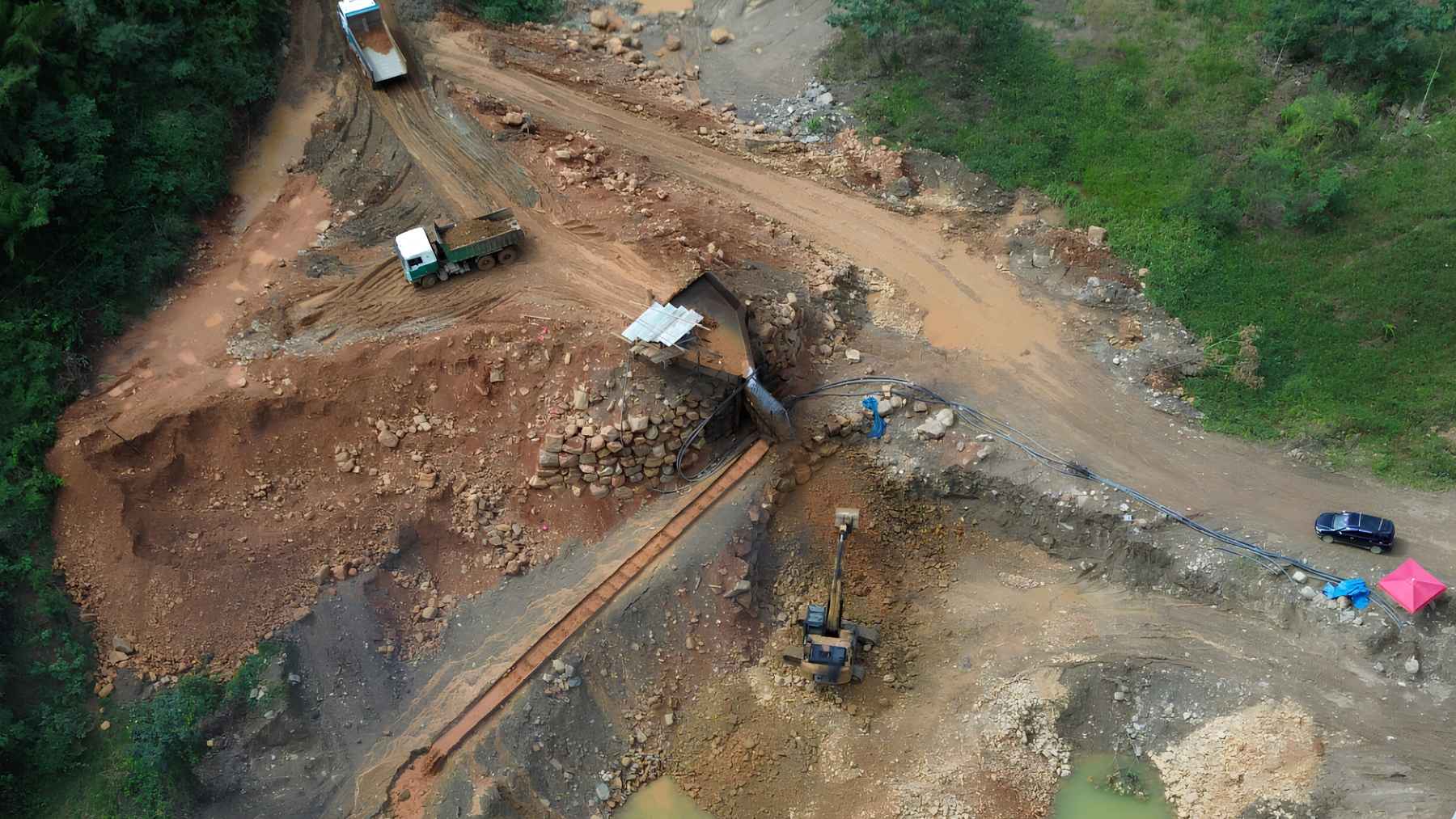
Bolivia’s government is weighing a decree that could turn 3,982 old mining authorizations into formal administrative mining contracts, even though many have not fully adapted to the country’s current mining law.
The proposal, tied to President Rodrigo Paz’s administration, has triggered concern because thirty-eight percent of those operations are in the Bolivian Amazon, where gold mining and river pollution are already tense public issues.
The dispute may sound like paperwork. It is not. At the center are Special Temporary Authorizations, known as ATEs, which are old mining rights that must be adapted to Law 535, Bolivia’s 2014 mining framework. After twelve years and eleven deadline extensions, only about eight percent have completed that process.
What the decree would change
So what exactly is being fast-tracked? The draft decree would set procedures and deadlines to convert ATEs into administrative mining contracts, a move the government frames as a way to give legal certainty and reduce red tape.
The draft was prepared by the Ministry of Mining and Metallurgy, sent to the Ministry of Development Planning and Environment, and supported by the Economic and Social Policy Analysis Unit.
Effectively, many old mining rights could move into the current system with fewer documents than critics say the law requires. The official government portal describes this adaptation as the process through which former mining concessions and mining leases are brought into the new legal framework through contracts with the Administrative Mining Jurisdictional Authority, known as AJAM.
The missing license question
The sharpest concern is environmental oversight. According to Fundación Solón, the proposal could reduce requirements to just two documents, proof that the mining right is current and proof that mining fees are paid. For cooperatives, the current discussion does not clearly require an environmental license, a tax certificate, or a work and investment plan.
That license is not just a stamp on a folder. It is supposed to show how a mine will prevent damage, control pollution, reduce impacts, and repair exploited areas. Fátima Monasterio, a lawyer and researcher, warned that the proposal would “guarantee investments” while pushing environmental concerns into the background.
A backlog years in the making
The numbers show why the decree matters. Official figures cited in the draft identify 3,982 mining rights granted before Law 535, including 2,816 cases where operators started the adaptation process and 1,166 that never filed a request. Another 511 correspond to rights held by the Bolivian Mining Corporation on non-nationalized areas.
Close to half of the pending applications reportedly had observations, meaning officials found some kind of problem or missing requirement. Only about 350 operators have completed the process. That is the bottleneck the government says it wants to clear, but the question is what gets lost when speed becomes the priority.
Why the Amazon matters
The Amazon share of the list is especially sensitive. Thirty-eight percent of the ATEs are in the Bolivian Amazon, while others are in the highlands and valleys where miners extract gold, silver, zinc, copper, and other minerals. For communities living near rivers, mining is not an abstract policy debate. It can show up in fish, drinking water, boat routes, and the mud along the banks.
Gold mining brings a specific risk because mercury is often used to separate gold from sediment. In rivers, that metal can be transformed into methylmercury, a toxic form that builds up in fish and then moves into people who eat them. That is why a shortcut in licensing worries many environmental groups.
Mercury studies have raised alarms
A 2023 study carried out by the Central of Indigenous Peoples of La Paz examined hair samples from 302 people in Indigenous communities along the Madre de Dios and Beni rivers.
The samples were analyzed by the Environmental Quality Laboratory at the Higher University of San Andrés. Nearly six in ten participants had mercury levels above the reference value cited in the study.
Earlier research published in the Journal of Environmental Health also documented mercury exposure among Amerindian populations living along the Beni River. That study looked at 556 people and found that fish consumption and river access were important exposure factors.
Together, these findings do not prove that every mining site causes the same harm, but they do show why environmental review matters before mining rights are locked in.
The legal fight ahead
Pablo Solón, director of the same foundation, questioned whether a decree can reduce requirements that are set by national law. His concern is simple enough for anyone to understand. Can a lower-level rule cut down a checklist created by a higher-level law?
The official government description says adaptation of preconstituted mining rights does not require prior consultation or legislative approval. That detail adds another layer of tension for Indigenous communities, especially in areas where mining activity overlaps with rivers, forests, and traditional territories.
What happens next
Sources from the mining ministry confirmed the draft’s authenticity to the original reporting, but said there was no date for approval. If signed, the plan would aim to resolve the adaptation process in about ten months. That would be a dramatic turn after more than a decade of delays.
For the Paz government, the pitch is investment, legal certainty, and fewer stalled files. For critics, the risk is turning delay into permission without first answering the environmental questions that people in mining regions live with every day.
The main report has been published by Mongabay Latam.