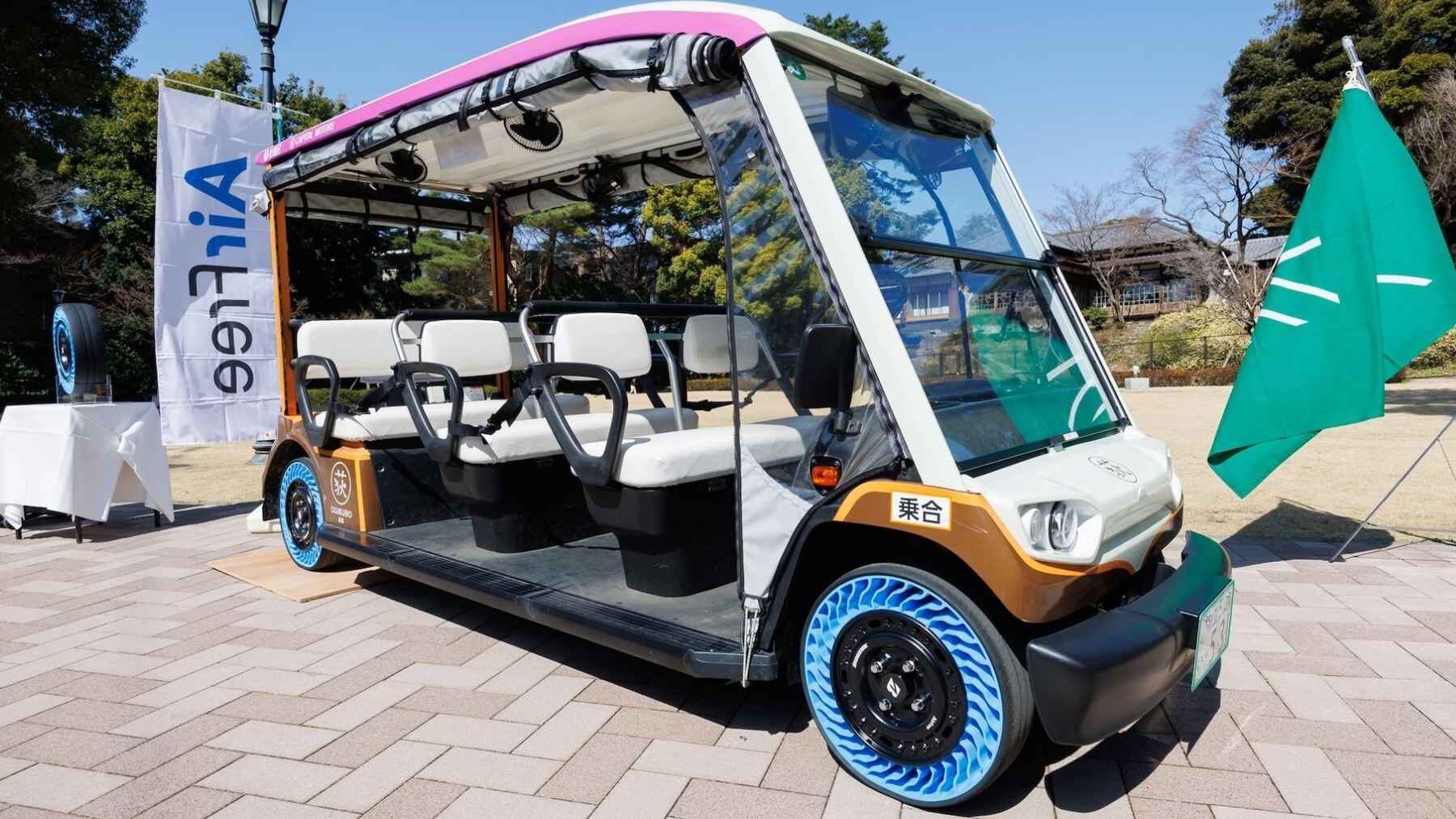
After nearly two decades of research, Bridgestone has begun the first commercial operation of its AirFree tire. The airless wheel is now being used on a small fleet of low-speed autonomous electric vehicles that transport older residents in Higashiomi, Japan.
The launch takes AirFree beyond experimental testing, but it does not mean airless tires are ready for ordinary cars. The current version can travel at no more than about 12 mph, making it suitable for controlled shuttle routes rather than highways, busy streets, or the daily commute.
The first real-world AirFree rollout
The vehicles chosen for the project look more like golf carts than family cars. They travel slowly along predetermined routes in a controlled area, where the technology can be observed during routine passenger service.
That limited setting is part of the point. It allows the manufacturer to validate the wheels in daily use without yet tackling the higher speeds and broader performance demands that remain unresolved.
For passengers, the change may be almost invisible. The bigger difference sits inside the wheel, where a structure of spokes replaces the pressurized air found in a conventional tire.
How the airless tire supports the vehicle
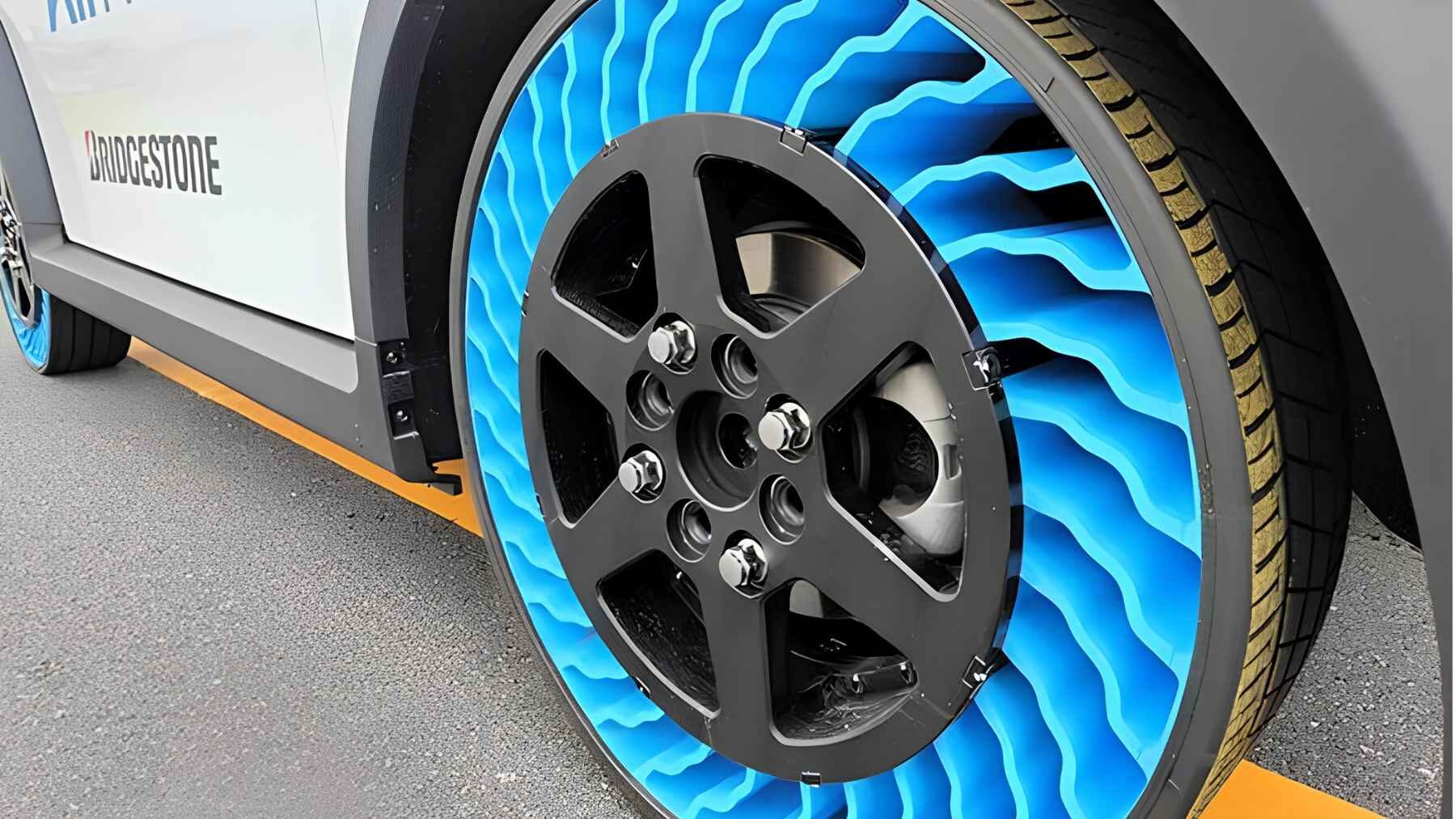
AirFree uses a series of spokes made from recyclable thermoplastic resin. These spokes carry the vehicle’s weight and absorb bumps and uneven surfaces, performing the supporting role normally associated with compressed air.
A thin rubber tread is fitted around the outside of that structure and provides the contact surface between the vehicle and the road. The design does not depend on an air-filled chamber, so it removes the familiar risk of a puncture causing the tire to deflate.
That feature could be particularly useful for autonomous shuttles following regular routes. Avoiding punctures may reduce one possible cause of service interruptions, although the information released so far does not include maintenance or reliability results from the Higashiomi operation.
Recycling is built into the concept
The company says both the rubber tread and the structural spokes can be recycled at the end of their useful lives. AirFree is therefore being developed not only as a puncture-free wheel, but also as a product whose main components could be recovered and reused.
The spokes have a distinctive blue color called “Empowering Blue.” The manufacturer developed the shade to increase the visibility of the structure, making the unusual design easy to recognize at a glance.
Of course, recyclable materials still need a working collection and recovery system. That is why the company is evaluating a business model that would combine the supply of the wheels with recycling and component reuse services throughout their life cycle.
Why passenger cars must wait
The current speed limit is the clearest obstacle. At roughly 12 mph, AirFree can work on a slow shuttle route, but it is nowhere near the performance expected from passenger cars or commercial vehicles.
Higher speeds bring a much harder engineering challenge. Comfort, road noise, heat dissipation, structural strength, and dynamic behavior still require further development before the wheel can be considered for faster vehicles.
Anyone who has felt vibration or tire noise during a drive knows how much the wheels shape the experience. An airless tire must carry the vehicle while also delivering the stability and comfort drivers expect, and that balance has not yet been achieved for normal road speeds.
No mass-production date has been announced
The first commercial use is a milestone, but there is still no timetable for large-scale production. The manufacturer has not said when AirFree could expand to additional applications or become available to private drivers.
Instead, the company is studying how tire supply could be linked with recycling and material reuse over the product’s full life. The idea is not to put a different wheel on a vehicle, but to reconsider what happens to its components after use.
Details of that business model have not been announced. For now, the Higashiomi operation remains a small and carefully controlled first step, not the beginning of an immediate rollout for consumer cars.
From neighborhood shuttles to the Moon
The AirFree principle is also being developed for a different destination. A separate version is under consideration for future lunar exploration vehicles, using the same basic idea of a load-bearing internal structure without relying on air pressure.
That lunar wheel uses metal components instead of the recyclable thermoplastic resin fitted to the low-speed vehicles in Japan. The materials are different, but the underlying concept remains closely related.
The contrast is striking. One version is helping older people travel along a planned route in a Japanese community, while another is intended for future movement on the Moon. It shows the range of applications being explored, even though neither project proves that the design is ready for ordinary cars.
What this commercial launch proves
AirFree has crossed an important line from a research project to real-world commercial use. It is now carrying passengers in daily service, giving the manufacturer a practical setting in which to validate the technology outside an experimental environment.
But the debut should not be mistaken for the arrival of an airless replacement for every tire on the road. The 12 mph limit and the unresolved questions around comfort, noise, heat, and high-speed behavior show how much work remains before consumers see the technology on normal vehicles.
For now, the first commercial AirFree wheel is best understood as a carefully controlled proof of use. It points toward a future without conventional punctures and with more attention to material recovery, but that future is still moving at golf-cart speed.
The information on the AirFree commercial operation was provided by Bridgestone.