CERN has switched off the Large Hadron Collider for an overhaul expected to last about four years. The world’s most powerful particle accelerator entered Long Shutdown 3 on June 29, 2026, beginning a rebuild that will replace nearly three-quarters of a mile of equipment and prepare it to return as the High-Luminosity LHC around mid-2030.
When it comes back, the collider will not mainly be faster. Instead, it will deliver many more particle collisions, giving scientists much larger datasets to study the Higgs boson and hunt for rare signs that do not fit the Standard Model, today’s leading map of known particles and forces. The next leap is about statistics.
Why luminosity matters
In accelerator physics, luminosity is not visible light. It measures how many potential collisions a machine can produce over time, much like increasing the number of lottery tickets when the winning event is exceptionally rare. Why chase more collisions instead of more speed?
Because unusual particle processes can disappear inside billions of ordinary events. The upgraded collider is designed to raise its total collision dataset to about 10 times the original design target and could produce roughly 380 million Higgs bosons over its lifetime, compared with about 55 million since the LHC began operating. That larger sample should let researchers test the particle’s behavior with far finer precision.
A machine under the border
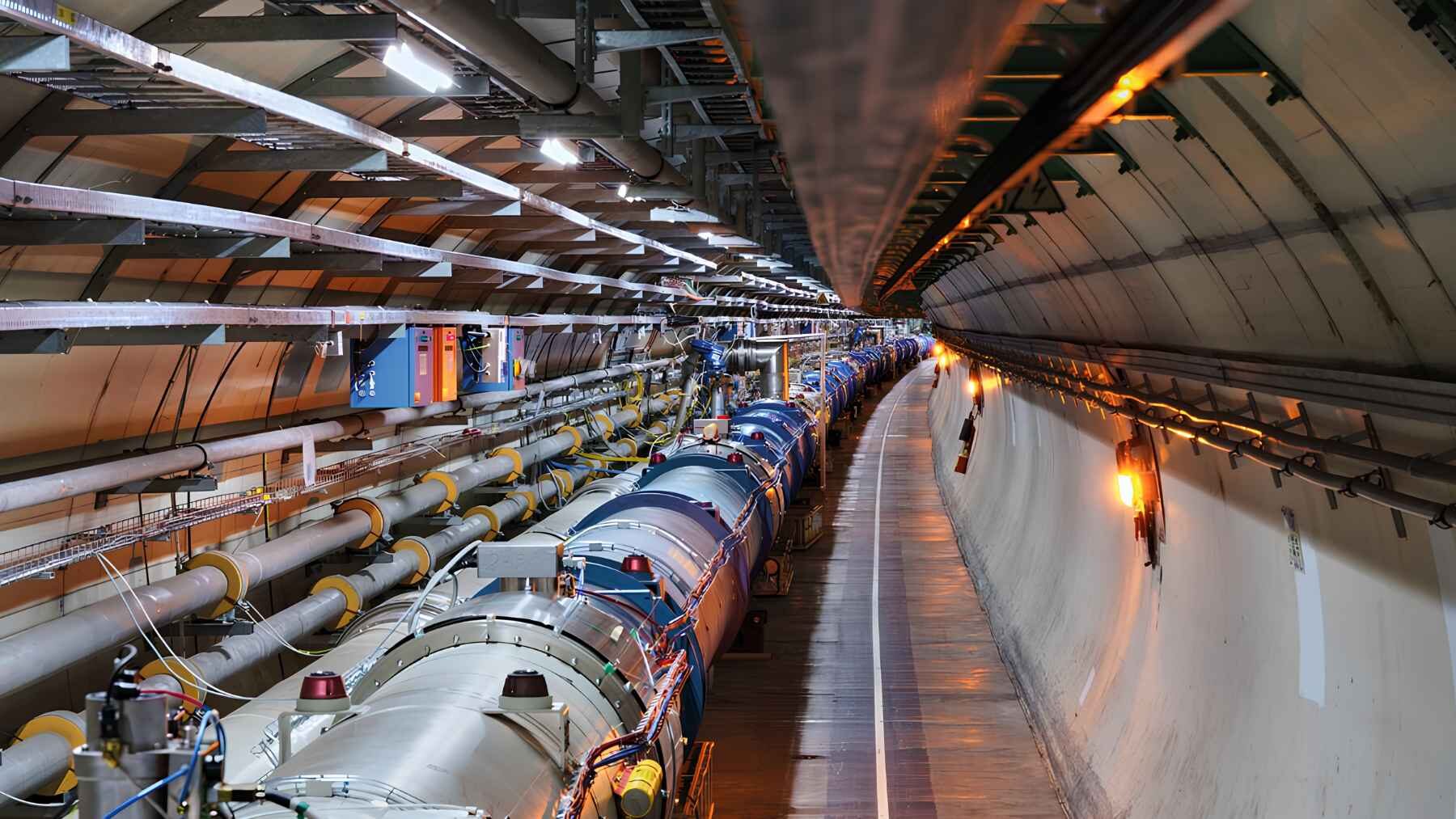
The Large Hadron Collider first circulated beams in September 2008 and recorded its first proton collisions in 2009. Its 17-mile ring sits about 330 ft. underground beneath the French-Swiss border and uses more than 9,000 superconducting magnets to guide particles around the tunnel. Those magnets carry electricity with almost no resistance after being chilled to around 456 degrees below zero Fahrenheit.
Its defining moment came on July 4, 2012, when the ATLAS and CMS collaborations announced the Higgs boson discovery. The particle is linked to the field that helps other elementary particles acquire mass, and the finding confirmed a central part of modern particle physics. Since then, the collider has also uncovered more than 85 hadrons, composite particles built from quarks, while probing antimatter and the hot matter associated with the early universe.
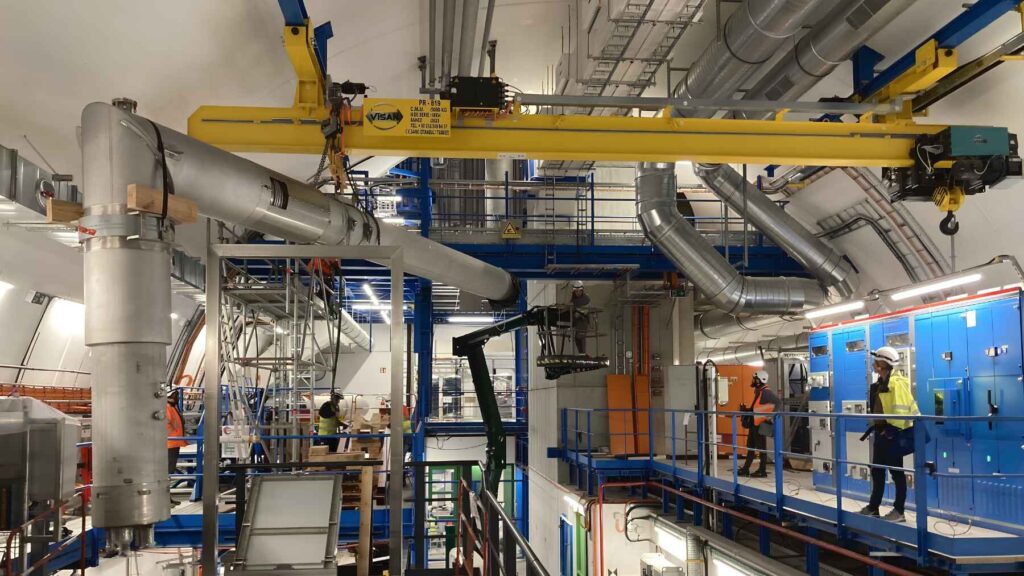
Rebuilding from within
This is not a routine maintenance break. Engineers will remove and replace nearly three-quarters of a mile of magnets and other components across the underground machine. Jean-Philippe Tock, head of the shutdown coordination team, called the work “a huge and complex logistical and engineering undertaking.”
The upgrade includes stronger focusing magnets, devices called crab cavities that tilt particle bunches so they overlap more cleanly, reinforced protection systems, and new superconducting power lines. The new focusing magnets are designed to generate fields about 50% stronger than current units, while 16 crab cavities will help align the beams near the collision points. In practical terms, the lab is rebuilding the key junctions of a 17-mile scientific highway.
Detectors face a data storm
The two general-purpose detectors are also being transformed, not simply repaired. Each bunch crossing is expected to contain about 140 to 200 proton collisions, up from roughly 60 during the last run. Those crowded encounters will occur as particle bunches meet about 40 million times every second.
Altogether, the system must sort through more than five billion interactions per second. Saving everything would be like trying to record every car in every traffic jam at once, including its speed, direction, and passengers, so new trigger systems must decide almost instantly which events deserve a closer look. New silicon trackers, precision timing layers, and calorimeters will then measure the selected debris at much higher rates.
Rare events are the prize
Why build such an enormous data funnel? Many of the most important particle processes happen so rarely that scientists need a mountain of ordinary collisions before one useful signal appears.
More Higgs bosons could expose tiny differences between measurements and the Standard Model’s predictions. Such a mismatch would not automatically prove that a new particle or force exists, but it could give researchers a direction for the next search. A small, repeatable crack in an otherwise successful theory can matter a great deal.
Science during the silence
No particle beams will circulate in the LHC during the shutdown, but the research does not stop. Thousands of scientists will keep analyzing data from the first three operating runs while engineers install and test the new hardware. Findings can still emerge from collisions that have already happened.
Parts of the wider accelerator complex are expected to restart gradually from 2028, while High-Luminosity operations are scheduled for mid-2030 and could continue into the 2040s. The returning machine will use the same tunnel, but it will work more like a far more sensitive camera, exposing details that were previously lost in the background.
For now, the underground ring is quiet. This time, the silence is not an ending but part of the experiment.
The official shutdown announcement was published on CERN’s website.