An international group of researchers demonstrated in a photonic quantum experiment that it is possible to build a quantum machine that generates useful energy while it cools down another system. Published in Physical Review Letters, the study shows how the quantum coherence and the ordering of thermal interactions can be used as thermodynamic resources.
Although it is not an electrodomestic ready for your house, this breakthrough could be great for the future to cool quantum processors and manage the heat in nanoscale devices.
Heat moved in the direction nobody expected
In daily life, heat tends to run one way. Coffee cools, ice melts, and that sticky summer heat we all know enters our houses unless the AC spends energy to push the heat outside.
The new experiment went a little bit deeper, exploring how when a quantic system started hotter than two thermal reservoir, it could still absorb heat from them. But specifically they saw that this happened only under some temperature differences and after a particular measurement result from a control qubit.
A quantum switch changes what comes first
In general, processes occur in a fixed sequence. This means that the first one is followed by the second one, or that the second one is followed by the first. In the case of a “quantum switch” what actually happens is that both orders can coexist until the control is measured.
Zhong-Xiao Man, a co-senior author, explained that the settings did not simply choose between two random routes. What it did was actually to maintain a quantum relationship between them.
Another thing that the authors pointed out is that the same thermodynamic effect can also be reproduced in a casually ordered circuit through coherent controlled operations. This means that the result may not be the exclusive consequence of indefinite casual order.
One tiny cycle performs two different jobs
So what researchers did was to use this exact anomalous flow to design a modified quantum Otto cycle. As would happen with a common engine cycle, the energy levels of the system are changed, alternating with stages where heat is being exchanged.
But in this case, the cycle extracts the heat from a smaller source of temperature, liberating the heat into a warmer one and producing “net work”
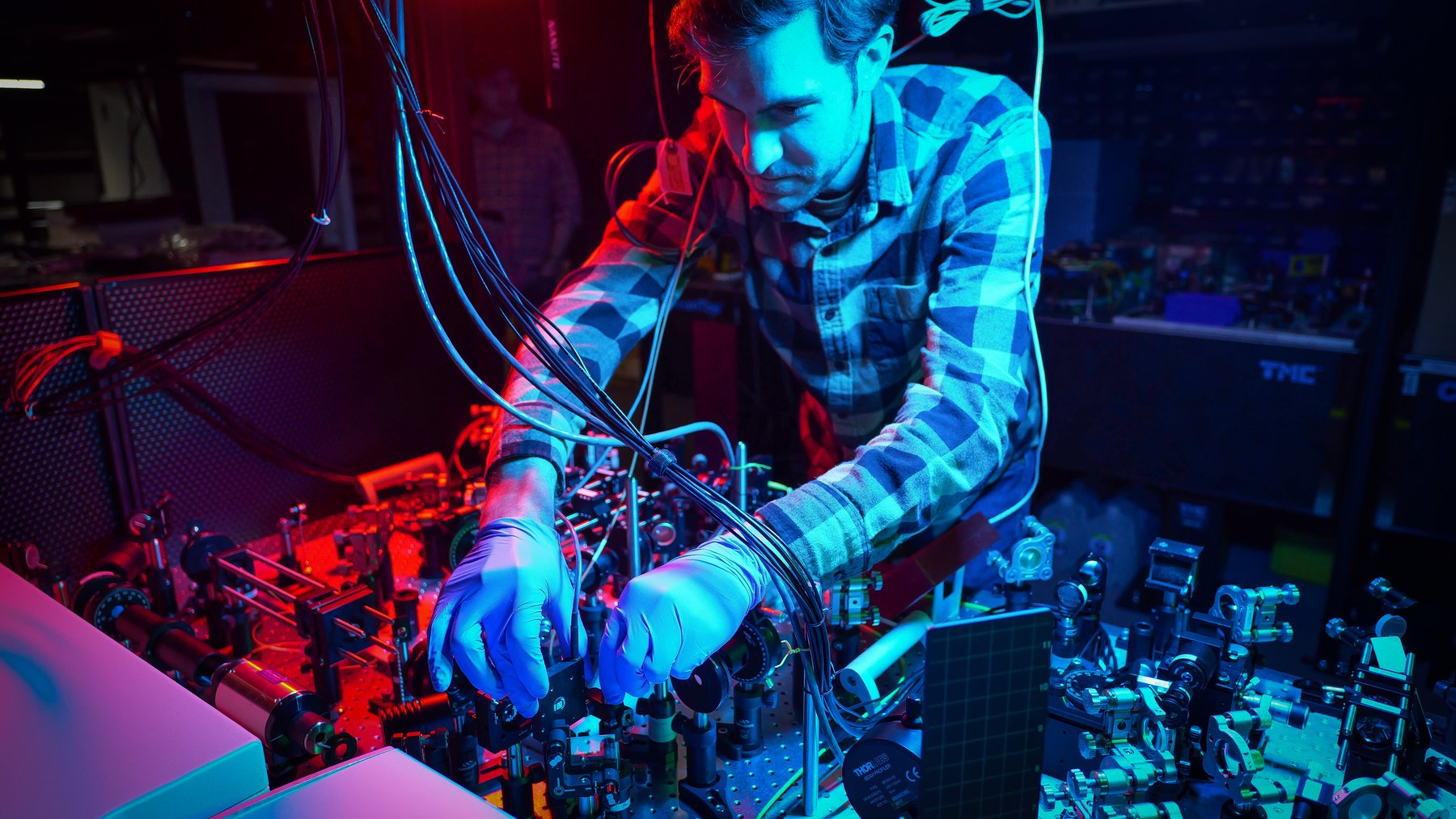
Photons provided the laboratory test
The team could reproduce the effect using individual photons. The thing was that the photon’s polarization represented the working quantum system, and in the case of its path through a Mach-Zehnder interferometer, the control that placed the two thermalization channels was done in different orders.
Researchers built separate photonic demonstrations for the anomalous heat flow and the Otto cycle. They characterized five simulated thermalizing channels at different temperatures and reported high process fidelity, where the experimental results tracked the theoretical predictions.
This experiment definitely took the proposal to another level…It even simulated thermodynamic behaviours through the photon states instead of only cooling a physical processor directly.
The second law of thermodynamics remains intact
What they did was to condition the inverted flow to the recorded measurement outcome, and when those final results were not separated, the exchange of total heat matched with the classical process.
It can also track the energy available back to the quantum resources that were used in the control and machine operation. Its model includes a Maxwell’s demon-style measurement process and the energy cost of erasing the demon’s memory. This last one plays a role similar to plugging in a conventional refrigerator.
What is important to remark here is that it is not that “free” energy appears; it is only about how microscopic information,coherence and the heat can be organized inside the cycle.
Why the result could matter beyond the laboratory
Quantum processors, like sensors, or any other nanoscale technologies face demanding heat-management problems. The researchers affirm that their approach can inspire devices to cool components while they also recover useful work.
There is still a lot to be solved and because of that, there need to be future studies that check and examine operations completed in finite time, where speed affects power output and can create a balance in energy cost, information obtained, efficiency and performance.
It would be very interesting to have the future quantum machines able to combine the energy conversions and cooling in the same place.