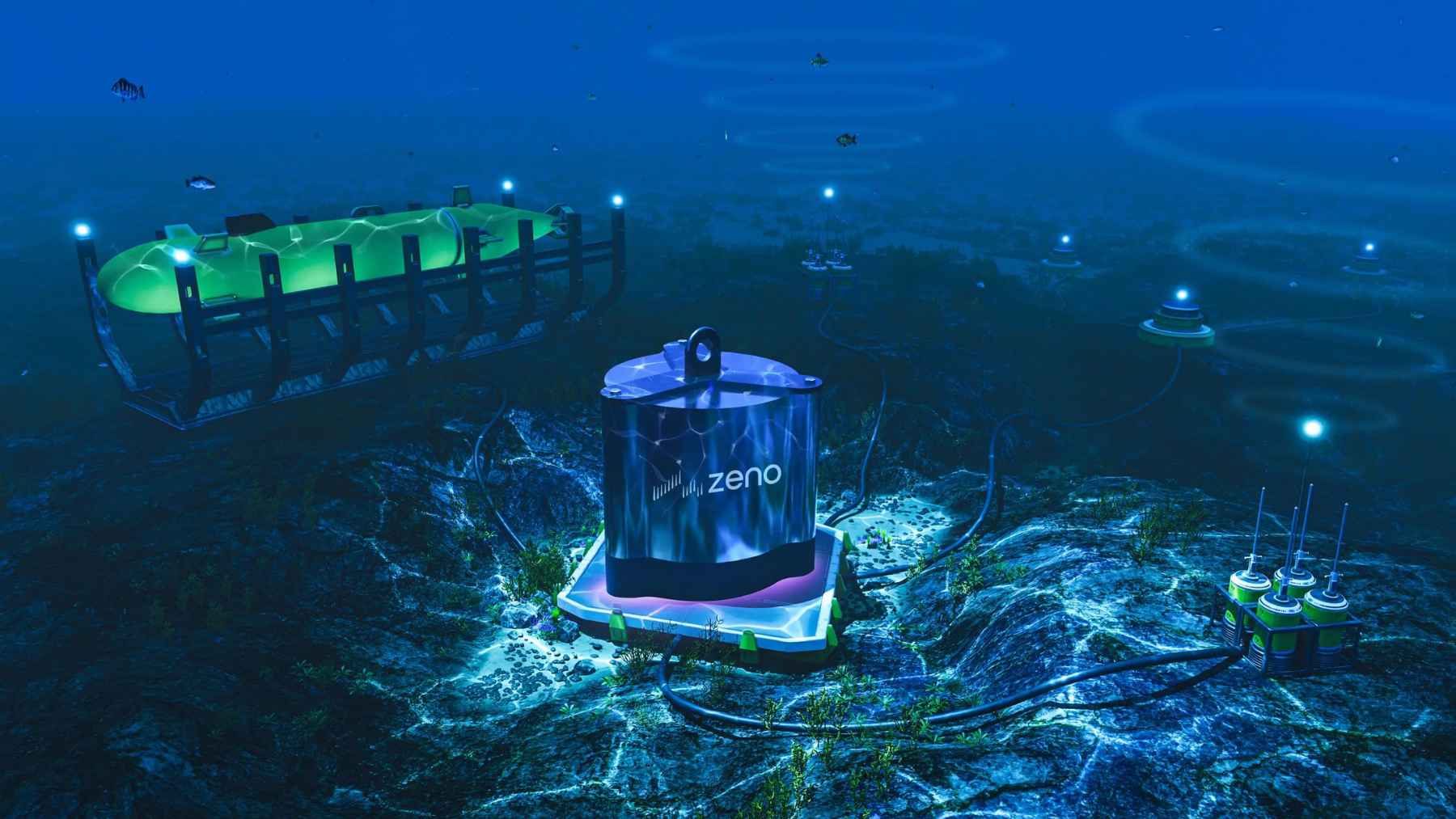
The next dawn in the United States might bring a new horizon. The country is backing up a new kind of underwater power station, designed to sit on the seafloor for years and supply electricity to sensors or charging points for autonomous underwater vehicles. A company called Zeno Power is now responsible for a $7.5 million Department of Defense contract under the DEPTHS program.
The project hasn’t begun yet, and is still in a stage called “industrial phase”. Before it starts Zeno is restoring shielded “hot cells” at California’s historic Vallecitos Nuclear Center. The project’s planned fuel comes from a strontium-90 generator that contains an isotope with a half-life of 28.8 years. That means its heat output declines gradually rather than suddenly ending on that date. That thing was stored back 40 years ago at the Department of Energy, in Oak Ridge.
How a nuclear battery could power the seafloor
Strontium-90 releases heat as it decays into yttrium-90 releasing a reliable and predictable amount of thermal energy in the process. Zeno plans to capture that steady, slowly declining thermal energy with a Stirling converter, which uses a temperature difference to move a piston and generate electricity. What’s interesting is that the converter doesn’t need sunlight, nor a routine refueling or even permanent cables.
That process matters underwater because autonomous vehicles that use batteries are forced to stop their work due to those limitations. On the other hand if they worked with a distributed charging node researchers would be able to extend the mission and reduce the costs of the expensive support visits. Retired Adm. John M. Richardson described widespread maritime power access and technological advancement as “critical to maintaining U.S. leadership.”
Old radioactive material becomes a new fuel supply
The fuel source is an old thermoelectric generator called BUP-500. It is a 500-watt radioisotope that was built in the mid-1980 at the Oak Ridge National Laboratory but that has never been deployed. Authorities say the unit has been stored for nearly 40 years and that it could still be stored for another 30 years before they need to dispose of it.
Recycled nuclear waste can be a harmful material. Strontium-90 can behave like calcium after ingestion and collect in bones and teeth, damaging both bone and bone marrow. A sealed system is different from an environmentally exposed one, but any seabed use will demand extra regulatory work and accountability.
America tried this idea more than 60 years ago
This isn’t America’ s first rodeo on the subject. Back in December 1961 we had the SNAP program. Under the program we built a 10-watt generator that fueled a Coast Guard light buoy near Baltimore. At some point we also had a larger 60-watt system prepared for a Navy weather buoy in the Gulf of Mexico. Those old tests showed radioisotope power could work, but still needed further work on sustainability.
Today’s scientists have learned from the past. At Zeno they said their heat-source design can now raise the thermal power available per kilogram, tackling the sustainability problem out of the way. At the same time NASA estimates that small Stirling radioisotope systems could convert roughly 15 to 25 percent of their heat into usable electricity. Which in other words means more power can be produced with less need of fuel and other heavy equipment.
The California factory as a milestone
On June 18 2026 Zeno announced they took possession of the hot cells at Vallecitos, in Sunol, California. There the thick-walled rooms allow the technicians to handle radioactive material remotely, through lead-glass windows and using mechanical arms. Thanks to that the company announced that non-radiological work has begun, while radiological operations are expected to start later in 2026 (those are still awaiting approval).
The company plans to create more than 50 local jobs over 3 years, plans the first government deliveries in 2027 and also targets scaled production beginning to 2028. Those are estimates, but based on Zeno’s currently published updates the company has demonstrated they still have a long road to walk.
The next step
The next stage for Zeno should be an integrated test. One that can prove the strontium heat source working together with the Stirling converter and all the other needed equipment. That also needs to happen for an extended period of time under conditions that simulate a real environment.
If the test is successful the technology could help to make ocean monitoring less dependent on high maintenance costs. It could also turn a troublesome radioactive legacy into an useful alternative as long as it can prove its own effectiveness.