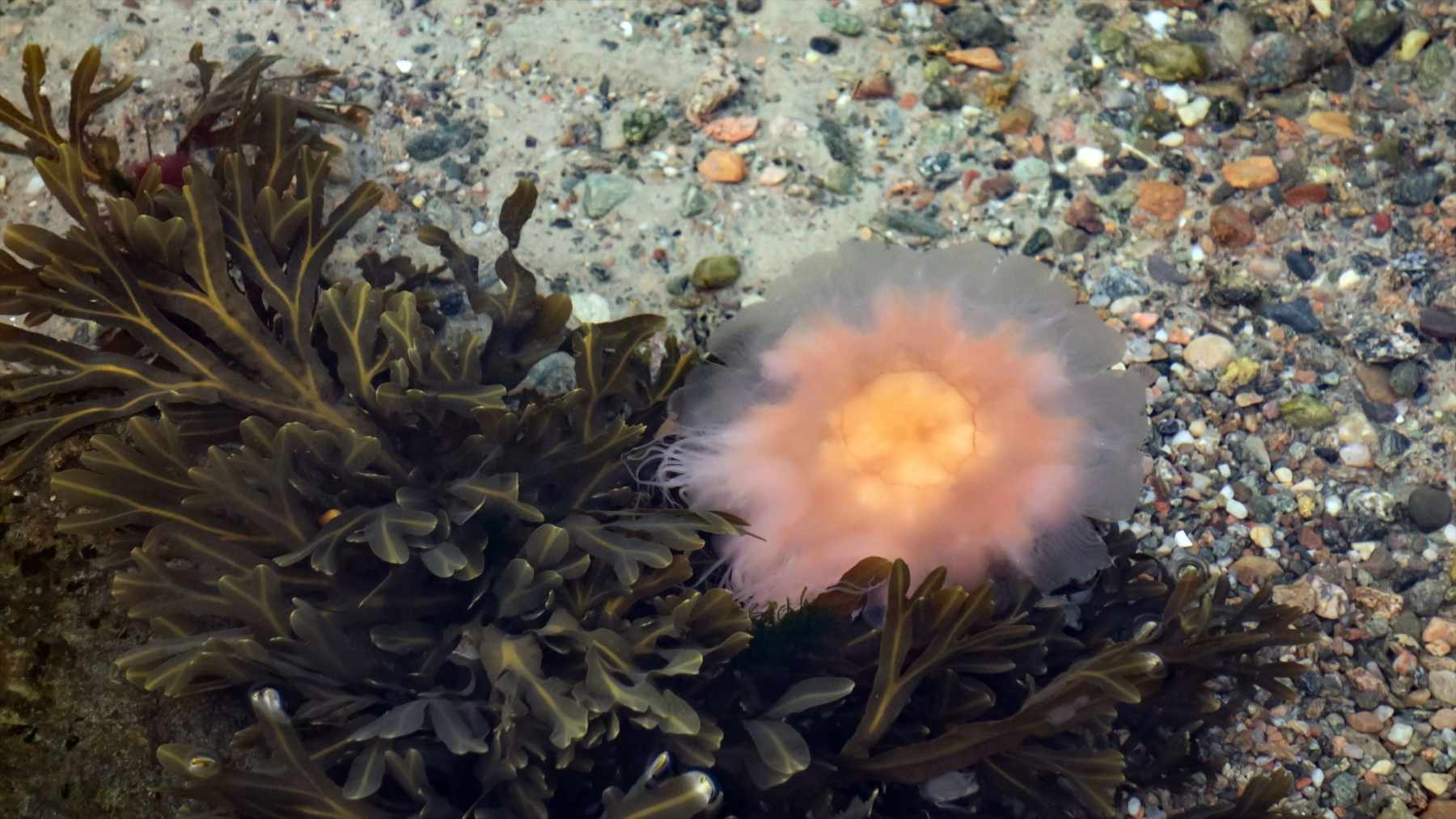
“Jellyfish are part of the plankton, which means they cannot actively swim against ocean currents,” Ina Stoltenberg, a marine biologist at the GEOMAR Helmholtz Centre for Ocean Research in Kiel, told the German newspaper Kreiszeitung, in remarks translated here from German, after hundreds of pink and reddish jellyfish piled up on the sand and in the shallows of the Bay of Lübeck, near Grossenbrode, just across from the island of Fehmarn.
“The animals are probably specimens of the lion’s mane jellyfish (Cyanea capillata), which is popularly called the fire jellyfish,” Stoltenberg said. The color can be misleading, since the younger and smaller ones are often pink or reddish, according to the paper’s report, which was last updated Sept. 16 and placed the stranding early that week.
Wind, currents and the end of summer
The mechanism is simple enough. “Onshore wind and a corresponding current then push the drifting animals directly onto the coast and the beaches,” Stoltenberg said, and the result tends to be very local, because “thousands of jellyfish can appear on one beach, while not a single one is seen on the neighboring beach.”
Their life cycle plays a part too, as the swimming stage winds down at the end of summer, and Stoltenberg said that “such events are seen more often from autumn through January or February.” In Danish waters this year the jellyfish showed up early, and Cornelia Jaspers, a biological oceanographer quoted in July by the regional paper Der Nordschleswiger, said that “this year we observed significantly earlier growth because of the record-high water temperatures,” as quoted there in German.
Look, but don’t touch
Kreiszeitung’s advice for anyone tempted to poke one with a finger was to admire them from a distance, and Stoltenberg explained why. “The stinging venom can still be active for some time after the animals have died,” she said.
The state of Schleswig-Holstein says the same in its official guidance on jellyfish, warning that dead jellyfish and torn-off tentacles can still sting, that the fine tentacles are hard to see in the water, and that people should avoid swimming where many stinging jellyfish are visible and make sure children know the danger.
A Baltic population of its own?
The lion’s mane in the Baltic has long been thought to depend on animals drifting in from saltier water to the west. A study published March 13 in Marine Biology, led by Sanna Majaneva with Stoltenberg among the co-authors, questions that idea. The team compared 187 mitochondrial DNA sequences and found two distinct groups, one in the Baltic and one in the North Sea and Norwegian Sea, and computer simulations of drifting jellyfish suggested there may be separate eastern and western groups within the Baltic itself.
That led the authors to suggest the Baltic has a self-sustaining population that may even act as a source for its neighbors, though no lion’s mane polyps have been documented in the Baltic, and the nearest known polyp beds, identified from their appearance, are in the Gullmar fjord on Sweden’s west coast. Finding the polyps is hard everywhere, and Tone Falkenhaug, a jellyfish expert at Norway’s Institute of Marine Research, told Science Norway last year, “We still haven’t found them out in the wild.”
Those polyps are the hidden half of the animal’s life. Larvae settle on hard surfaces and grow into small attached polyps that can live for several years and release young jellyfish, while the swimming stage usually lasts less than a year, according to the Oregon Coast Aquarium. The aquarium adds that lion’s mane jellyfish are eaten by leatherback sea turtles and that some young fish shelter under their bells.
A beach full of jellyfish is a snapshot of one week’s wind and water, and it says nothing on its own about whether the Baltic population is growing. Big jellyfish blooms make headlines, but telling a trend from a windy week takes repeated surveys over a much wider area.
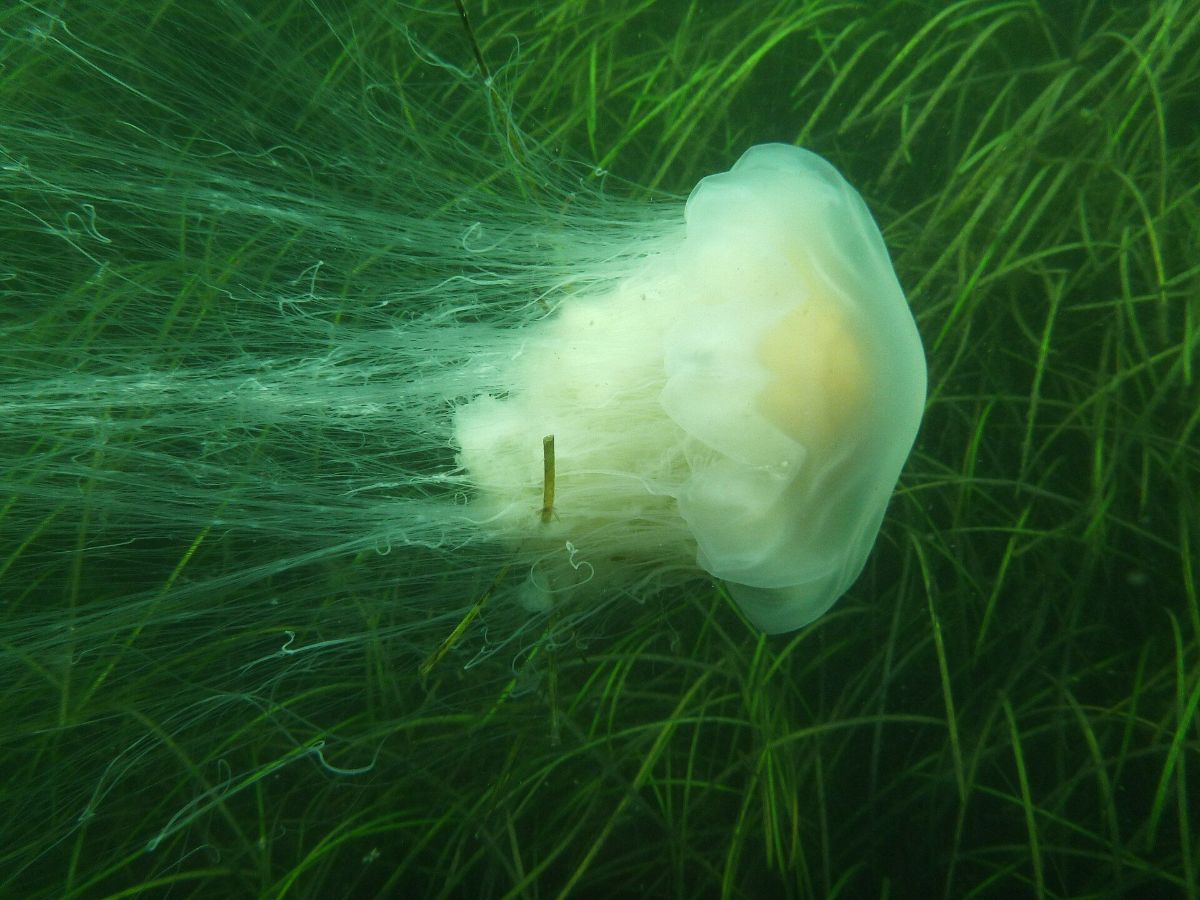
Photo: W.carter / Wikimedia Commons (CC0)