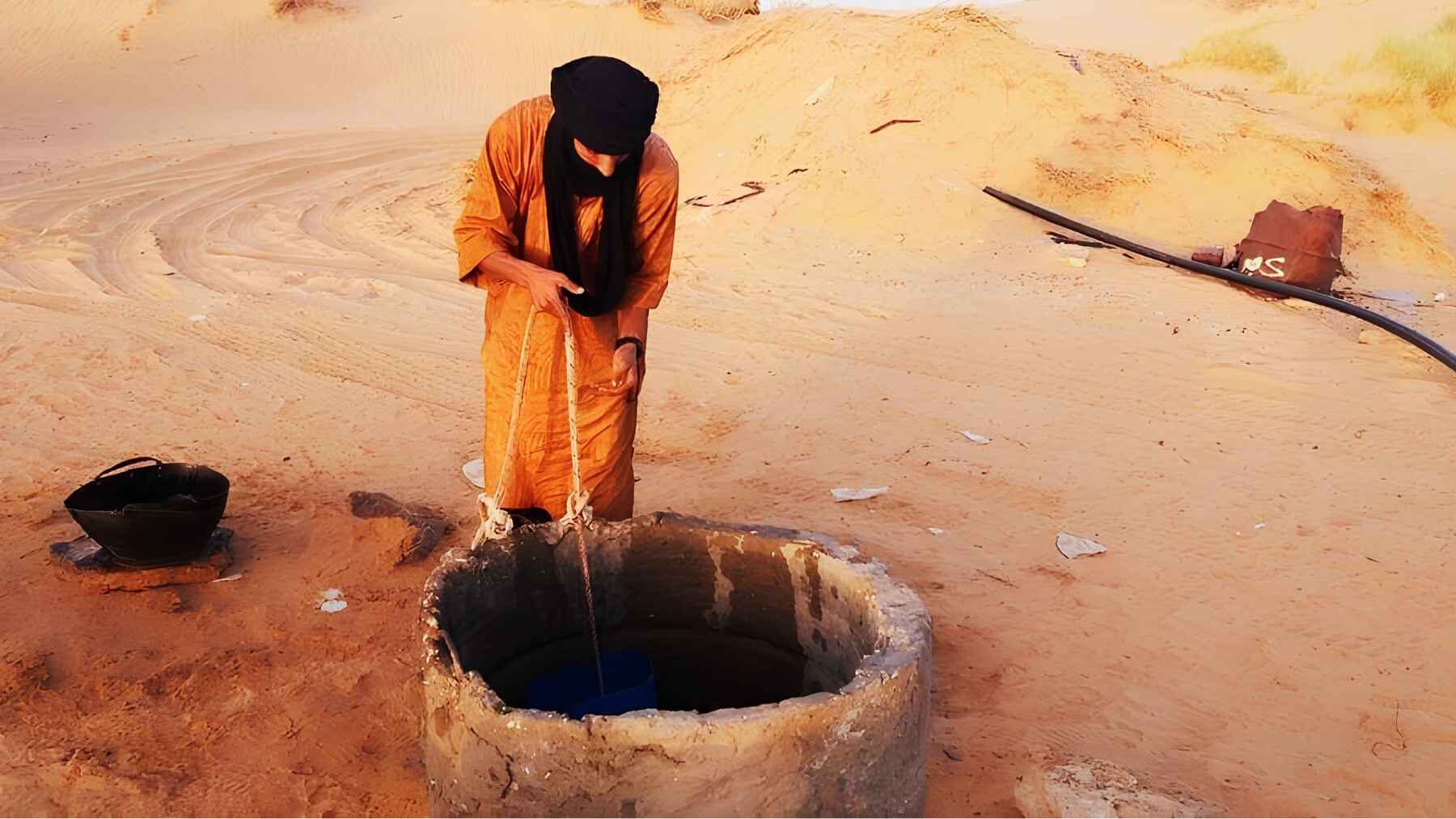
Imagine crossing the Sahara under a cloudless sky and learning that enormous quantities of ancient rain lie beneath your feet. Water that fell during greener chapters of North African history still fills sandstone formations below one of the driest regions on Earth, and some deep samples appear to have remained underground for nearly 1 million years.
That discovery sounds like an underground ocean, but the reality is more complicated and more useful. The water sits inside several aquifer systems, and scientists warn that a huge amount in storage does not automatically mean every farm, town, or well can reach it.
The Sahara is not hiding a single ocean
Alan MacDonald of the British Geological Survey led a 2012 Africa-wide assessment that estimated the continent stores about 158,000 cubic miles of groundwater. The uncertainty was large, ranging from roughly 86,000 to 420,000 cubic miles, but the biggest volumes were concentrated in sedimentary aquifers beneath Libya, Algeria, Egypt, and Sudan.
Those figures cover all of Africa, not only the Sahara. They also describe water stored underground rather than water that can be pumped economically, so the popular image of one vast blue chamber under the dunes is misleading.
Water fills rock like a sponge
Most groundwater occupies tiny connected pores between grains and fractures inside rock. Picture a soaked kitchen sponge rather than a hidden lake, with sandstone holding water in the spaces left between ancient sand grains.
How much water a formation contains depends partly on porosity, which means the amount of empty space in the rock. How easily that water reaches a well depends on permeability, or how well those spaces connect, and that is why a thick aquifer can hold a fortune in water yet release it frustratingly slowly.
The best-known reserve is the Nubian Sandstone Aquifer System, which extends beneath Chad, Egypt, Libya, and Sudan across about 772,000 square miles. The International Atomic Energy Agency identifies it as the world’s largest known “fossil water” aquifer system, while another major system farther west is shared by Algeria, Tunisia, and Libya.
Rain arrived when the Sahara was green
North Africa has repeatedly shifted between dry and humid conditions as slow changes in Earth’s orbit altered summer sunlight and strengthened the African monsoon. During wetter phases, rainfall moved farther north, rivers crossed landscapes that are now desert, and water seeped through exposed sandstone into deeper layers.
Charlotte Skonieczny led a satellite radar study that revealed a buried river channel about 323 miles long near the Mauritanian coast. The researchers concluded that the larger drainage system was reactivated during several humid episodes over the past 245,000 years, showing that the groundwater reserve was built in chapters rather than during one rainy age.
The most recent African Humid Period lasted from about 14,700 to 5,500 years ago. Grasslands, wooded savanna, wetlands, rivers, and lakes spread across parts of the region, supporting fish, crocodiles, elephants, and human communities, although the “Green Sahara” was a changing mosaic rather than an unbroken tropical forest.
Radioactive atoms reveal the water’s age
Groundwater age measures the time since rain entered an aquifer and largely stopped exchanging with the atmosphere. Scientists estimate it by examining dissolved chemicals and rare radioactive isotopes, which decay at known rates and act like clocks hidden inside the water.
Mustafa El-Rawy led a 2020 analysis that summarized age estimates of roughly 20,000 to 49,000 years for parts of the Nubian groundwater. Radiocarbon works well across that time range, but older water requires an isotope with a much longer clock.
Neil Sturchio and his colleagues used krypton-81 and chlorine-36 in a 1-million-year dating study of deep wells in Egypt’s Western Desert. Their results showed that some Nubian groundwater had remained beneath the Sahara for close to 1 million years, although that does not mean every gallon in the system is equally old.
A giant reserve can still be depleted
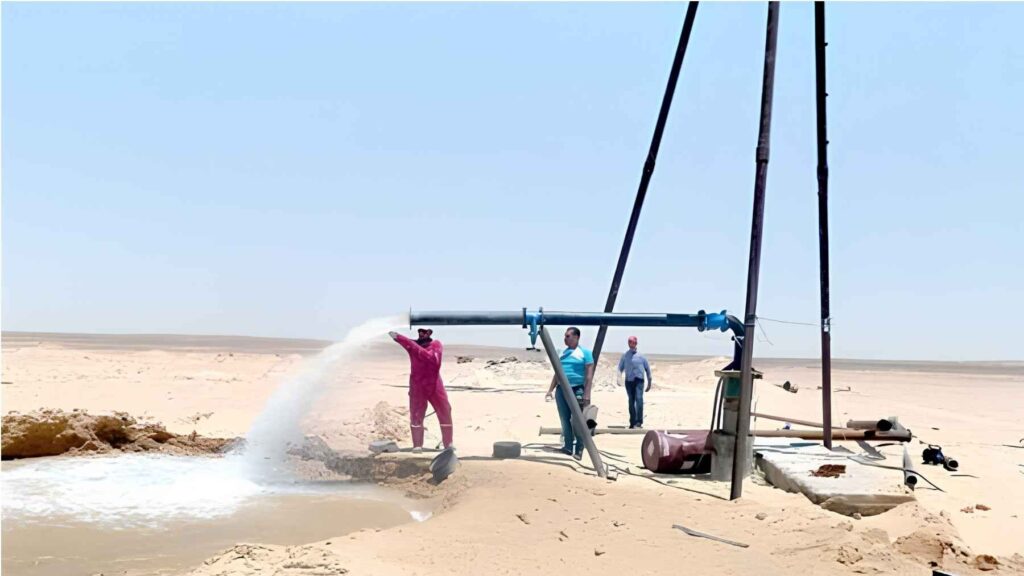
In the hyperarid interior, modern rain replaces very little of the water withdrawn by large wells, so pumping fossil groundwater is less like drawing from a river that returns each season and more like spending savings deposited before modern civilization. Heavy withdrawal can lower pressure, raise energy costs, leave shallow wells dry, and pull saltier water toward freshwater zones.
The four countries above the Nubian system have created a joint management framework because pumping on one side of a border can affect users on another. At the end of the day, the difficult question is not simply how much water exists, but how much can be recovered in each place, at acceptable quality and cost, without handing depletion to neighbors or future generations.
The main assessment was published in Environmental Research Letters.
Most read
- US scientists poured 16,500 gallons of lye into the Gulf of Maine and dyed the water bright pink to track it, the first federally approved try at reversing ocean acidity
- Soviet scientists released giant red king crabs into the Barents Sea in the 1960s to build a fishery, but decades later those invaders are still changing the seafloor
- New Orleans is collecting thousands of used Christmas trees and dropping them from helicopters to slow the loss of land, which has already exceeded 5,000 square kilometers
- Britain is dropping 20 concrete reef cubes and 44 tons of scallop shells into the sea, and the goal is to bring back oysters down more than 95% since the 1800s
- The U.S. will pay up to $65 million to leave Colorado River water in Lake Mead, and Hoover Dam explains why