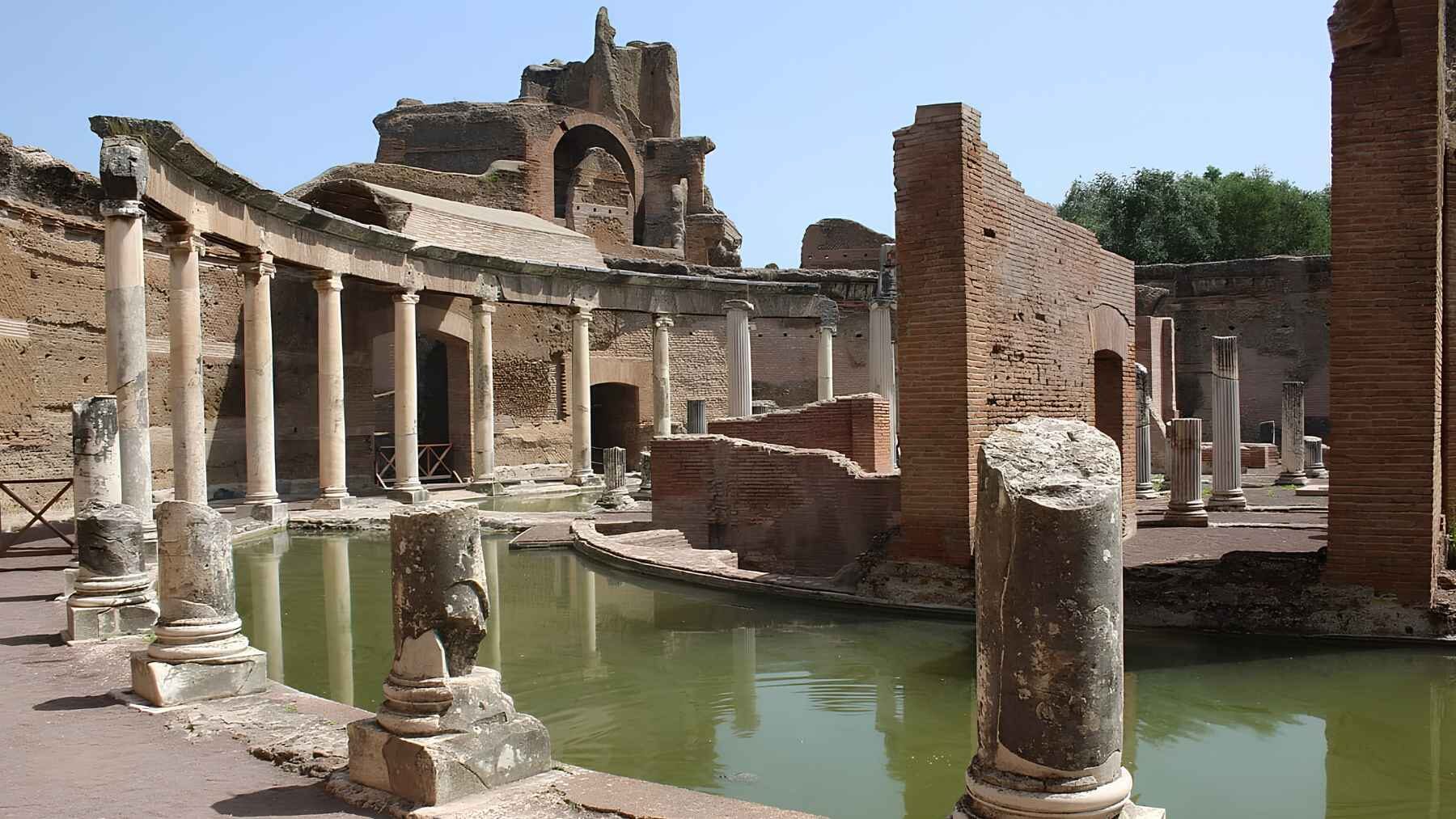
About 17 miles east of Rome, the remains of a communal latrine have survived for nearly 2,000 years inside Hadrian’s Villa. A new study suggests that its Roman concrete did more than resist decay. Over centuries, calcite grew through pores and fractures, helping bind the material into a denser and more durable structure.
The humble bathroom has become an unusually valuable scientific record. Researchers led by Xiaohong Zhu of Beijing University of Technology and Paulo J. M. Monteiro of the University of California, Berkeley, used advanced imaging to see how carbonation changed the concrete long after Roman builders finished their work.
Why a Roman bathroom mattered
Hadrian’s Villa was built in the second century as an imperial residence near Tivoli, Italy. Many celebrated Roman ruins have been repaired or patched over time, which can blur the original chemistry that researchers want to examine.
Why study an ancient toilet instead of a temple? “Nobody restores a latrine,” Monteiro said, and the largely undisturbed concrete had effectively recorded about 19 centuries of slow mineral change. In practical terms, it gave the team a cleaner view of what aging Roman concrete actually did on its own.
The chemistry behind Roman concrete
Scientists have long linked Roman concrete’s durability to a mixture of lime, volcanic ash, water, and stone. The lime and ash trigger what is known as a pozzolanic reaction, producing binding compounds that harden the material and can continue developing after construction.
Maria Juenger, a concrete materials researcher at the University of Texas at Austin who was not involved in the work, compared the ancient approach with modern cement making. Roman builders, to a large extent, relied on volcanic ingredients to improve their concrete, while today’s industry depends on extremely hot cement kilns.
Another clue emerged in 2023. Researchers from Massachusetts Institute of Technology (MIT) and other institutions argued that white pieces called lime clasts could provide calcium when water enters a crack, allowing calcium carbonate to recrystallize and seal part of the opening. That does not make Roman concrete indestructible, but it points to a built-in chemical route for limited self-repair.
Calcite formed a hidden network
The new team examined concrete from the latrine with high-resolution X-ray imaging, electron microscopy, and chemical analysis. Their main focus was carbonation, a slow process in which carbon dioxide from the air enters concrete and reacts with calcium-rich compounds to form calcite, a hard crystalline mineral.
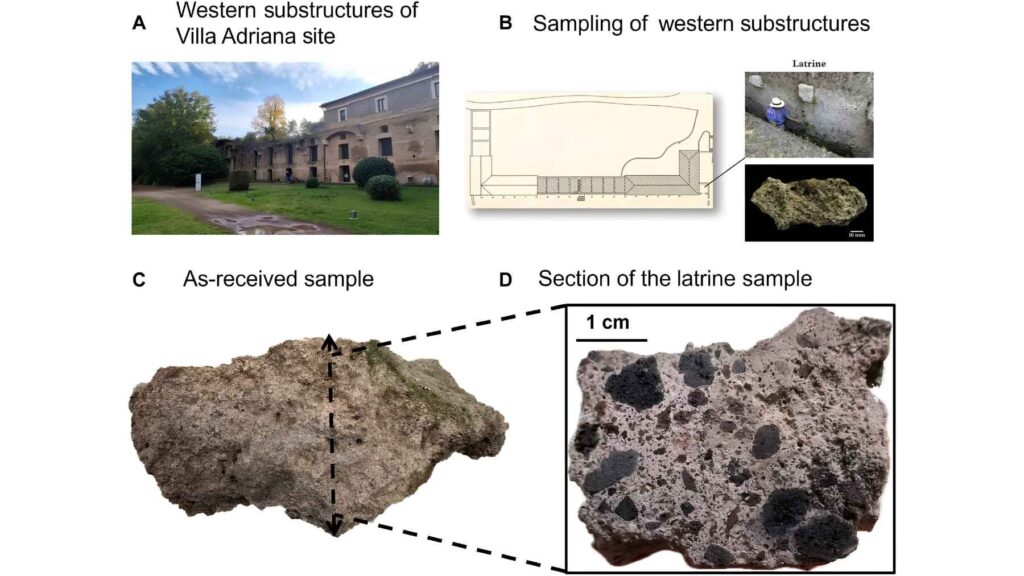
The scans showed calcite woven through pores and fractures rather than sitting at the edges as a minor byproduct. “What is new is that we can now see how it binds,” Monteiro said. The growing mineral network can fill small voids, improve contact between components, and reduce routes through which water can penetrate.
That finding adds an important layer to the older explanation based on volcanic ash. The pozzolanic reaction remains fundamental, but the researchers argue that long-term carbonation also helped densify the concrete and may have closed fine cracks as the structure aged. The material was not frozen in time because its internal chemistry kept moving.
Modern concrete has a major complication
At first glance, the discovery sounds like a simple recipe for longer-lasting roads, bridges, and apartment blocks. The trouble is that most modern structural concrete contains steel reinforcement, while the ancient material examined at Hadrian’s Villa did not depend on embedded steel bars.
Fresh modern concrete is alkaline enough to protect reinforcing steel from corrosion. Carbonation gradually lowers that alkalinity, which can weaken the protective environment and allow the metal to rust. In other words, a reaction that helped bind ancient Roman concrete can become a slow threat inside a modern steel-reinforced structure.
That does not make the Roman lesson useless. It means engineers will need to control where, when, and how carbonation occurs, possibly using it in carefully designed binders or parts of infrastructure where it can add durability without exposing steel to damage. Copying the ancient recipe wholesale would miss the point.
An ancient clue for lower-carbon construction
The environmental stakes are substantial because clinker, the kiln-fired ingredient at the heart of conventional cement, carries a heavy carbon cost. UC Berkeley reported that producing one ton of clinker releases about 0.83 ton of carbon dioxide. Longer-lived concrete and durable low-clinker binders could reduce emissions not only during production, but also by limiting repeated repairs and replacement.
Still, the study does not offer an instant climate fix. The calcite network developed over centuries, so researchers must determine whether similar benefits can be encouraged on useful modern timelines without creating new structural risks. That balancing act is where the real work begins.
A communal bathroom that outlasted an empire is now offering a practical lesson about patience, chemistry, and construction.
The full study was published in Science Advances.
Most read
- US scientists poured 16,500 gallons of lye into the Gulf of Maine and dyed the water bright pink to track it, the first federally approved try at reversing ocean acidity
- Soviet scientists released giant red king crabs into the Barents Sea in the 1960s to build a fishery, but decades later those invaders are still changing the seafloor
- New Orleans is collecting thousands of used Christmas trees and dropping them from helicopters to slow the loss of land, which has already exceeded 5,000 square kilometers
- The U.S. will pay up to $65 million to leave Colorado River water in Lake Mead, and Hoover Dam explains why
- Britain is dropping 20 concrete reef cubes and 44 tons of scallop shells into the sea, and the goal is to bring back oysters down more than 95% since the 1800s