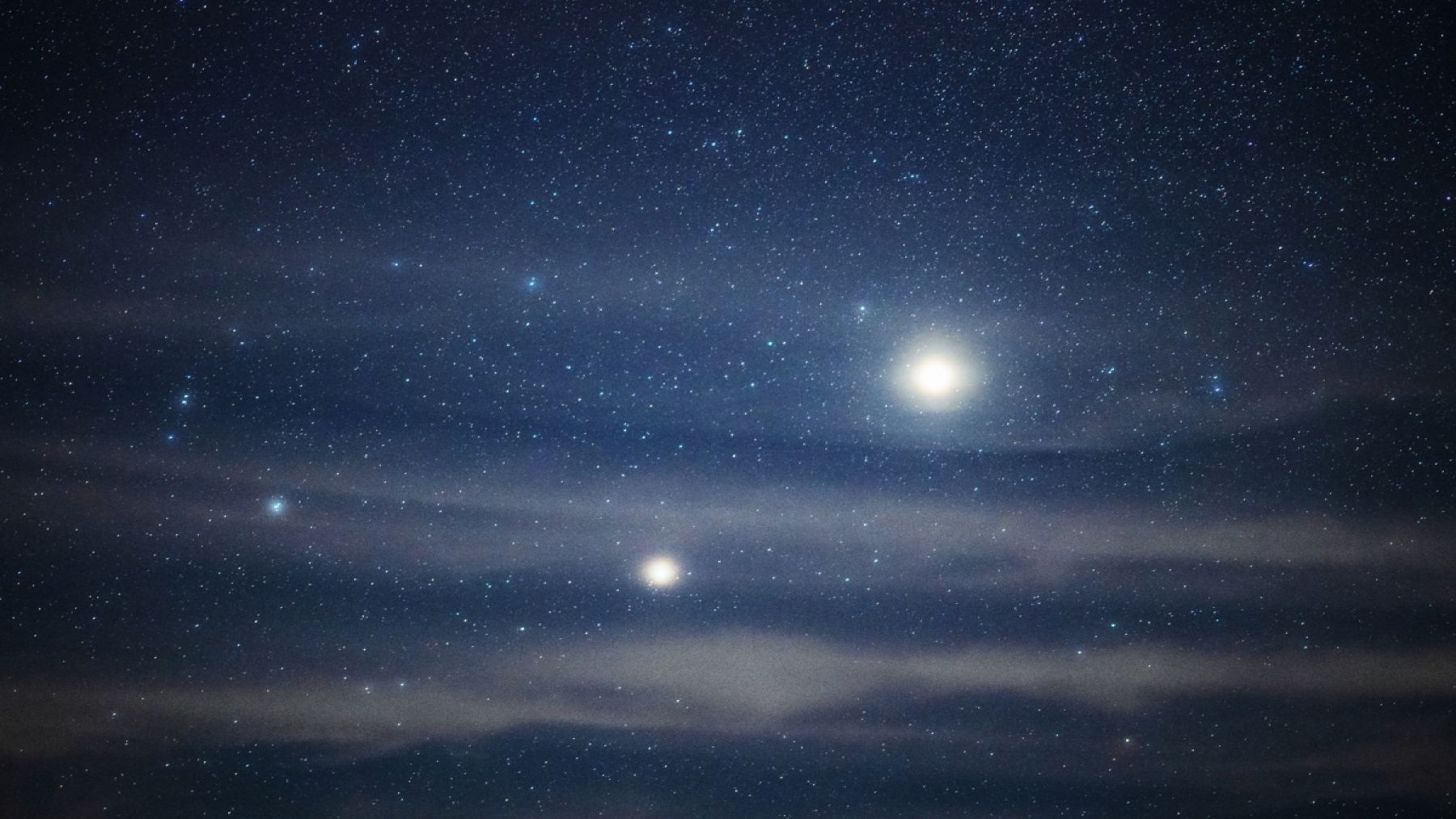
January brings a stunning spectacle for star watchers, a rare celestial alignment wherein several planets appear across the sky. The skies are active, with Venus and Saturn’s thrilling waltz and Mars shining bright in opposition. As if a six-planet view across North Texas wasn’t enough, this month has undeniably wondrous spectacles for amateurs and casual sky-gazers.
A planetary celestial alignment: Lighting up the skies in January
Venus, Saturn, Jupiter, and Mars illuminate the night sky in January. Venus and Saturn are visible low in the southwestern sky soon after sunset in early January. Jupiter sits higher in the sky, and Mars rises in the east to form a large arc that can be seen with the naked eye.
Also visible, through telescopes, are the faint, closer-to-home Uranus and Neptune. Mars opposes the Sun, so it’s exceptionally bright this month when people observe the Red Planet. On January 13th, the moon passed in front of Mars for viewers in the US and Canada, adding a curtain call that showcased its fiery hue. On January 17th and 18th, Venus and Saturn got closer in the southwestern sky, appearing strikingly near to observers.
Escape urban areas with light pollution for a magnificent six-planet spectacle
Late January will offer people across North Texas a unique view of a six-planet alignment. Mars, Jupiter, Uranus, Neptune, Saturn, and Venus will align as an arc stretching from the southeastern sky to the southwestern sky. Mars, Jupiter, Venus, and Saturn can be seen with the naked eye, but Uranus and Neptune require a telescope. You can view the celestial phenomenon from just after sunset to around 8:30 p.m., but some planets will stay longer.
By midnight, Mars, Jupiter, and Uranus will still be visible; however, Venus, Saturn, and Neptune will have plunged below the horizon. To see this alignment in its entirety, you need to escape from city light pollution and have a clear horizon view.
These planetary alignments, which stem from the different orbits and velocities of various planets in the Solar System (like this strange object found in the solar system), appear close together in the sky, which will be a visual phenomenon. While not genuinely aligned in space, they make for a stunning show from Earth’s perspective.
The cosmos continues to astonish: Future planetary alignments
If you missed the alignment in January, don’t worry; there is more to see. In April 2025, before dawn, Neptune, Mercury, Saturn, and Venus will align quietly yet beautifully. Then, on August 11, an even bigger alignment of Mercury, Jupiter, Venus, Uranus, Neptune, and Saturn will occur in a stunning planetary parade across the night sky.
On the horizon, even rarer alignments occur in the future. All planets of the Solar System will align on May 19, 2161, November 7, 2176, and May 6, 2492. Such spectacular cosmic events will again remind us of the grandeur of the universe and fuel our curiosity about our place in it. The sky is never done showing its wonders; be it through telescopes or merely the naked eye, one can always look forward to another heavenly sight.
January 2025 is a fantastic month for stargazing, with several interesting celestial events that can spark curiosity and wonder. Among these remarkable happenings are the striking brightness of Mars (which is brimming with this new invisible oil) at opposition and the beautiful trails created by several other planets.
Our universe is still vast and beautiful, which reminds us of whether we are serious astronomers or just casual viewers of the stars. If you can get outside urban areas with light pollution, enjoying an incredible evening under the sky should be easy.