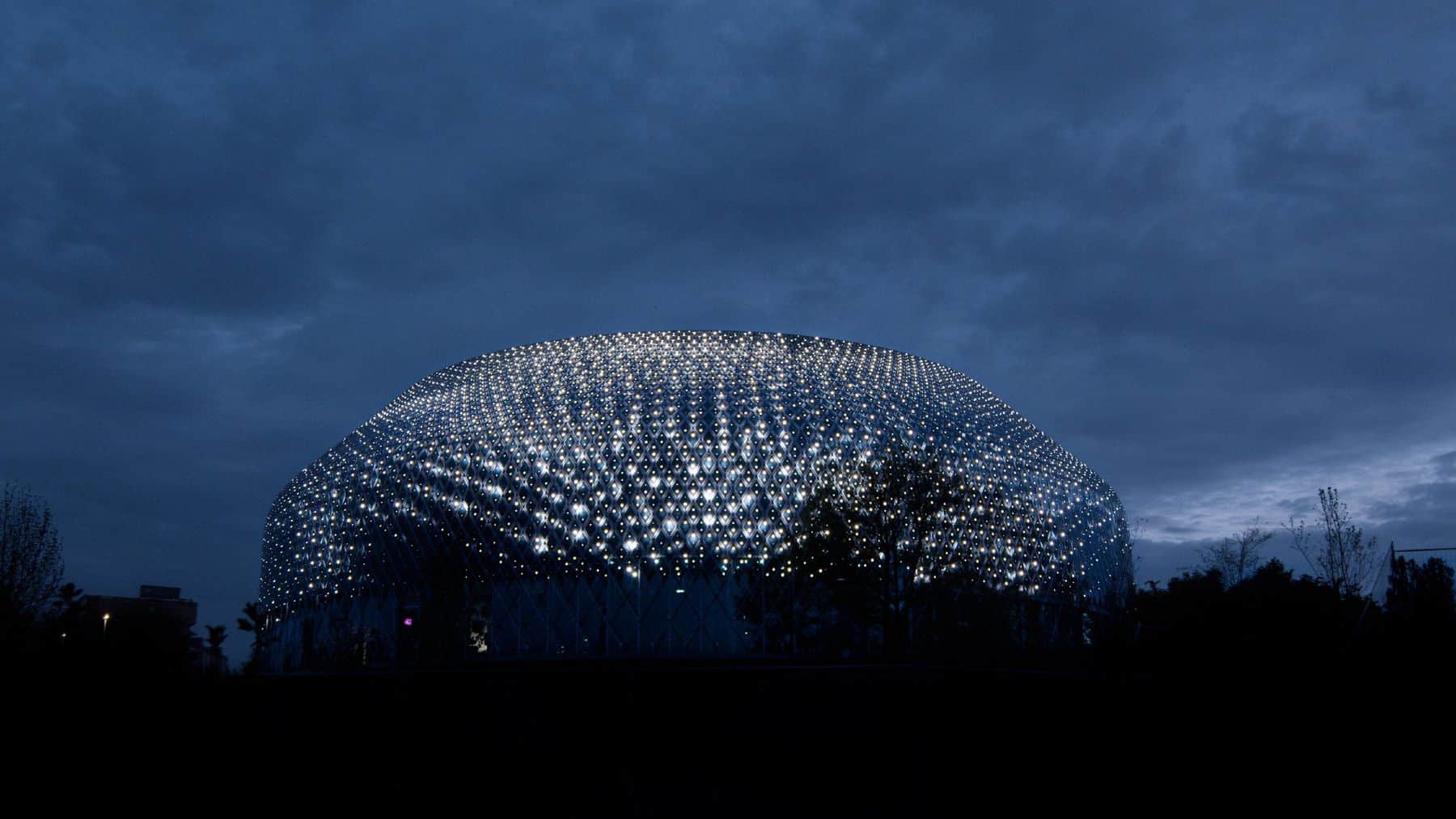
A new innovative display has been released by Italian studio AMDL Circle and interdisciplinary design studio iart. The new building design features an energy neutral energy facade wrapped around the entire building. Dubbed the Novartis Pavilion and located in Basel, Switzerland, the new infrastructure is a learning, event and exhibition space in Basel that explores “the big questions around healthcare.”
Innovation by AMDL Circle and iart
AMDL Circle is founded by famous Italian architect and designer Andrea Morgante. The design studio has been involved in numerous projects across multiple interdisciplinary fields such as architecture, exhibitors, space interiors, urban planning, and product design. Their designs are human-centered and focus on ways to enhance the lived human experience within space and place. They are known for their holistic approach to design.
iart is an interactive studio based Switzerland, the home of the new Novartis Pavilion. iart is known for their immersive installations and digital art, specifically with regards to their use of futuristic technology within their work. Dubbing themselves a “studio for media architects,” they “creates spaces for astonishing encounters between people and technology” according to their official website.
New installation to highlight the potential of facades
The new Novartis Pavilion was designed by AMDL Circle with the exterior wrap-around media facade created by iart. The collaborative project between the two has produced a facade which features 10,000 solar modules with 30,000 embedded LEDs. This striking exterior has the added addition of only consuming only as much power as it is capable of produce.
“With this project we want to show that a media facade not only consumes electricity, but can also generate it itself,” iart founder Valentin Spiess told Dezeen.
To make the solar modules, iart opted for organic solar modules as opposed to the standard silicone modules seen in solar and photovoltaic technology. This is because, in keeping with the renewable and sustainability theme of the project, organic modules have a much lower carbon-footprint than their silicone counterparts. As an innovative medical solutions company, Novartis wanted their pavilion design to align with their core values and principals which encompass sustainability.
“They require less grey energy in production and need little light to start generating electricity,” said Spiess. “They can be used in areas where light conditions are not ideal, such as a facade…the aim is for curiosity and fascination to arise in the viewer; for the medium, for the content and for the subject of life sciences.”
Solar power continues to soar
Solar power has continued to be an advancing technology which holds significant potential in multiple different industries. Solar energy is one of the most abundant natural resources on Earth, and holds the largest share in term of renewable energy sources currently being utilized. If we possessed the technology to capture the full range of the sun’s energy, an hour and a half of the sun’s rays would produce enough energy to power the entire world for an entire year.
Solar panels were some of the first renewable energy technologies to gain momentum, and they continue to be rise in terms of their technological capabilities. Solar panels are not just limited to powering a private home, but large solar farms are also used to provide energy to national grids. Currently, the world’s largest solar farm is the The Talatan Solar Power Station in China. The farm has a total capacity of 8,430 megawatts.
Solar energy is the sole energy provider for the International Space Station. This has pushed the advancement of solar power technology, as the solar panel designs used in space are very different to the ones used in practical application on our home planet.