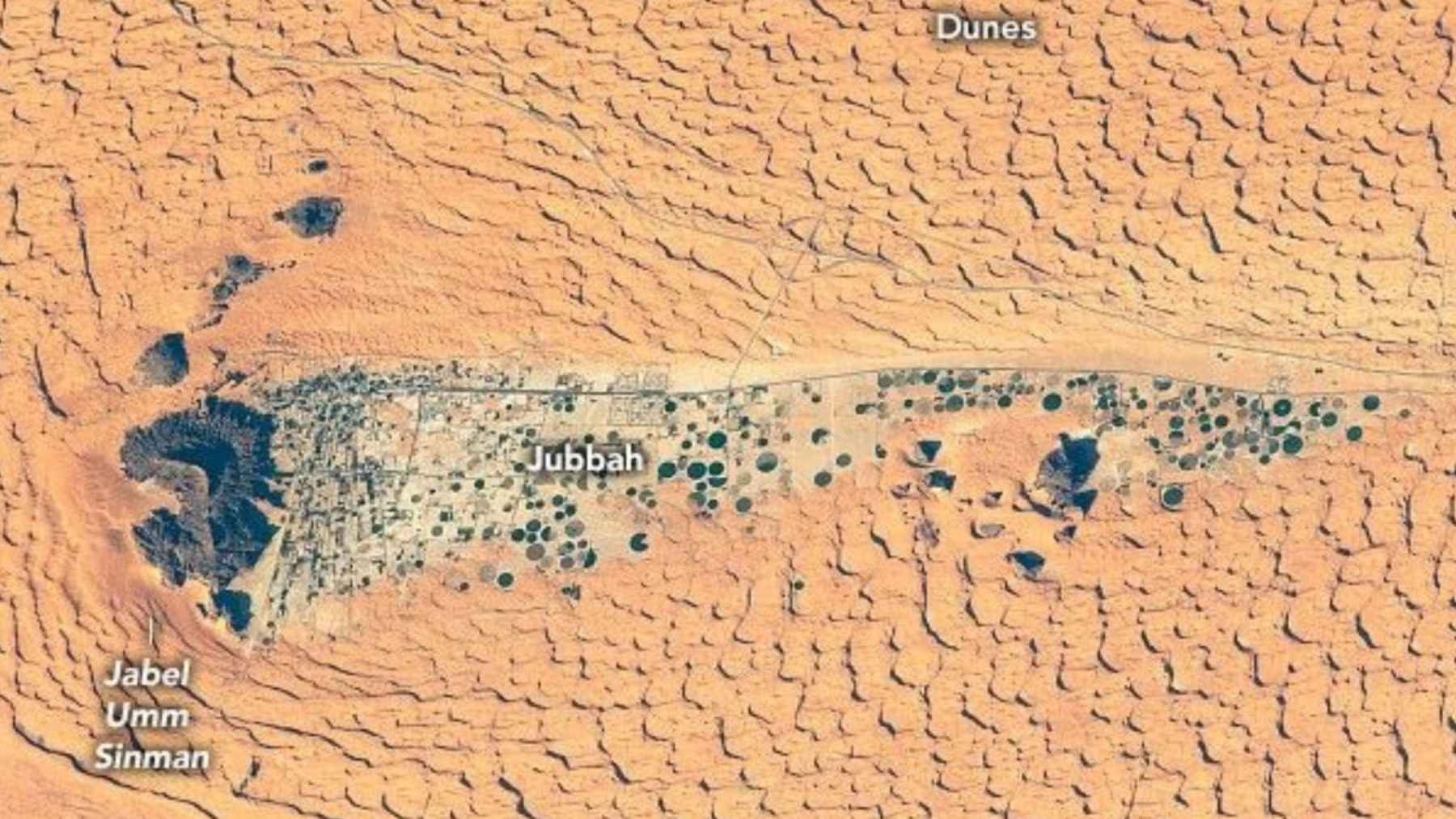
From orbit, the northern desert of Saudi Arabia looks like an endless sheet of orange dunes. Yet in a new image released by NASA, a chain of bright green circles suddenly breaks that monotony, marking the oasis town of Jubbah. The pattern is so geometric that it almost resembles a giant crop art project, but it actually tells a story about ancient lakes, modern farming, and the future of water in arid lands.
Jubbah oasis and the ancient lake beneath the dunes
So what are those circles doing in the middle of the dunes? According to NASA’s Earth Observatory, Jubbah sits inside the basin of a long-vanished lake in the heart of the Nafud Desert, about 650 kilometers northwest of Riyadh. Today the former lakebed lies hundreds of feet lower than the surrounding sand sea and stretches roughly 20 kilometers in length, creating a natural depression where water once pooled in a greener Arabian climate.
At the western edge of this basin rises Jabal Umm Sinman, a dark, rocky massif whose twin humps resemble a resting camel. Its bulk disrupts the prevailing westerly winds and casts what NASA calls a protective “wind shadow” that keeps migrating dunes from smothering the oasis. That simple bit of desert topography is one reason farming there has survived for generations while other lakes in the region dried out and disappeared.
Center pivot irrigation and the green circles seen from space
The circles themselves come from center pivot irrigation, a system where a long sprinkler arm slowly rotates around a central well. Seen from space, each irrigated field appears as a nearly perfect disk, often close to one kilometer across.
The wells tap deep aquifers filled with so called fossil water that seeped underground during wetter periods tens of thousands of years ago. Hydrologists working with NASA describe this groundwater as effectively non-renewable under today’s climate and estimate that pumping it will only remain economical for a few decades.
Fossil groundwater and the limits of desert agriculture
Why should anyone outside this remote town care how the fields are shaped? Because Jubbah is a vivid example of how technology can squeeze crops from extreme landscapes while quietly drawing down very old water. Similar circular farms now dot other parts of Saudi Arabia, turning hidden aquifers into wheat, fodder, and fruit for regional markets and eventually into higher demand on a limited resource.
UNESCO rock art and the deeper history of Jabal Umm Sinman
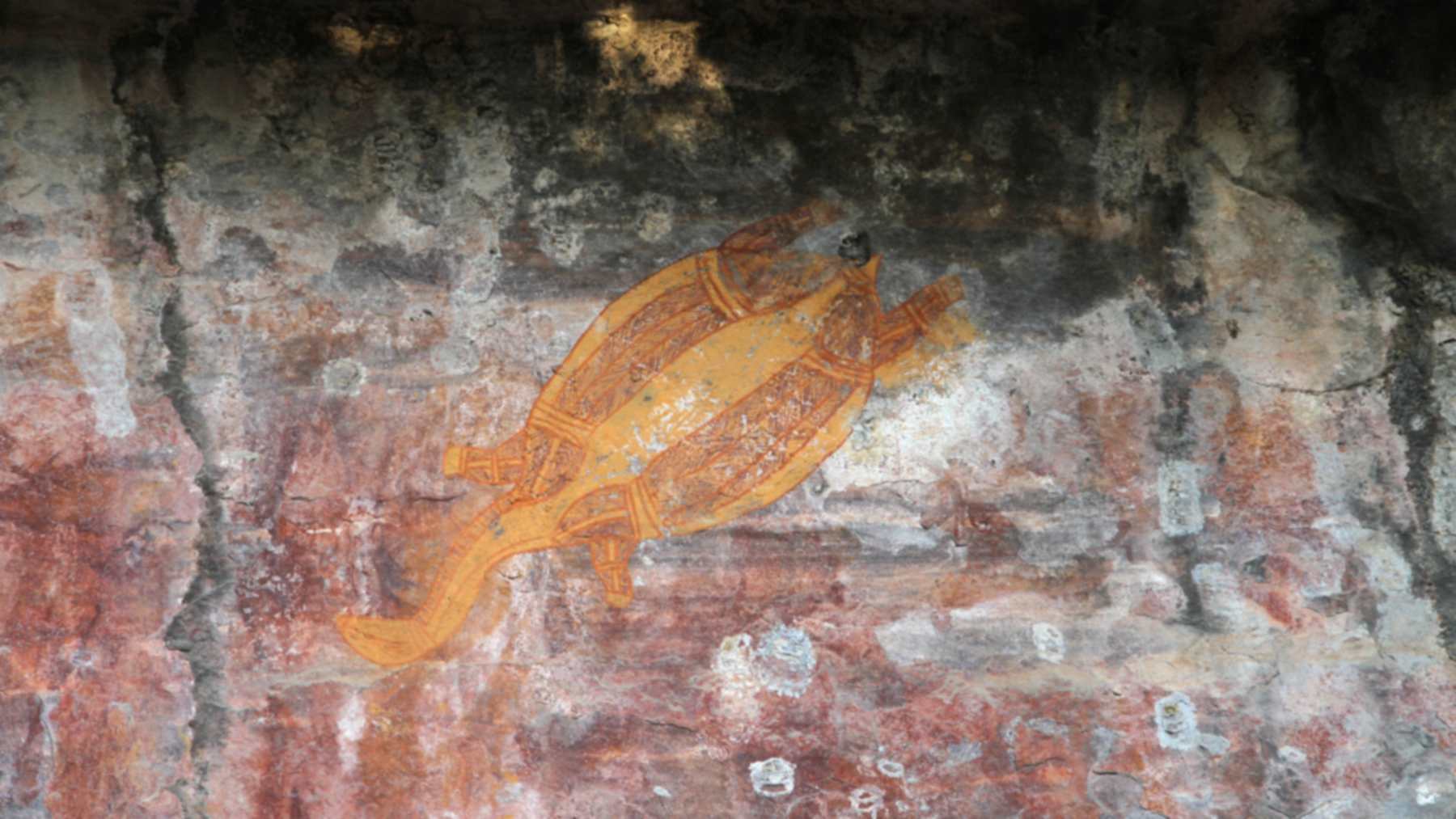
There is a deeper time scale here too. The rocky flanks of Jabal Umm Sinman hold at least 5,500 inscriptions and 2,000 animal carvings, including camels, ibex, and leashed dogs, part of a UNESCO World Heritage Site that records human life in a much wetter “Green Arabia.” The same basin that once drew prehistoric travelers now anchors a high-tech farming hub that you can spot from your laptop screen.
In practical terms, the image is a reminder that every bright green circle in the sand rests on a finite underground savings account. Remote sensing makes those withdrawals visible, field by field, at a moment when many dry regions are wrestling with how to balance food security and long-term water security.
The official statement was published on the NASA Earth Observatory site.