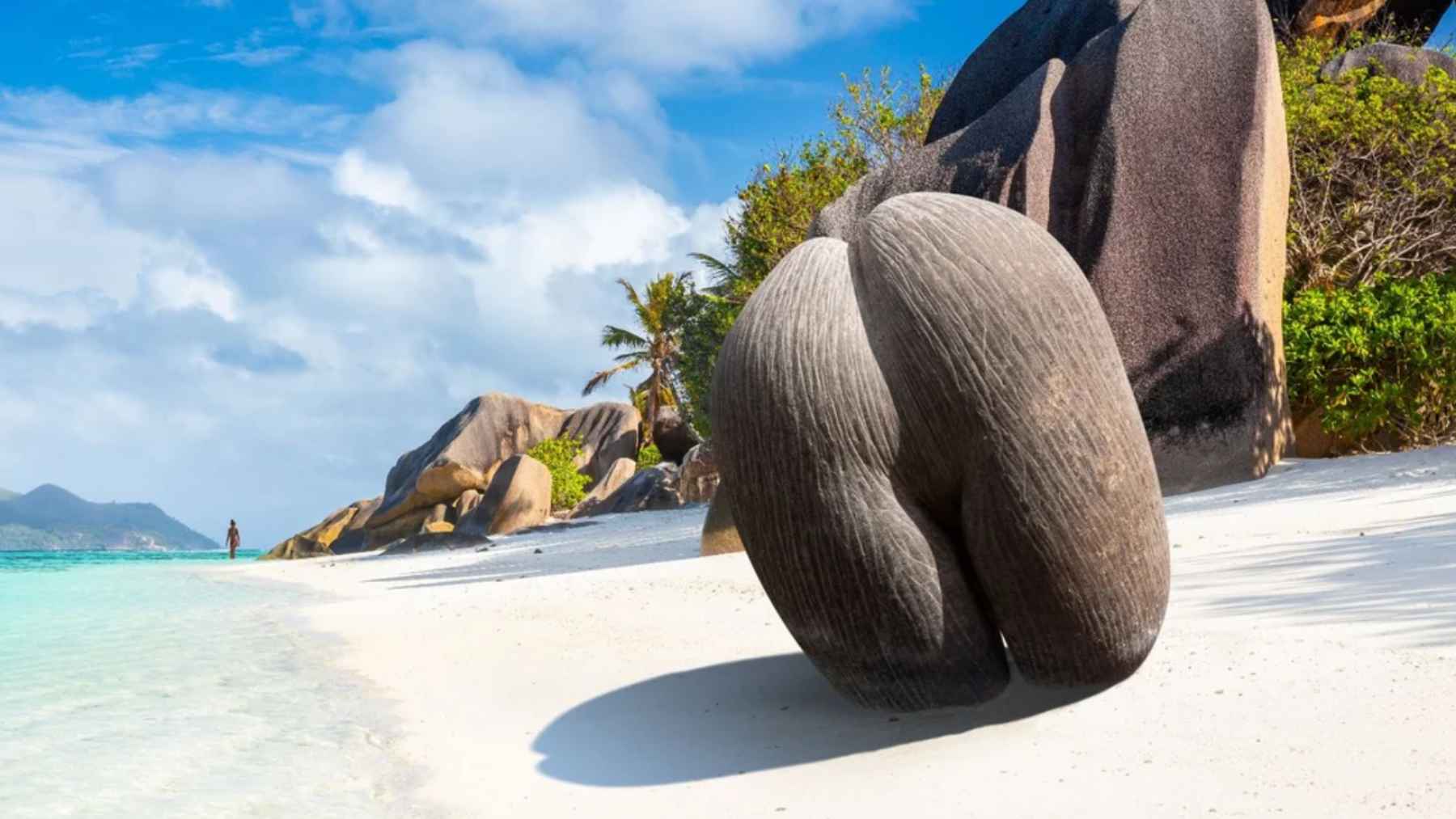
Weighing up to 66 pounds and measuring nearly 20 inches, the Seychelles sea coconut is the largest seed on the planet

Image Autor
Published On: February 23, 2026 at 7:04 PM
Follow Us
Seychelles sea coconut (coco de mer) seed on a beach, the world’s largest seed at up to 66 pounds and nearly 20 inches wide

Scientists are piecing together how this palm, called the coco de mer, manages such an extreme feat on poor soil. New research suggests the tree has turned its leaves into a rain-harvesting system that feeds the parent and its young.

The giant seed of the coco de mer

The coco de mer comes from a rare palm that grows naturally only in the Seychelles, where its seeds can reach about half a meter wide. Most of us are used to pumpkin or sunflower seeds, so how do you picture one this size? In a recent BBC Wildlife report, the seeds were described as the biggest on the planet.

A seed is the plant’s starter kit, storing food and genetic instructions for the next generation. Here the starter pack is supersized, giving the young palm energy to push roots into rocky ground and survive years in the shade beneath its parent.

A palm that funnels rain like a gutter

Ecologist Christopher Kaiser-Bunbury at the Technical University of Darmstadt found that coco de mer leaves act like gutters that catch rainfall and channel it down the trunk, like rain running off a roof. As the water flows, it sweeps up fallen pollen, animal droppings, and other debris rich in phosphorus, an important plant nutrient.

This mix soaks into the soil at the base of the tree, right where the giant seeds land and germinate. Scientists describe this as a kind of “parental care,” since the palm effectively fertilizes the nursery under its own crown.

Why evolution favors such huge seeds

On isolated islands without many large animals, seeds do not travel far and end up sprouting close together. Studies of island plants suggest that species in these conditions tend to evolve larger seeds that fuel sturdier seedlings.

Big seeds are expensive to produce, so each tree makes fewer of them, but each one has a better chance of surviving tough competition and poor soil. Seen together, the new findings suggest the coco de mer’s seeds are not a botanical oddity but a survival strategy for island life.

The main study has been published on the journal New Phytologist.

Image Autor

Kevin Montien

Social communicator and journalist with extensive experience in creating and editing digital content for high-impact media outlets. He stands out for his ability to write news articles, cover international events and his multicultural vision, reinforced by his English language training (B2 level) obtained in Australia.

Related news

Construction concept rendering of Panama City’s proposed Canal Underline pedestrian and bicycle tunnel beneath the Panama Canal

The pedestrian and bicycle tunnel under the Panama Canal, which was on the verge of being approved in March 2026, is still on the table and promises something that once seemed almost impossible: crossing one of the main barriers to global trade on foot, without cars, without traffic jams, and without relying on bridges

April 9, 2026 at 10:28 AM
Bird singing on a tree near a home during daytime linked to environmental health and mental well-being

If you hear birds singing in your home during the day, it’s not just background noise: science believes something very good might be happening around you… and inside you

April 8, 2026 at 6:30 PM
Chicago Archaeopteryx fossil specimen showing preserved bones, feathers, and wing structure in limestone slab

An Archaeopteryx fossil dating back some 150 million years, hidden away for decades and reanalyzed using CT scans and ultraviolet light, has finally revealed a detail that could settle a scientific debate that has raged for more than 160 years over how bird flight began

April 8, 2026 at 5:09 AM
Preserved squid specimen identified as Mobydickia poseidonii, a new squid family discovered from a sperm whale stomach sample

It all began with a strange, squid-like mass found in the stomach of a sperm whale in 1955 and 1956, and decades later, scientists discovered that it was something far stranger than anyone could have imagined

April 6, 2026 at 3:19 AM
For years, no one knew what those strange clay “chimneys” protruding from the ground in the Amazon were for, until a study published on February 23, 2026, came up with an answer that was as simple as it was brilliant

For years, no one knew what those strange clay “chimneys” protruding from the ground in the Amazon were for, until a study published on February 23, 2026, came up with an answer that was as simple as it was brilliant

April 5, 2026 at 1:54 PM
Green vegetation belt along the edge of the Taklamakan Desert showing reforestation efforts in arid northwest China

China is transforming the Takla Makan Desert, which at 337,000 km² is almost the size of Poland, into a “lung in the sand”: the 66 billion trees planted since 1978 have increased vegetation, multiplied rainfall during the wet season by 2.5 times, and even reduced local CO2 levels from 416 to 413 ppm

April 3, 2026 at 6:30 AM

Leave a Comment