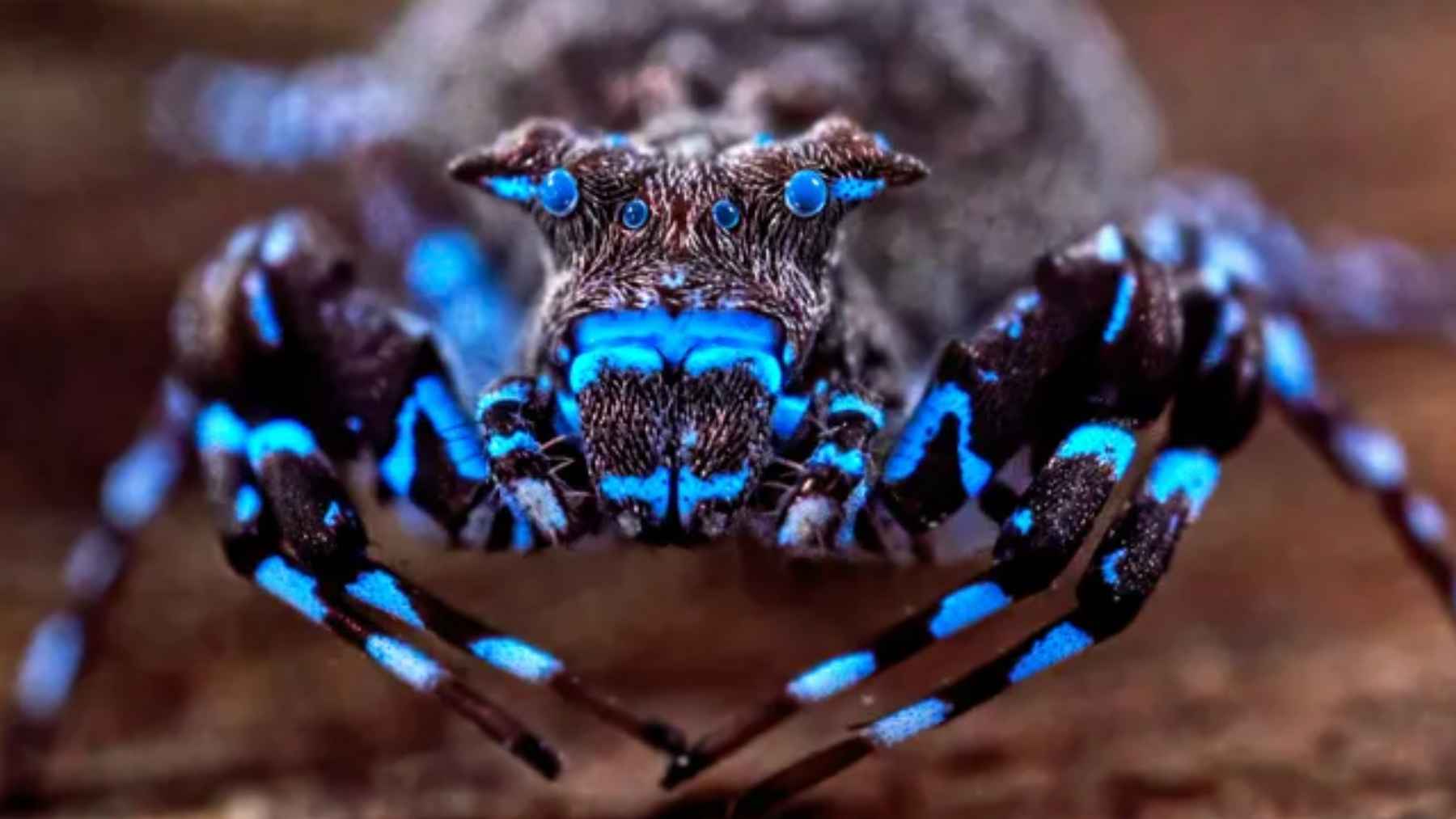
A bright blue glow under ultraviolet light has become the unforgettable image of a major biodiversity survey in Angola’s remote Lisima Plateau. During a February 2026 expedition, researchers documented dozens of animals that appear to be new to science, including dragonflies, grasshoppers, moths, butterflies, and a crowned crab spider with a mysterious blue shine.
The discovery is not just a strange wildlife story. It is a reminder that some of Earth’s most important places are still poorly known, even when they help feed major river systems and support communities far beyond the forest edge. In simple terms, “new to science” means a species has not yet been formally described and named by researchers, even if people living nearby may have seen it before.
A blue glow
The most eye-catching find was an undescribed crowned crab spider that glows blue when exposed to ultraviolet light. Fluorescence works like a hidden color switch, where a body absorbs invisible ultraviolet light and sends some of it back out as visible light.
Why does this spider do it? For now, scientists do not know. It could be linked to camouflage, communication, or something else entirely, but the responsible answer is that the reason remains unclear.
The team also found a ladybird orb-web spider that may be new to science. Its bright orange-red look appears to mimic toxic ladybirds, a clever warning sign that could help keep hungry predators away.
Tiny lives, big numbers
The Cassai Life Atlas survey recorded 103 species of dragonflies and damselflies. Of those, 34 had not previously been recorded in the Lisima region, six were added to Angola’s national list, and eight undescribed species are now being formally described.
The numbers for insects were just as striking. Researchers recorded 47 grasshopper, katydid, and cricket groups, including three believed to be new to science. They also collected more than 1,000 butterflies and moths, with early estimates suggesting that up to 6 percent of the recorded moth species could be new to science.
That may sound like a bug collector’s dream, but it matters far beyond a display case. Insects pollinate plants, feed birds and frogs, recycle nutrients, and help keep ecosystems running. Take them away, and the whole system starts to wobble.
Why Lisima stayed hidden
The Lisima Plateau has remained one of Africa’s great biodiversity blind spots for reasons that have little to do with science and a lot to do with history. Decades of civil war, persistent landmines, extreme remoteness, and difficult terrain kept large parts of the area beyond the reach of researchers.
Rob Taylor, the expedition lead and conservation ecologist, described the work as “extremely difficult.” According to the expedition account, vehicles got stuck in mud, mechanical failures slowed the convoy, and several team members dealt with malaria.
Still, delays did not mean wasted time. When the convoy stopped, scientists studied nearby dambos, which are seasonally flooded grasslands, along with swamp forests and wetlands. In the field, a breakdown can become an unplanned research stop.
Why this plateau matters
Lisima is not just a remote patch of land with rare insects. Its waters help feed the headwaters of four major African river systems, the Congo, the Okavango, the Zambezi, and the Cuanza. Those waters support ecosystems and people thousands of miles downstream, including the Okavango Delta.
The February expedition included 16 African and international specialists, with support from Fundação Lisima and The HALO Trust. It also builds on earlier work by the National Geographic Okavango Wilderness Project in the Okavango and Lungwevungu headwaters, where more than 70 species have already been confirmed as new to science.
Dr. Klaas-Douwe B. Dijkstra of Naturalis Biodiversity Center linked the region’s clean, reliable freshwater to its unusual dragonfly life. Dr. Piotr Naskrecki of the E.O. Wilson Biodiversity Laboratory at Gorongosa also noted that many animals appeared in low numbers, yet the variety of unusual insects was remarkable.
The clock is moving
For now, isolation has protected much of Lisima. That protection is fragile. As roads expand and minefields are cleared, places that were once hard to reach can quickly become vulnerable to logging, diamond mining, settlement expansion, and slash-and-burn farming.
That’s where the survey becomes more than a list of cool creatures. A biodiversity survey creates a baseline, which is a starting point for knowing what lives in a place before major change arrives. Without that baseline, species can disappear before anyone knows they existed.
The bigger picture is sobering. A United Nations-backed global assessment found that around one million animal and plant species are threatened with extinction, many within decades. Against that backdrop, every overlooked wetland, forest, and grassland becomes a little more urgent.
What happens next
The work is not finished. Beetles, spiders, scorpions, and other specimens still need laboratory study, and formal descriptions can take months or years. That slow process is normal because scientists must compare bodies, patterns, habitats, and sometimes DNA before naming a species.
Taylor has said the most important result is that the area is no longer a blank spot. That is a simple sentence, but it carries weight. Once a place is mapped in biological terms, protecting it becomes harder to ignore.
At the end of the day, the glowing blue spider is the hook, not the whole story. The deeper discovery is a living landscape full of specialized creatures, clean water, and unanswered questions.
The official press release has been published by The Wilderness Project.