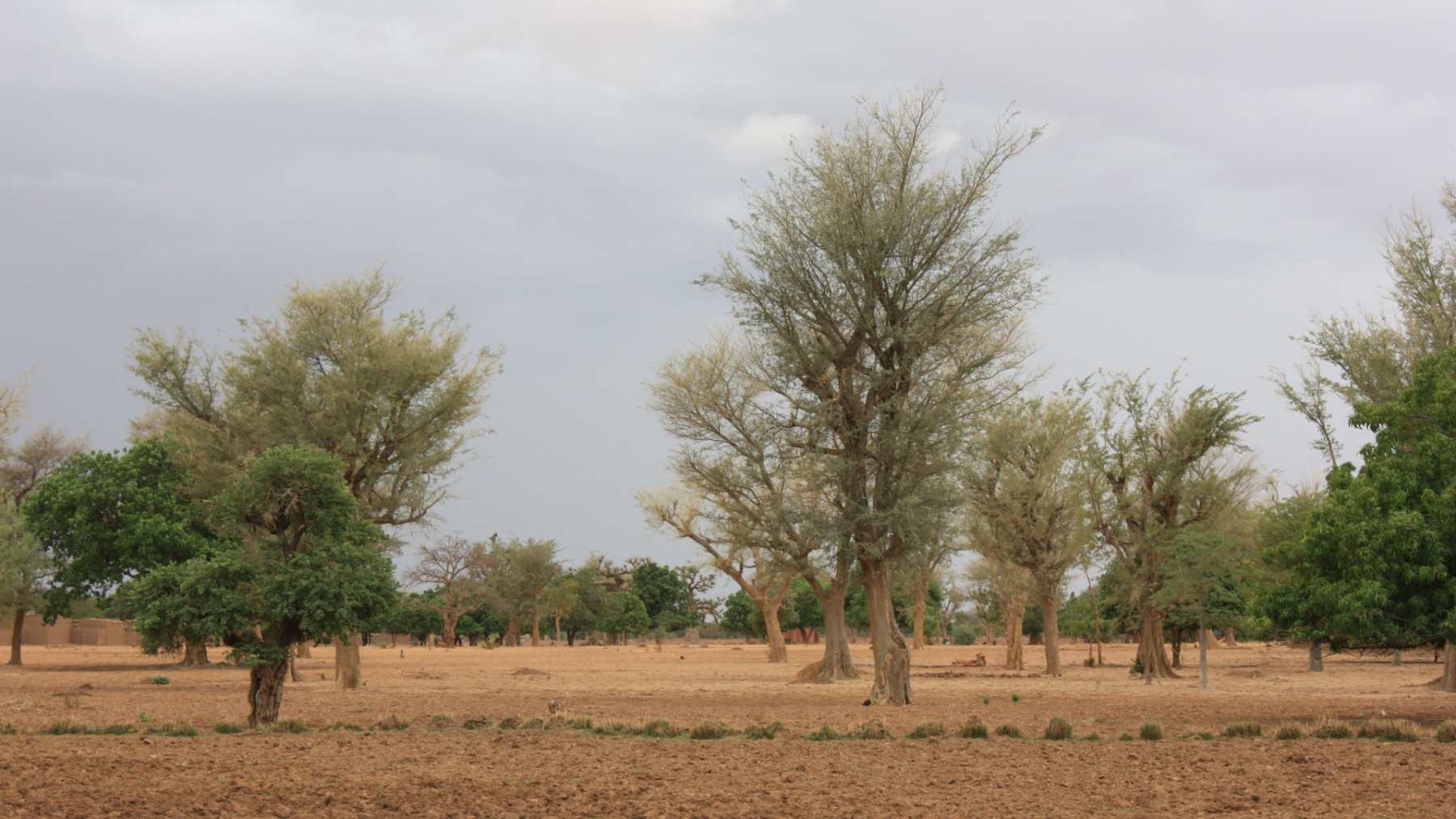
Planting a green barrier across the Sahel sounds straightforward until the first dry season arrives. In Australian agronomist Tony Rinaudo’s early work in Niger, many nursery seedlings failed, yet small shoots kept appearing in farmers’ fields. Beneath them, the roots of cut trees were still alive.
That observation helped spread farmer-managed natural regeneration, or FMNR, decades before the African Union launched its Great Green Wall in 2007. Niger’s farmers showed how living stumps could help restore cropland, an example that fits the initiative’s broader approach today. The often-cited figures for Niger describe work led by farmers over many years, rather than a tally of trees planted by the Great Green Wall.
From a line of trees to a patchwork of land
The original plan called for a green belt stretching roughly 8,000 kilometers (about 5,000 miles) across the Sahel, the dry region south of the Sahara. It promised to curb land degradation while improving life for people who farm and raise livestock there. But fields, grazing areas and depleted soils called for different kinds of care.
Today, the African Union describes the Great Green Wall as an effort to restore land and support communities. The United Nations Environment Programme says the plan has shifted from a literal wall of trees to a mosaic of productive landscapes shaped by local conditions. In some places that means planting; in others, it means protecting vegetation already trying to return.
The shrub that was really a tree
Rinaudo came to Niger in 1981 and initially tried to raise and plant young trees with villagers. He later described how few of those seedlings survived the heat, wind and grazing animals. In 1983, while looking across a field, he noticed what seemed to be an ordinary shrub.
It was a shoot from a cut tree whose stump and root system remained alive. “In that instant, everything changed,” Rinaudo recalled in a field manual published by World Vision. He promoted regeneration with farmers, building on local practices, and received the Right Livelihood Award for his work in 2018.
With FMNR, farmers choose useful trees and keep the strongest shoots from living stumps or roots; they can also manage trees that sprout naturally from seeds. They prune competing stems and protect new growth from livestock, fire and repeated cutting. An established root system can give a shoot a head start, though someone must keep tending it.
What Niger’s tree numbers tell us
Using aerial photographs, satellite images and field evidence, researchers Chris Reij, Gray Tappan and Melinda Smale estimated in 2009 that regeneration had spread across about 5 million hectares of southern Niger. Their widely repeated figure of about 200 million additional trees came from applying an estimated increase of 40 trees per hectare across that area, rather than counting individual trees. In a later study, the researchers estimated that FMNR affected about 7 million hectares by 2017.
The change can be felt outside a satellite image. In a 2006 field study, women in the village of Damaga estimated that gathering firewood took half an hour a day, down from at least two and a half hours before. That is a local account, rather than a measured average for all of Niger.
More trees can supply fuelwood and fodder, soften wind and help protect soil. Their effect on harvests varies with tree species, density and local conditions; a scientific review noted that one study in Niger found no statistically significant increase in cereal grain yields. The evidence gives reason to value regrowth without promising the same result in every field.
Why the rules mattered
The technique also depended on village life above ground. When Rinaudo arrived, forest rules gave the state authority over trees and required permits to harvest them, even on farmland. Farmers had more reason to protect shoots when they could benefit from the shade, firewood, fruit and livestock feed those trees might provide.
Niger’s rules evolved alongside farmers’ efforts. A 2020 decree specifically regulated assisted natural regeneration and clarified producers’ rights to manage and benefit from trees maintained on their fields, within rules that also address other land users. Keeping a tree made more sense when its caretaker could share in what it produced.
A green wall still has limits
FMNR needs living roots, stumps or a source of seeds. Other restoration methods matter where those are scarce, including zaï pits and crescent-shaped basins that catch rainwater. In Niger, projects associated with the Great Green Wall use such methods alongside protection for naturally returning vegetation.
The initiative’s overall progress is also difficult to measure. A 2026 United Nations review reported 1.66 million hectares under restoration from fewer than 90 projects with comparable data among 389 listed at the end of 2025, while warning that reporting and national validation remained incomplete. That partial count is not a total for the Great Green Wall, whose target remains 100 million hectares restored by 2030.
For Niger’s farmers, the lesson began with noticing that a cut tree was still trying to grow. The official five-year review of the Great Green Wall Accelerator was published on the UNCCD website.