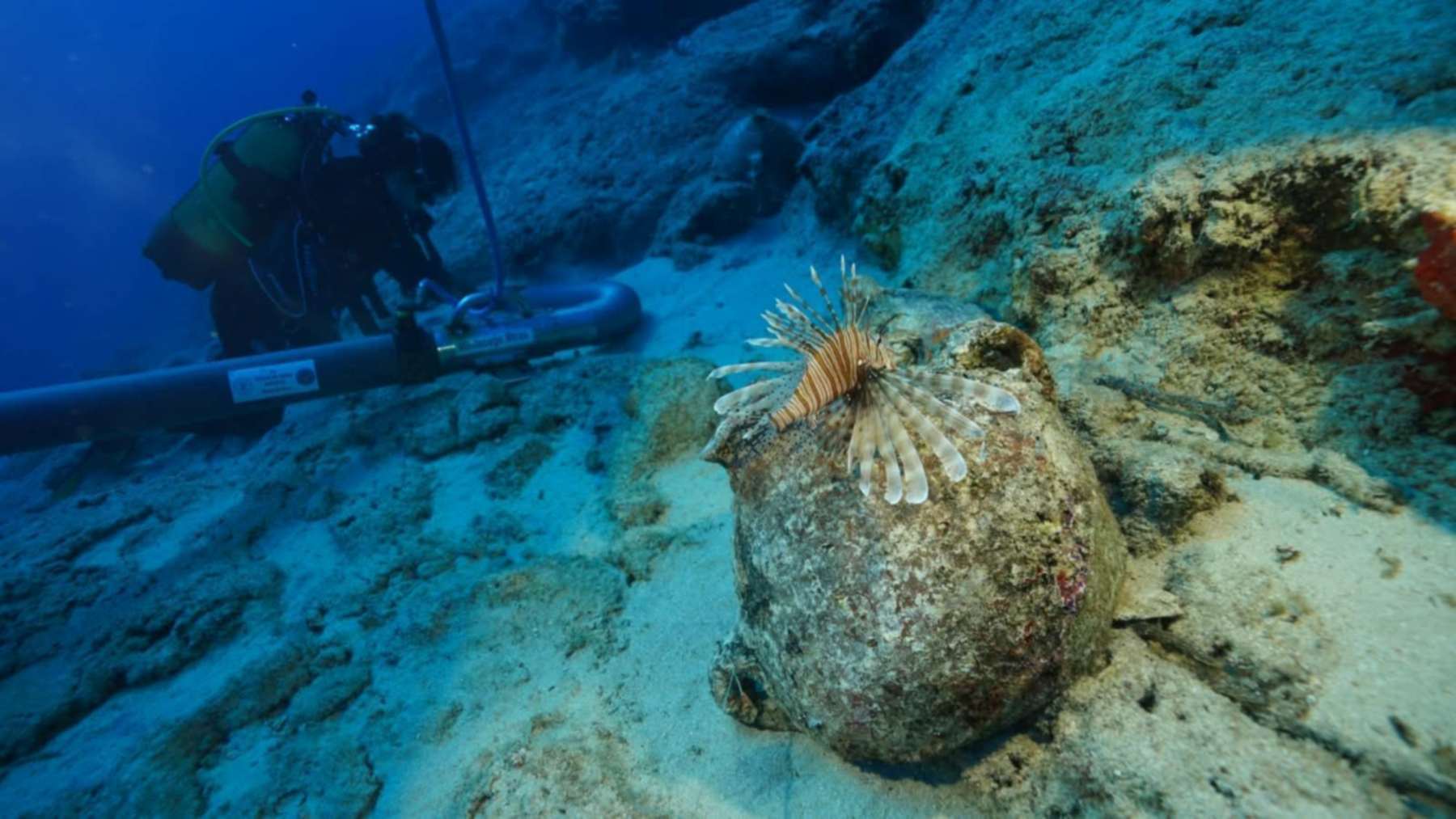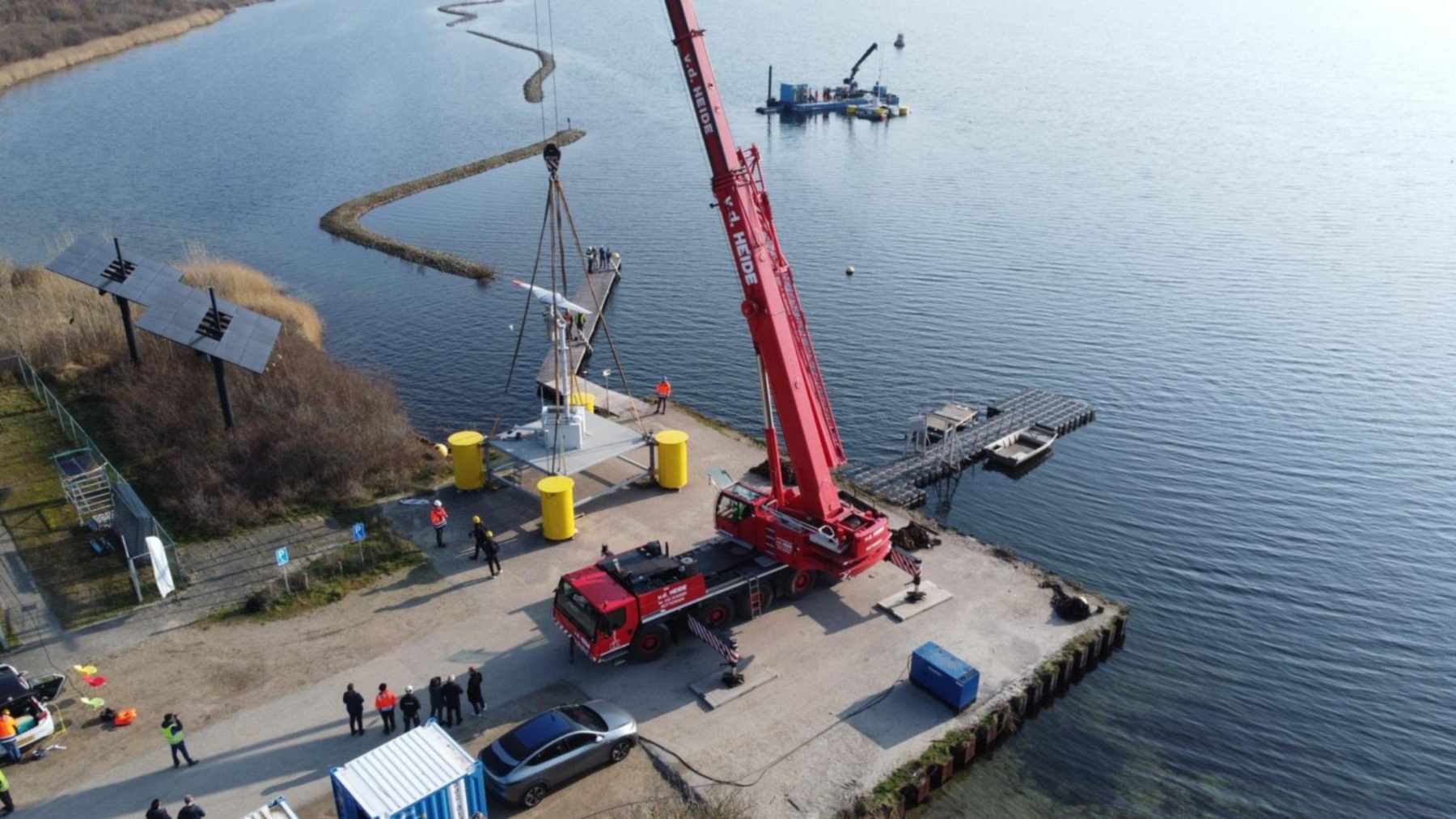
“A diver. Mooring lines. Precision under water.” That is how TouchWind, a small wind company from Eindhoven, opened its post about the day its floating wind turbine went into a lake near Oostvoorne, in the Dutch province of South Holland.
A crane from Peinemann lifted the turbine into the water, and a professional diving team hooked its mooring lines to anchors on the lakebed. The company announced the installation on May 28, 2026.
TouchWind calls the test machine “a 6 m rotor, ~12 kW prototype,” so the rotor is about 20 feet across. The lake trial is meant to show how turbines with tilted rotors “can deflect wakes and draw higher-energy wind from upper air layers,” which could let wind farms put turbines closer together.
A test site and a long project name
The turbine sits at Fieldlab Green Economy Westvoorne, which TouchWind describes as “a facility that supports the testing and demonstration of innovative sustainable technologies.”
It is part of a program called POWER, for “POsitive Wake Effects of turbines with tilted Rotors.” The partners are TouchWind, the Japanese shipping company Mitsui O.S.K. Lines (MOL), the research organization TNO, the Maritime Research Institute Netherlands (MARIN), motor maker Nidec and blade specialist We4Ce. The Netherlands Enterprise Agency (RVO) pays part of the bill.
Rikus van de Klippe, TouchWind’s founder and CEO, was upbeat when the project began in 2023. “It is wonderful that we can start this project with ten wind turbines with tilted rotors together with our consortium partners who all have their own expertise on specific areas of this research & demonstration program,” he said in the consortium’s announcement.
How the helicopter mode works
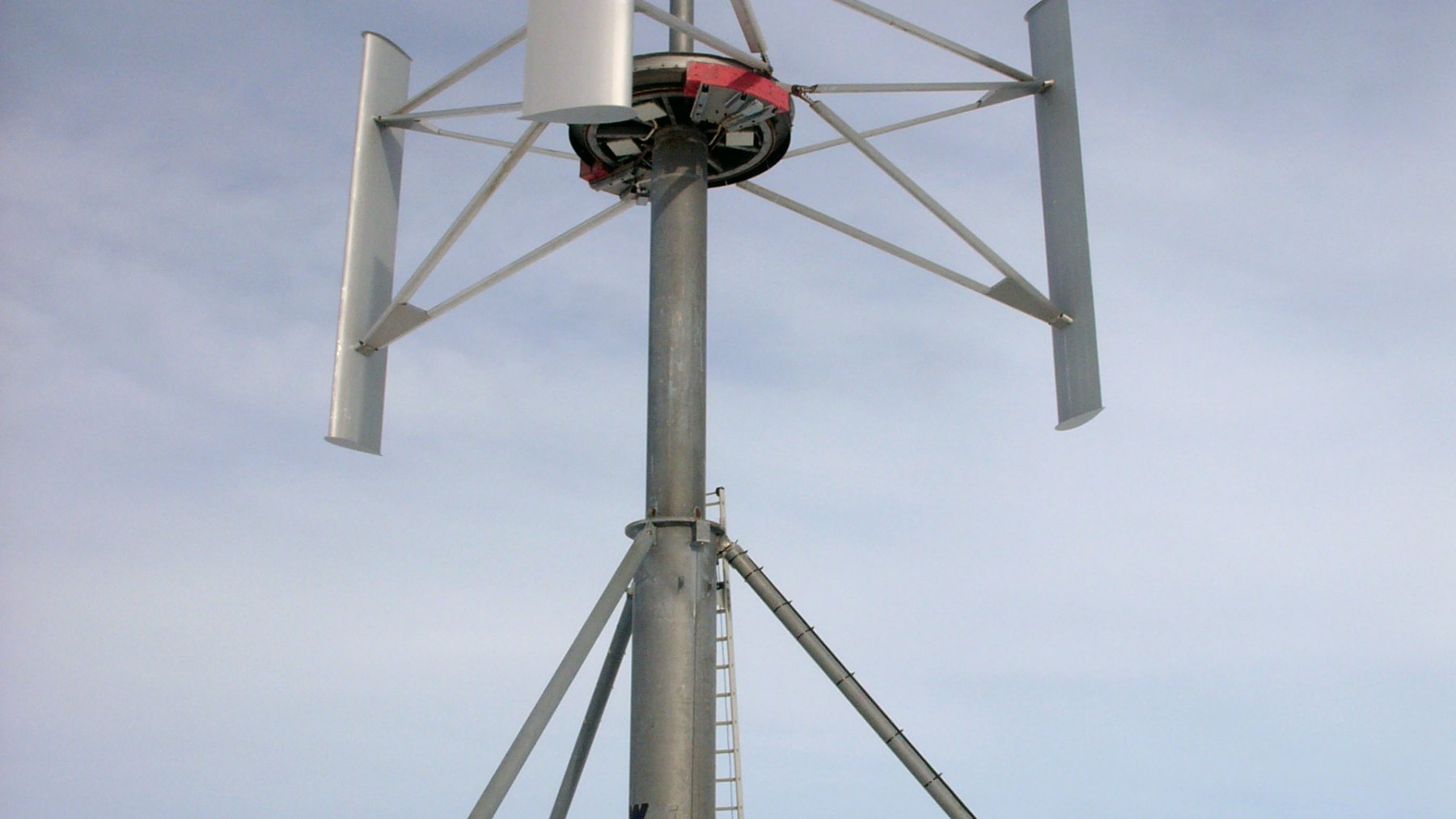
Most big turbines control power with pitch, meaning each blade rotates on a bearing to take more or less wind. TouchWind gets rid of that. Its rotor is one piece, it sits downwind of the tower, and it tilts.
“As wind speeds increase, the rotor tilts, reducing loads instead of increasing them,” the company says on its technology page. Skipping pitch hardware is meant to cut “the number of critical components to increase reliability, robustness and decrease costs.”
Arne van de Mortel, who is now TouchWind’s chief technology officer, put it more simply in 2023, back when he was the company’s senior system engineer. “The entire rotor assembly tilts into the wind,” he said. He explained that it can go into “helicopter mode,” pointing straight up, or “tilt up to 60 degrees.”
Regular turbines normally stop producing in rough weather, he said, but the TouchWind Mono design “can operate in winds up to 70m/s.” That is about 157 miles per hour.
On May 21, 2026, the team posted that its POWER turbine in Oostvoorne was “now running fully autonomously” and that the rotor “smoothly tilts into ‘helicopter mode’ under high wind conditions.”
“Our tilt controller continuously monitors rotor torque (generator load) and adjusts the tilt angle using a proven PI control strategy,” the post said. PI stands for proportional-integral, a common type of feedback control. “By actively keeping the generator load below the overload threshold, the turbine remains operational even during heavy gusts, resulting in a highly robust system.”
Blades made for tilting
We4Ce designed and delivered ten blade sets for the test machines, called the TW6. In an April 8, 2025, post, TouchWind said the blade structure was shaped for the tilting rotor, “eliminating bonding lines in the nose to reduce erosion risk and extend blade life.”
The nose is the leading edge, the part that slams into rain and dust. The blades were made by vacuum infusion with epoxy resin and glass fiber, with help from mold specialist Kleizen.
“The TW6 campaign will give us the data we need to refine larger machines and prepare for demonstrators and, ultimately, commercial turbines,” the company wrote.
The wake is the real target
Any turbine leaves a wake, the messy air behind it. The POWER partners described that air in 2023 as having “reduced speed, thus lower energy content, and increased turbulence,” which hurts the next turbine downwind.
Wind farms reshape the air on a large scale, too. Researchers have watched lasers catch the wind slowing down before it reached a North Sea wind farm, and over one Danish offshore farm in 2008 spinning blades mixed layers of air enough to help form fog.
TouchWind’s pitch is that tilting changes where the wake goes. “Instead of expanding horizontally, the wake is deflected downward,” the company says. “As a result, turbines can be placed closer together, increasing energy output per unit area compared to conventional designs.”
There is a second idea as well. The partners want to check whether tilted rotors can “‘pull’ more wind from upper air layers into a wind farm and create a positive effect.” If both effects hold, they said, that “would allow for the development of wind farms with a significantly higher power density.”
Reefs, sensors and nine turbines on shore
Steel and polyester lines tie the floater to concrete deadweight anchors. Those anchors carry 3D-printed reefs from Coastruction, put there “to stimulate ecology in the lake.” Out at sea, turbine foundations already act as artificial reefs that pull in fish.
Load shackles in the mooring lines measure the forces while the turbine runs, and MARIN watched those numbers during installation so the lines got the right tension. California is backing a similar push to turn floating wind mooring lines into sensors that track structural strain.
A floating weather mast has been on site since April 2025. Nine more TouchWind turbines near the shore are set up for wake studies on land, and testing runs throughout 2026.
On June 11, the company added that the turbine “can be easily reached by small vessel” and “can be lowered when required, simplifying maintenance activities and reducing operational complexity compared to traditional offshore solutions.”
MARIN threw a 100-year storm at it
Before the lake, there was the basin. A MARIN report from April 2023 describes a model of the TouchWind Mono floater facing a once-in-100-years North Sea storm, with winds of 50 meters per second (about 112 miles per hour) and a significant wave height of 13 meters (about 43 feet).
Significant wave height is the average of the highest third of the waves. “The standard tests demonstrated that the floater was stable and actually much better than expected. Therefore, we decided to push on and test the rotor in more extreme weather events,” van de Mortel said.
He also gave the institute credit. “We had weekly meetings with Floor and the team. MARIN really helped us develop the concept even further by thinking along with us,” he said.
Floor Spaargaren, the MARIN project manager he meant, focused on conceptual designs at the time and is now a senior project manager for offshore work at the institute. “Originally, TouchWind designed a concept where the whole floater would be tilting, but we did some calculations and jointly decided on a new approach which led to this latest design,” she said. “It is really nice to be able to support them right from the early stage of the project.”
What a lake can’t prove
Scale is the obvious gap. The U.S. Department of Energy projects that the average hub height of U.S. offshore turbines will hit about 500 feet (150 meters) in 2035. This whole rotor is about 20 feet wide.
Van de Mortel’s 70m/s figure is a design claim for the TouchWind Mono, and the lake turbine has yet to face ocean swell or salt spray. The wake gains are still claims, since the partners haven’t published their measurements, and there is no peer-reviewed paper yet.
TouchWind has also changed course. “Today, our primary focus is accelerating the development and deployment of containerized mobile wind energy,” its website says, and floating wind “remains part of our long-term roadmap.” On its project page, the stated aim is to prepare “the first demonstration farm of full-scale turbines before 2030.”
The main source is TouchWind’s installation announcement, published May 28, 2026.
“During the testing programme which will run throughout 2026, the POWER project consortium will collect operational data on turbine performance, platform behaviour and mooring loads,” the announcement says.
Photo: TouchWind