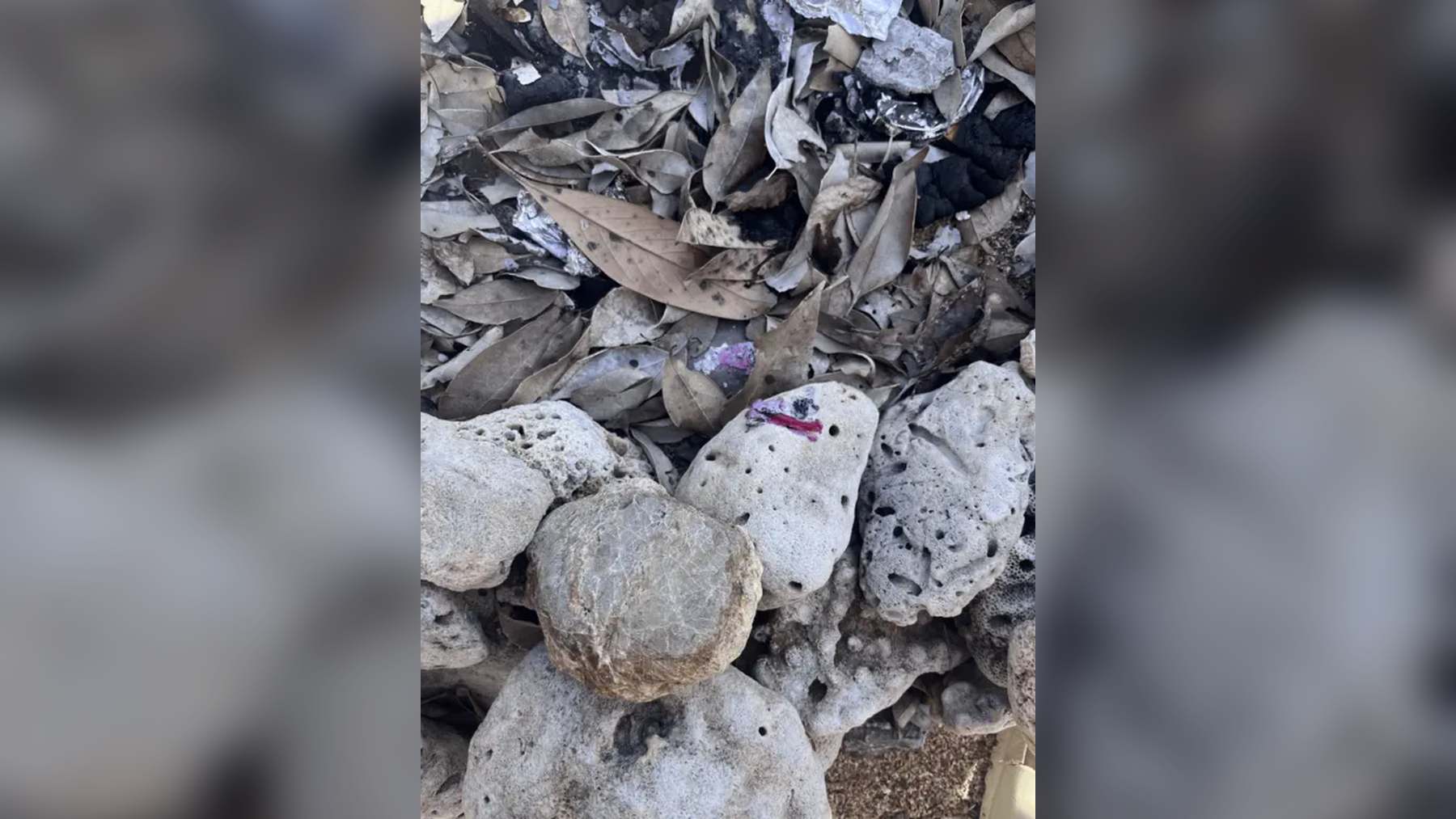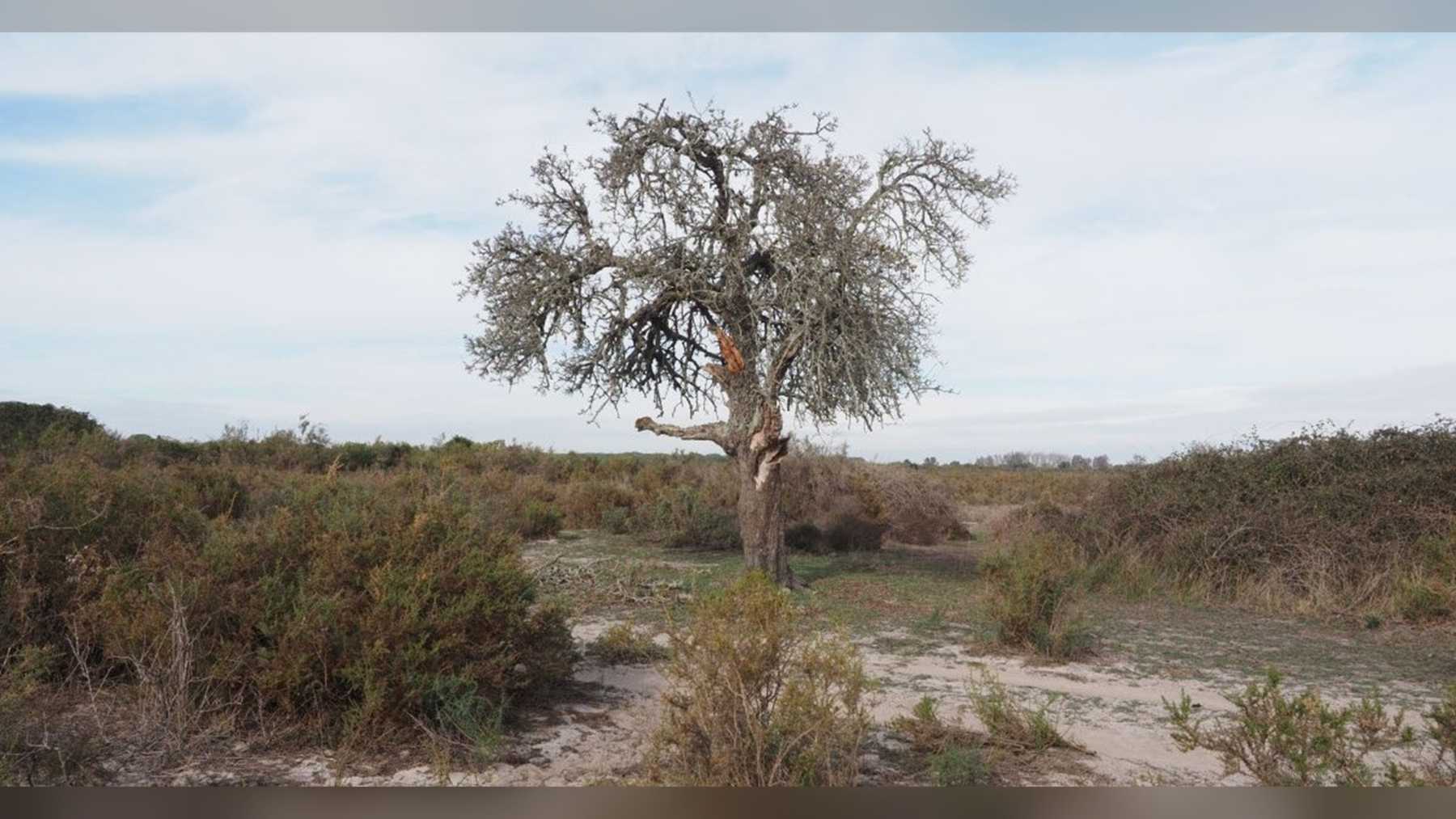
A lone piruétano, one of the Iberian pear trees of Doñana’s Biological Reserve, stands gray and nearly leafless in the scrub, with a split in the trunk where a branch broke off. The photo went out with a June press release from the Doñana Biological Station and a short caption calling it a tree in poor condition. Station researchers say the deer and wild boar that feed in the reserve help explain why so few young pears are coming up behind trees like this one.
The piruétano, or Iberian pear (Pyrus bourgaeana), grows wild only on the Iberian Peninsula and in North Africa. At Matasgordas, a site in the heart of Doñana National Park in southwestern Spain, more than 60 percent of the adult trees died in about 20 years, and virtually none of the young ones reached the age where they bear fruit.
José María Fedriani, a researcher at the station, which belongs to Spain’s research council CSIC, led the study. It appeared in Biological Conservation under the title “Wild pears in peril: Does National Park protection ensure tree conservation?” Coauthors came from universities and institutes in Spain, Poland and Germany.
“Although national parks and other protected areas are normally established to preserve biodiversity, their management practices can inadvertently generate contrasting effects on different components of the ecosystem,” Fedriani said in a Spanish-language CSIC press release dated June 17. His remarks, like the other Spanish quotes in this story, are translated here.
Seedlings that die under the parent tree
The team tracked five pear populations for two decades, two inside the park, at Reserva and Matasgordas, and three outside. Seedlings numbered more than 350, and almost all came up directly beneath adult trees. Fewer than 12 percent survived.
Inside the park, animals eating them were the main cause of death, the release says. Outside the park, dry weather and plowing killed most.
Older saplings, about 2,540 of them, were browsed too. Browsing pressure ran 23 to 40 percent inside the park versus 14 to 27 percent outside, the same kind of pressure moose put on Newfoundland’s forests. Hinojos was the exception, an outside site where damage matched the protected stands.
Deer numbers at a 2005-2024 high
Deer and boar have lived in Doñana for hundreds of years. Their numbers inside the park climbed in recent decades, the release says, probably because predators such as the wolf declined or died out locally. Besides seedlings, they eat or destroy a large share of fallen fruit, “which drastically reduces the number of seeds available for dispersal.”
In October 2024 the station reported a 2023 deer index of 4.69 contacts per kilometer, against a 2004-2022 average of 2.74. It was the peak of a record going back to 2005, and Doñana has carried around 4,000 deer since 2014.
“In the 2005 drought, abundance dropped a lot, but since then the deer has recovered to slightly higher values than at the beginning of the series,” Luis Santamaría, who leads the station’s Spatial Ecology Group, said then.
Francisco Carro, who is responsible for monitoring deer populations at ICTS Doñana, the park’s scientific infrastructure, pointed to one estate north of El Rocío. “In this autumn’s censuses, this estate has recorded a significant increase in the abundance of deer. This is probably because the Coto del Rey has no livestock, so there is more pasture and the deer have less competition,” he said.
The station’s note said deer densities in Doñana are moderate compared with other areas of the peninsula, and Santamaría explained the trade-off. “Although there are no predators or hunting operations in Doñana, the environment is less productive, as the grazing areas represent only a fraction of the Park and the resources they offer are shared with livestock and other wild ungulate species. In addition, the absence of predators that can regulate the population increases the risk of the population growing beyond the carrying capacity of the vegetation, especially in years of drought, which can degrade ecosystems,” he said.
Badgers and foxes carry the seeds
Foxes and badgers eat the pears and spread the seeds. The new release says both have declined in parts of the area, so seeds don’t travel as far from the parent tree.
Fedriani has studied those animals before. In 2022, while working at the CIDE desertification research center in Valencia, he coauthored a study on how lynx change the way foxes feed on wild pears in the Sierra de Andújar. “The badger could balance out the loss of seeds dispersed by foxes inside lynx territories in areas where badger populations are at high densities, as happens in some parts of Doñana, where the piruétano is mainly dispersed by badgers,” he said in a CSIC release at the time.
Groundwater and dying trees
Adult deaths at Matasgordas lined up with a sharp drop in groundwater in the north of the park, “due to legal and illegal water extractions,” according to the release. Farm irrigation, tourist areas and housing all draw on the Doñana aquifer, and hotter summers and long droughts make it worse.
The pears aren’t the only trees in trouble. Ricardo Díaz-Delgado, a station researcher who has handled everything to do with the park’s landscape since 2002, described to the Spanish newspaper elDiario.es in March 2024 how old cork oaks were going down. “When it happens, it’s like a massive heart attack,” he said. “The decline is accelerating and multiplying.”
“In nature, questions don’t have simple answers,” Díaz-Delgado told the paper, though he considered that “the lack of water is the main suspect,” including “a drop in the aquifer due to lack of recharge.”
A CSIC review of more than 70 studies, released in February 2024, cited monitoring data showing that 8 percent of Doñana’s century-old cork oaks had died since 2009 and that many were losing leaf cover as the water table fell. “Since the 1970s, different scientific and technical voices have denounced, and continue to denounce, that uncontrolled groundwater extraction would have very serious consequences for Doñana,” said Carolina Guardiola Albert, a CSIC researcher at the Spanish Geological and Mining Institute (IGME-CSIC).
“It is impossible not to have the feeling that the water and land managers involved in this area at every level have not listened to these warnings, or, if they have listened, have not managed to take effective action,” she said.
Miguel Delibes, a station biologist and one of the new study’s coauthors, was chairing Doñana’s participation council when he spoke to the Spanish magazine La Marea in July 2022. “The conflict is that the same water is needed to grow crops and is necessary to conserve Doñana’s landscapes and biodiversity,” he said. “I often say that Doñana will always be in danger, and new threats will appear even if we put an end to the current ones. Half a century ago nobody was thinking about the aquifers, and what worried us was a road along the coast, for example.”
“These findings expose a conservation paradox: while National Park status prevents land-use conversion, it simultaneously allows high ungulate densities and remains vulnerable to regional groundwater overexploitation and prolonged drought,” the authors wrote. Ungulates are hoofed animals, in this case deer and boar. A study of rare magnolias sheltering in China’s karst sinkholes turned up a similar catch for a protected refuge.
Hunting is banned inside the park
The Spanish hunting magazine Jara y Sedal reported, in Spanish, that the study warns the “overprotection” of deer and wild boar “is contributing to pushing the piruétano toward local extinction.”
Spain’s National Parks Law bans sport and commercial hunting in national parks. Article 7 of that law also says park managers can “program and organize population control and habitat restoration activities.”
The researchers call for sustainable groundwater use with the aquifer’s recharge monitored. They also want high deer and boar densities brought down, or the predator-prey balance restored, and healthy seed-dispersing animals. Genetic monitoring could flag inbreeding or hybridization with domestic pears early, they said, and might also warn of trouble for cork oaks and ash trees.
“The results call for a reassessment of the species’ conservation status on the IUCN Red List (currently Least Concern),” Fedriani said. The release says field observations elsewhere suggest that rating may understate the danger.
Asked by elDiario.es what could be done about the dying cork oaks, Díaz-Delgado was blunt. “We offer proposals for conservation, but there is little we can do when there is no water available; it is very complicated to act,” he said. He has worked in the park since 2001 and remembered seeing Doñana “in all its splendor. Now it is getting worse and worse, and it is very demoralizing.”
What the study can and can’t show
The water link is based on timing at one site, and the five populations are all in the Doñana area. Still, the authors concluded that “current management is insufficient to ensure the persistence of the Iberian pear and likely other tree species in Doñana’s scrublands.”
The IUCN still lists the tree as Least Concern.
Photo: Carlos Ruiz / EBD-CSIC