A French mail carrier named Ferdinand Cheval tripped over an oddly shaped stone on April 19, 1879, near Hauterives. He was 43 and walking his rural route in southeastern France. Over the next 33 years he built a palace in his vegetable garden, a job he later summed up on the monument as 93,000 hours.
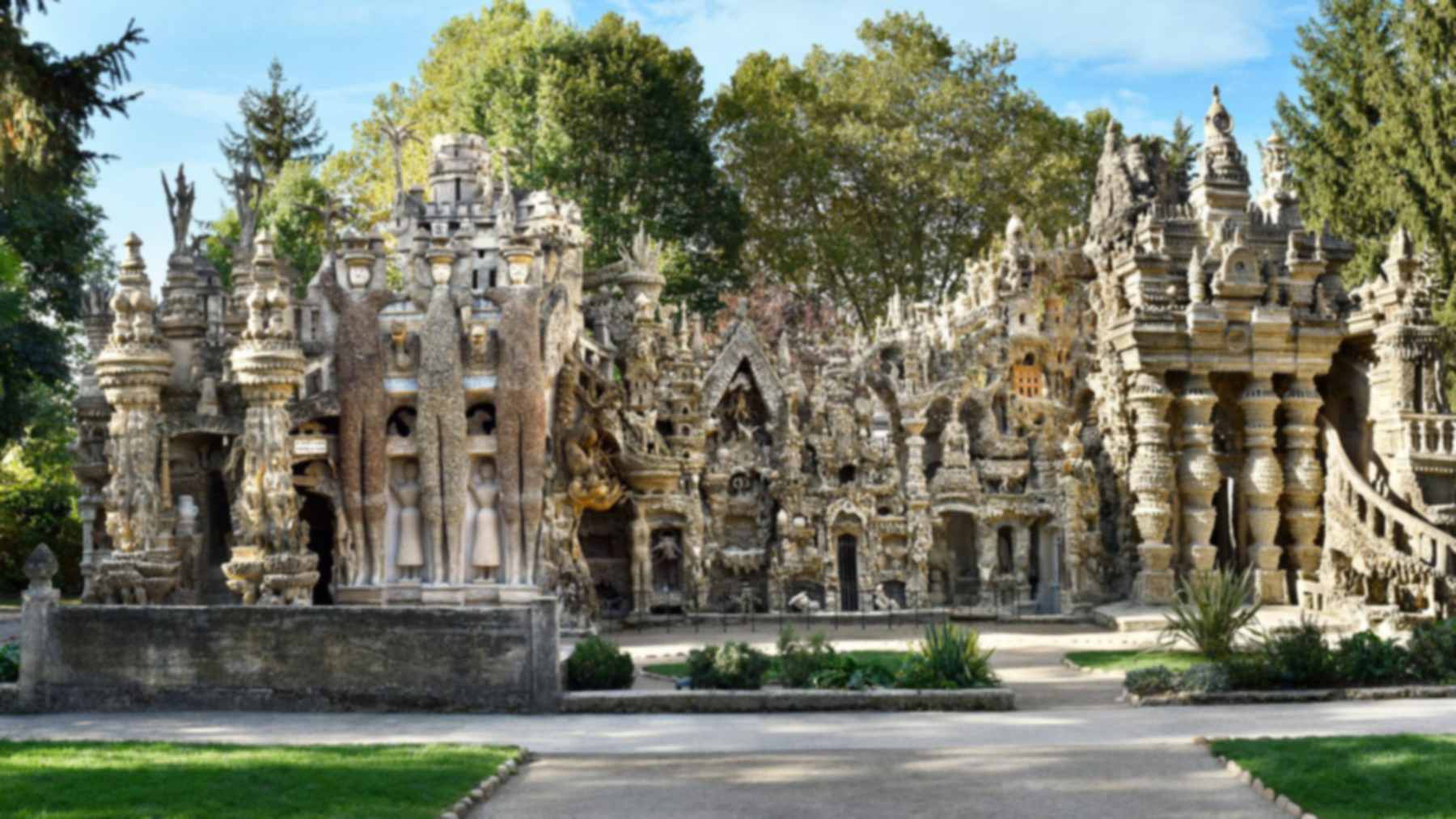
That building, the Palais Idéal or Ideal Palace, still stands in the same village. France’s Culture Ministry says it measures 85 feet long (26 meters). Its width and height are both about 39 feet (12 meters).
A half-buried stone near Tersanne
Cheval described the moment himself, and the palace reproduces his words in its official history. “My foot caught on a stone that almost made me fall,” he wrote, in translation. He thought the shape so strange that he put it in his pocket.
According to an account by palace director Frédéric Legros, running water had carved the grooves that caught his eye. Cheval went back the next day and found better ones. For about a decade he had already been dreaming of a palace on those long walks.
“Since nature wants to do the sculpture, I will do the masonry and the architecture,” he concluded. Neither trade was his. Cheval had left school at 12 and trained as a baker.
Candlelight after the mail round
Legros puts the daily postal round at 20 to 26 miles (32 to 42 kilometers) on foot. The stones came home later by wheelbarrow. Moving rock that way has a long history, as the builders of Yorkshire’s Devil’s Arrows showed on a far larger scale.
The same account says he built alone at night, by candlelight. He kept that up through 17 years of postal work. Retirement came in 1896, at age 60, and the palace took 16 more years.
Twenty years went into the east side alone, which carries the date 1899. France’s heritage database records lime mortar as the binder, and the SPACES art archive adds cement and wire. On the monument Cheval inscribed a phrase that translates as “work of one man.”
Elephants from an illustrated magazine
Because Cheval never traveled, the distant places on his walls came from paper. Legros writes that he subscribed to illustrated reviews, above all the Magasin Pittoresque. Its full-page engravings showed mosques, Hindu temples, Swiss chalets, flamingos and elephants.
Those pictures became niches on the west side of the palace. A Swiss chalet sits there with a Hindu temple, a white house, the Maison Carrée of Algiers and a medieval castle. Elsewhere an octopus, a caiman, pelicans and bears share the walls with giants and fairies.
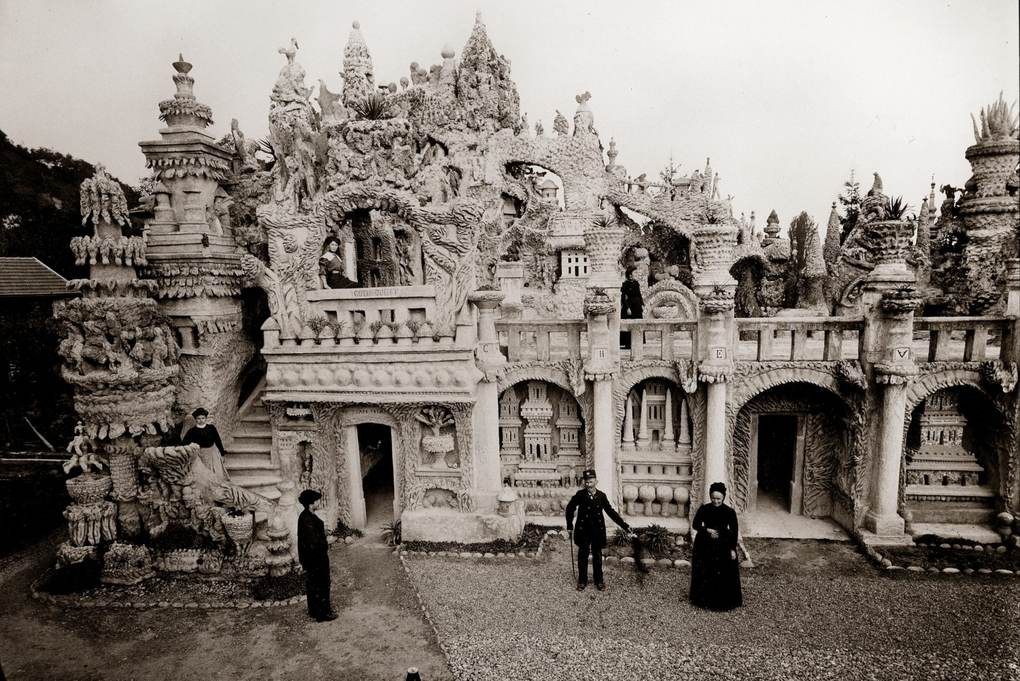
In its own history, the palace calls the whole thing uninhabitable. Cheval’s wheelbarrow still has a place there, tucked into a niche of the Hindu temple on the east side.
Tickets, postcards and two lawsuits
Seven years before the last stone went in, Cheval opened his garden to the public. In 1905 he set up a ticket office and sold postcards of the palace. He also put out a guest book for visitors to sign, Legros writes.
A photographer named Louis Charvat then began selling his own postcards of the site through local shops. Cheval fought him in two court cases, in 1906 and 1907. He claimed authorship rights over the image of his work.
Refused a grave in his garden
Part of the east side is an Egyptian-style tomb where Cheval hoped to lie with his wife. The palace says that wish was refused. In 1914 he took up his wheelbarrow again, this time at the village cemetery.
Eight more years went into what he named the Tomb of Silence and Endless Rest. He finished it in 1922, at 86. His death followed on August 19, 1924, when he was 88.
Picasso’s stop, Malraux’s signature
The surrealist writer André Breton visited several times and honored the postman in a 1932 poem. Art made from natural materials has kept that pull, as Truman Lowe’s willow sculptures show.
During a drive south in late July 1937, Pablo Picasso and Dora Maar stopped in Hauterives with Paul and Nusch Éluard. Maar took photographs on that visit. The palace bought six of them in 2023.
Official protection arrived on September 23, 1969, under Culture Minister André Malraux. The palace’s history says he acted against the advice of most officials in his own ministry. Malraux called it “the only example in architecture of naive art.”
Cheval’s tomb received the same status on May 23, 2011. The town of Hauterives has owned the palace since 1994.
No price on the south facade
Work on the stones continued this fall, according to a restoration notice on the palace’s website. It scheduled repairs from September 29 through November 6, 2026, on the south facade and the top of the east facade. The monument and its museum space stayed open throughout.
That notice names no contractor, gives no cost and does not describe the damage. Its page carried no completion update as of November 9.
Water caused trouble long ago, since the history says a system feeding the fountain was shut down for harming the structure. Conservators at Cambodia’s Ta Prohm temple face their own version of that balance.
Official accounts also disagree on smaller points about the postman. The palace’s history gives a route of about 19 miles (30 kilometers), shorter than the figure Legros cites. France’s heritage database has Cheval collecting stones in 1869, a decade before the famous stumble.
Photo: Palais Idéal du Facteur Cheval