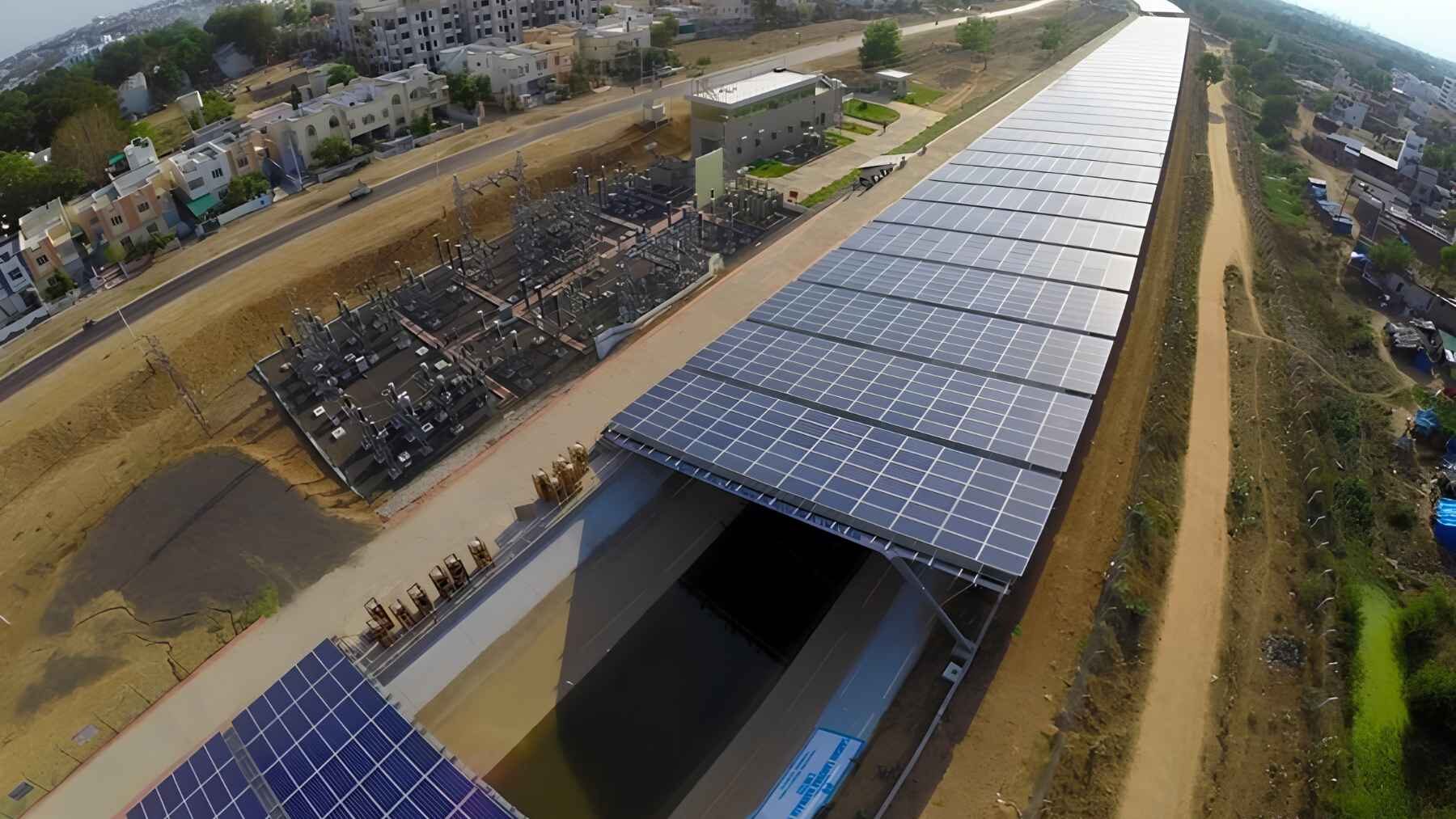
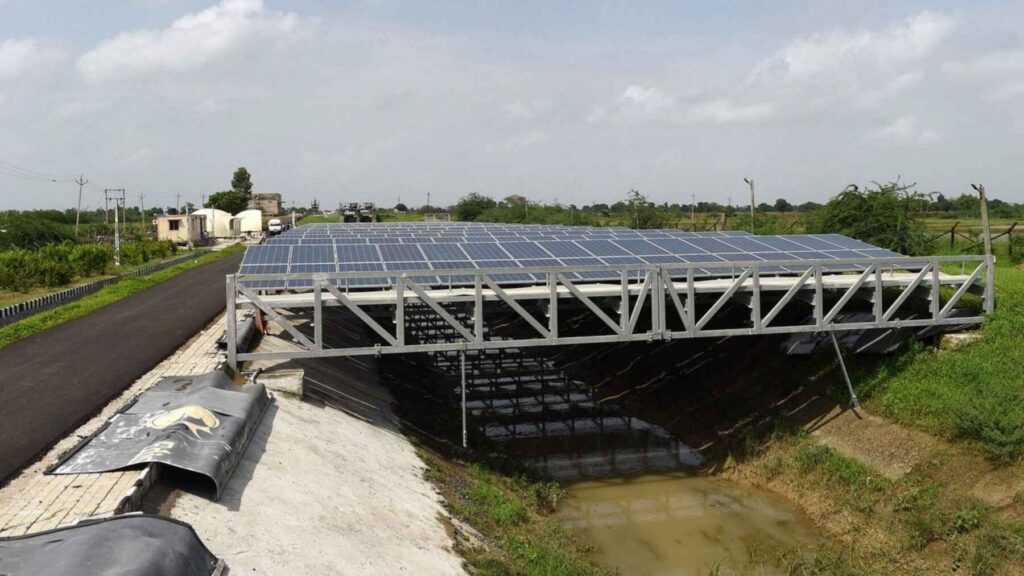
Solar farms usually spread across rooftops or open fields. But near Chandrasan village in the western Indian state of Gujarat, a roughly 2,460-foot ribbon of panels sits above moving irrigation water instead, turning an existing canal into both a power site and a shade structure.
The one-megawatt pilot does not produce the output of a vast solar park, yet its double use is what makes it stand out. Official project material estimates that it can generate about 1.6 million kilowatt-hours a year, prevent roughly 2.38 million gallons of water from evaporating, and avoid using about six acres of land.
A solar plant without a solar field
Gujarat State Electricity Corporation developed the canal-top plant with support from Sardar Sarovar Narmada Nigam, the public company that owns and maintains the canal network. Commissioned in 2012, the installation placed solar equipment on an elevated steel structure spanning about 0.47 miles of a branch canal.
A conventional utility-scale solar project normally needs a large, mostly unobstructed plot. This project used the airspace over infrastructure that was already public, so no crop rows had to disappear beneath the panels and no separate parcel had to be acquired for the array.
That detail matters in a densely populated farming region where land and water both carry a high value. Why compete with food production when an engineered corridor is already running past the fields?
Shade becomes water conservation
The panels block part of the intense sunlight that would otherwise strike the canal throughout the day. According to the official project presentation, that shade keeps about 2.38 million gallons of water in the channel each year instead of losing it to the air.
The reduced sunlight can also limit algae growth in the canal, another benefit listed by project planners. The same roof produces electricity above the water and helps protect irrigation supplies below it.
There is also a widely discussed cooling benefit, since photovoltaic panels generally lose some efficiency as they become hotter. But water beneath an array does not guarantee better output, and field studies of Indian canal-top systems show that design, airflow, humidity, dust, aging, and maintenance can all affect performance.
The numbers explain the excitement
For a pilot, the original figures were persuasive. The plant was designed for one megawatt of capacity and about 1.6 million kilowatt-hours of annual generation while conserving six acres that might otherwise have been needed for a ground-mounted project.
The larger opportunity looked even more dramatic. One official assessment examined about 5,068 miles of main canals, branches, and distributaries, estimating that using 30% of their length could support roughly 2,000 megawatts and cut evaporation by around 15.9 to 23.8 billion gallons per year.
Those totals are planning scenarios, not completed projects. Estimates also change with canal width, local climate, panel spacing, water flow, and the share of the network considered, so the biggest numbers should be read as potential rather than a promise. A projection is not a power plant.
Why every canal is not covered
Building above flowing water is more complicated than placing racks on flat ground. Steel supports must span the canal, withstand weather and corrosion, leave room for water operations, and provide safe access for cleaning, inspections, and repairs.
That extra structure can push up construction costs, while maintenance crews cannot drive between rows as they might at a normal solar farm. Ground-mounted solar can therefore remain the cheaper and easier choice where suitable land is available and inexpensive.
Canal-top solar makes the strongest case where farmland is scarce, evaporation is costly, and power can be used nearby. India recognized that promise in 2014 by launching a national program for 100 megawatts of canal-top and canal-bank solar, but deployment has remained gradual rather than covering entire water networks overnight.
A decade of operation matters
A 2025 study by Amandeep Singh Makhija and Shabbir S. Bohra returned to the pioneering Indian installation to examine its long-term performance and degradation. That kind of evidence matters because a clever clean-energy idea must keep working through years of heat, dust, humidity, and routine wear, not just look impressive on opening day.
The broader lesson is not that canal-top arrays should replace every solar field. It is that existing infrastructure can sometimes do two jobs at once, especially in places where the electric grid, freshwater supplies, and productive land are all under pressure.
For farmers and nearby communities, the possible gains are practical rather than abstract. More water can remain in the canal, fewer acres may be taken out of production, and renewable electricity can be generated close to rural demand. Still, each site has to justify the added engineering and upkeep.
What Gujarat proved
The Chandrasan pilot helped turn a curious design into a real operating project. Gujarat later added a larger 10-megawatt canal-top plant on the Vadodara Branch Canal, while engineers and researchers continued testing how the idea performs at a greater scale.
Its most important contribution may be the change in perspective. The clean-energy transition does not always have to begin by searching for untouched land, because roadsides, rooftops, reservoirs, parking lots, and canals can sometimes become part of the energy system too.
Canal-top solar is not a universal answer, but in hot, dry, land-constrained regions it can be a useful tool when the water and land savings outweigh the added cost.
The most recent performance study was published in Energy for Sustainable Development.
Most read
- US scientists poured 16,500 gallons of lye into the Gulf of Maine and dyed the water bright pink to track it, the first federally approved try at reversing ocean acidity
- Soviet scientists released giant red king crabs into the Barents Sea in the 1960s to build a fishery, but decades later those invaders are still changing the seafloor
- New Orleans is collecting thousands of used Christmas trees and dropping them from helicopters to slow the loss of land, which has already exceeded 5,000 square kilometers
- Britain is dropping 20 concrete reef cubes and 44 tons of scallop shells into the sea, and the goal is to bring back oysters down more than 95% since the 1800s
- The U.S. will pay up to $65 million to leave Colorado River water in Lake Mead, and Hoover Dam explains why