
Researchers from the Pacific Northwest National Laboratory have tested a new process of building electrodes that would make it possible to produce cheaper, yet still efficient, lithium ion batteries, a report said.
Most lithium ion batteries today are designed with metal oxides, the stable, positive electrode in batteries with whose electron lithium bonds with when a battery is charged and parts with when the battery is used. Metals used are often cobalt, nickel or manganese, all expensive materials.
The laboratory’s scientists, led by materials scientist Daiwon Choi, note that metals such as manganese or iron are cheaper. More than that, substituting phosphate for oxide, they argued, provides a more stable structure for lithium.
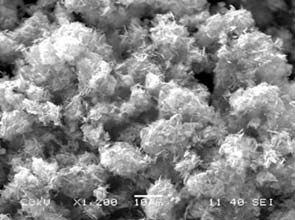
Trying to overcome a number of challenges, Mr. Choi and his team used paraffin wax and a surfactant called oleic acid, or soap, to help grow crystals that would create cheap, light and stable electrodes that would replace metal oxide with lithium manganese phosphate or L.M.P. battery.
The L.M.P. battery they developed could save as much as 168 milliAmp hours per gram of power in the material. Previous attempts only allowed investigators to eke out 120 milliAmp hours per gram.
The scientists raised the power capacity of the L.M.P. battery by completely replacing the metal oxide electrode with smaller particles or crystals.
Mr. Choi reasoned the 30 percent loss in capacity could be due to lithium and electrons having to battle their way through the metal oxide, a property called resistance. The less distance lithium and electrons have to travel out of the cathode, the less resistance and the more electricity could be stored.
A smaller particle would decrease that distance, but this was not something metal oxide could produce since growing smaller particles requires lower temperatures, and lower temperatures means the metal oxide molecules fail to line up well in the crystals.
Paraffin wax is made up of long, straight molecules that do not react with much, the scientists said, and the long molecules help in lining up the crystal’s structure. Soap, meanwhile, helps the growing crystals disperse evenly.
«Paraffin provides a medium in which to grow good electrode materials,» said Mr. Choi. «This method will help researchers investigate cathode materials based on cheaper transition metals such as manganese or iron.»
Although this version of an L.M.P. battery charges slower than other cathode materials, Mr. Choi said the real advantage to this work is that the easy, one-step method will let them explore a wide variety of cheap materials that have traditionally been difficult to work with in developing lithium ion rechargeable batteries.
In the future, the team will change how they incorporate the carbon coating on the L.M.P. nanoplates, which might improve their charge and discharge rates.