What looked like an old farmhouse about to collapse concealed 2,200 retro computers stacked on the second floor… The lot weighed 22 tons and sold on eBay in a matter of days

Image Autor
Published On: March 3, 2026 at 7:26 PM
Follow Us
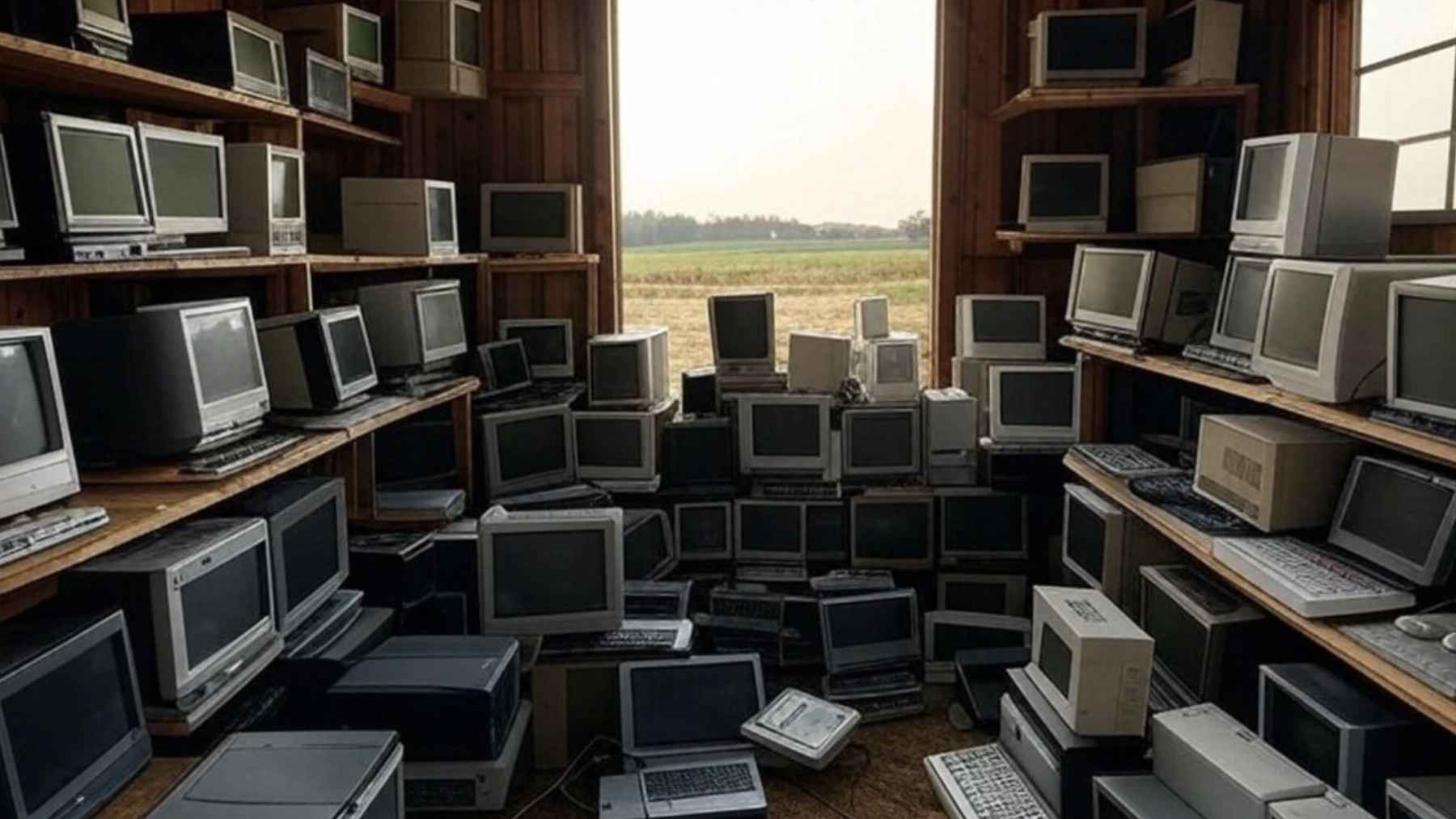
Stacks of boxed NABU retro computers stored on the second floor of a rural Massachusetts barn

For more than two decades, over 2,200 unused NABU personal computers sat stacked in an aging barn in rural Massachusetts. In 2023 they suddenly resurfaced online, sold for under €100 each on eBay to buyers eager for a slice of early home computing history.

The collection belonged to retired computer designer James Pellegrini, who had bought the machines in the late 1980s while dreaming of a new communications network for small firms.

That idea never turned into a working service, yet the forgotten stockpile has now become a textbook example of how nostalgia, rarity, and the right online marketplace can transform obsolete hardware into sought after collectibles.

A forgotten stockpile in a shaky barn

After Pellegrini moved the computers into a barn outside a small town around the year 2000, they stayed there for about 23 years. Stacked on the second floor, the units weighed roughly 22 tons in total, enough to spark worries about the safety of the aging wooden structure.

The barn was never meant to hold what was essentially a small data center in boxes. Over time, structural concerns turned what had been quiet long-term storage into a pressing problem that had to be solved.

From Craigslist to eBay

Once the barn began to look less like a safe warehouse and more like a risk, Pellegrini decided the computers had to go. His first attempt ran through Craigslist, where he offered the machines at low prices but saw only modest interest from local buyers.

The real change came when he moved the listings to eBay and set prices that stayed under €100 euros. Within just a few days, nearly a quarter of the stock was gone, snapped up by collectors and curious tinkerers, and eventually the entire supply disappeared from the platform.

If you imagine opening your front door to find a courier delivering a sealed NABU box from the early 80s, you get a sense of the appeal. For many buyers it was like unboxing a time capsule from the first era of connected home computing.

NABU computers and their digital legacy

NABU systems came from a little-known home computer platform of the early 1980s that connected through cable television networks. In simple terms, they let households download software, games, and information from a central server into the living room, a concept that anticipated later cloud services and app stores.

Today that technical legacy is documented by institutions such as the School of Computer Science at Carleton University, which describes the NABU personal computer as one of the first cable ready home machines designed for network delivered software.

The barn discovery did more than clear space for its owner, since it also supplied researchers and hobbyists with a large batch of identical systems to study and restore.

For retro fans, the Massachusetts stockpile offered a rare chance to own that piece of history at a relatively accessible price, at least while the listings lasted. 

Image Autor

Adrian Villellas

Adrián Villellas is a computer engineer and entrepreneur in digital marketing and ad tech. He has led projects in analytics, sustainable advertising, and new audience solutions. He also collaborates on scientific initiatives related to astronomy and space observation. He publishes in science, technology, and environmental media, where he brings complex topics and innovative advances to a wide audience.

Related news

Excavator dumping a large pile of recycled oyster shells used for coastal restoration projects.

A marine scientist in Southern California has turned restaurant waste into coastal restoration by collecting more than 24,000 pounds of discarded oyster shells, curing them in the sun, and using them to rebuild reefs that protect shorelines and filter water

June 1, 2026 at 3:00 PM
California farmers preparing to remove clingstone peach trees following the permanent closure of the Del Monte cannery in Modesto.

Del Monte’s Chapter 11 collapse left a California peach farmer staring at ripping out 20 acres of 9-year-old Ross cling trees tied to $12,500-an-acre contracts, after a shuttered Modesto canning hub and only 24,000 of 74,000 tons finding processing capacity turned the rest into fruit that may rot or be destroyed

May 31, 2026 at 3:00 PM
A close-up view of a tiny, reddish-orange kyawthuite crystal, the only confirmed natural specimen of this mineral species in existence.

The rarest mineral recognized by science weighs about 0.011 ounces, exists as a single known natural specimen, and its discovery exposes how fragile Earth’s catalog still is

May 31, 2026 at 8:45 AM
Aerial view of the Port of Recife in Brazil, showing the urban harbor, navigation channel, and coastal breakwater.

The Port of Recife will spend about $19.7 million on dredging to handle ships up to 689 feet, and that quiet project decides which cities win or lose trade

May 28, 2026 at 12:30 PM
Small tiny home with a front porch, representing compact permanent housing for veterans.

Plans are underway in Cincinnati to build a new “Veterans Village” featuring 14 tiny homes on church-owned land. Each unit, measuring 276 square feet, will include a porch, kitchen, dining area, and full bathroom, and will cost $70,000, allowing veterans to move out of their temporary housing

May 27, 2026 at 8:45 AM
Construction site for an immersed tunnel beside a wide port channel, with concrete tunnel sections, cranes, boats, and city buildings in the background.

São Paulo stuns with a roughly $1.35 billion megaproject – Brazil’s first immersed tunnel will span 0.93 miles and force the city to reinvent underwater construction logistics

May 26, 2026 at 12:30 PM

Leave a Comment