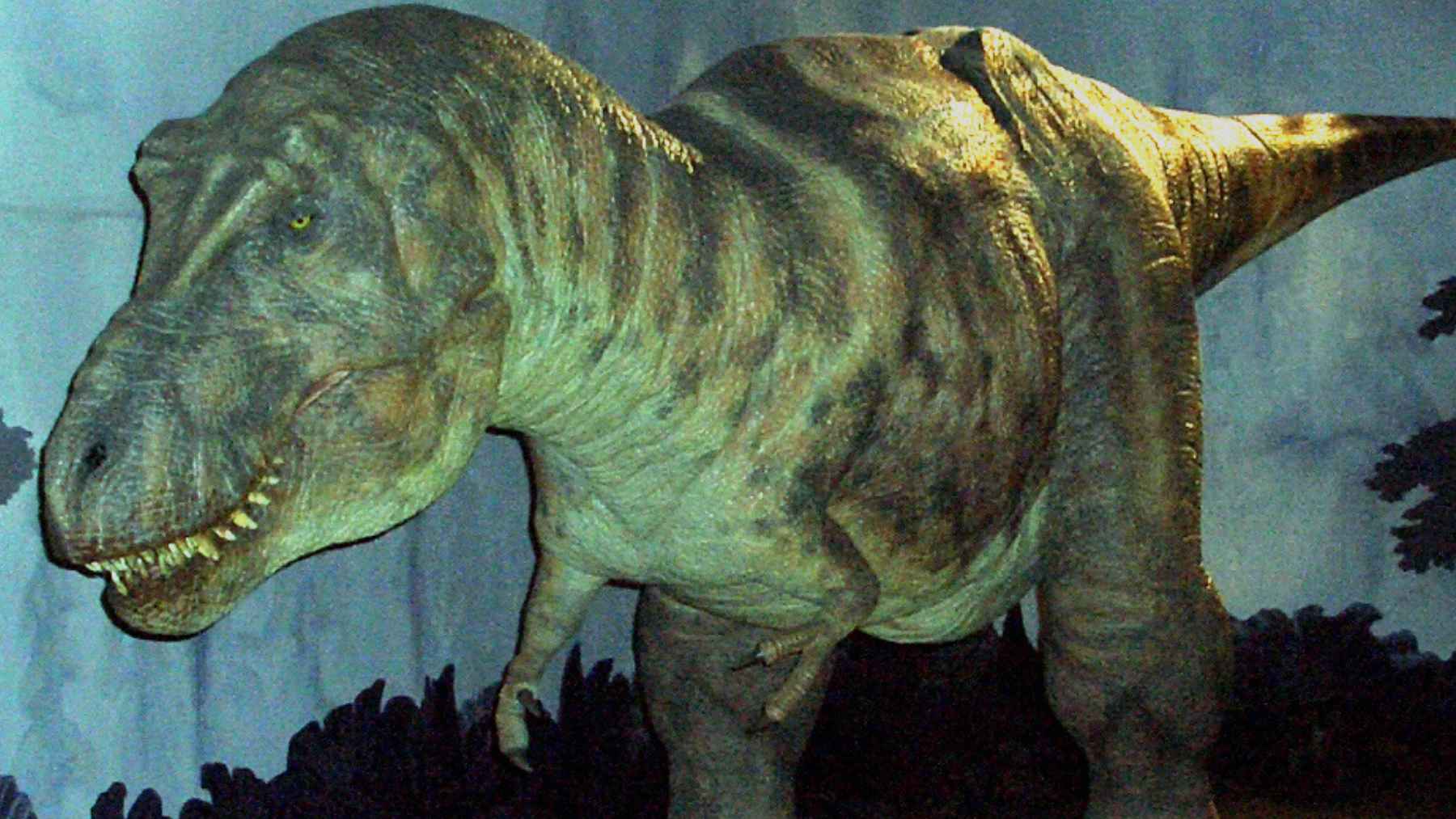
For years, pop culture has trained us to picture Tyrannosaurus rex as a massive, reptile-like giant that stomped flat-footed across the ground. Think of the famous chase scene in the 1993 film “Jurassic Park,” where each step sounds like a wrecking ball.
A new scientific study suggests the details were different at the ground level. What happens when you zoom in on the foot itself? The researchers argue that T. rex likely struck the ground on its toes, using a bird-like gait that could make its movement quicker and more stable, even if it still was not the kind of sprinter Hollywood loves.
A bird-like foot
The core idea is called digitigrade locomotion, which is a fancy way of saying “toe walking.” Modern running birds keep their heel raised and load most of their weight through the front of the foot, similar to how you stand on the balls of your feet when you start a sprint.
In contrast, humans are mostly plantigrade, meaning our heel and the rest of the foot share the load. If you have ever tried to run flat-footed in flip-flops, you know it feels awkward and slow.
The new paper argues that T. rex belonged closer to the bird side of that spectrum. In the study, the authors write that the dinosaur’s foot “functioned similarly to the foot of a bird” in ways that affect how it steps, not just how it looks in a museum mount. It changes the picture.
How the test worked
The research, available through the journal DOI page for the study, was led by Adrian Tussel Boeye with coauthors Kyle Logan Atkins-Weltman, J. Logan King, and the late Scott Swann, working across the College of the Atlantic, Oklahoma State University College of Osteopathic Medicine, and Colorado Northwestern Community College.
They describe it as a “first quantitative biomechanical analysis” of how foot strike changes Tyrannosaurus movement.
Their approach sits in biomechanics, which uses physics to understand how bodies move. The question was simple to ask and hard to answer. Where did the foot hit first?
To test it, they measured leg and foot bones, then ran those measurements through several established speed models that scale with body size. After that, they compared three possible landing styles, more rear-foot, more mid-foot, or mainly toe-first.
What fossils add
Bones can suggest what an animal could do, but fossil footprints can hint at what it did on a real surface. The study pulled in track evidence from ichnology, the field that studies traces like footprints rather than skeletons, and readers who want the terminology can check a glossary used by track researchers.
In many large theropod tracks, the deepest parts of the print sit under the toes. That kind of pattern is what you would expect if the animal’s weight was concentrated up front, not spread across the whole sole.
Still, track surfaces vary, and animals do not move like robots. A muddy patch, a turn, or a stumble can all change a footprint, so the study treats tracks as supporting evidence rather than a perfect record of speed.
The speed numbers
So what does toe-first movement mean in everyday numbers? The models suggest adult T. rex top speeds in the ballpark of about 11 to 25 miles per hour, which translates from roughly 5 to 11 meters per second.
The paper also suggests that a toe-first step could raise estimated top speed by about one-fifth compared with a flatter foot strike. That is the kind of boost you can imagine if you switch from clunky steps to a more springy running form.
It is worth keeping the scale in mind. Even at 25 miles per hour, this is a short-burst estimate, not proof that a dinosaur could run down a speeding car, and not a promise that every individual was equally athletic.
Age and size
One reason the range is wide is that T. rex changed dramatically as it grew. The study’s estimates suggest juveniles could reach around 25 miles per hour, while very large adults, including the famous specimen nicknamed Sue, would be closer to about 11 miles per hour.
That pattern matches what biologists see in many big animals today. As bodies get heavier, muscles have to do more work to move each pound, and extreme speed becomes harder to sustain.
Researchers have been debating this for decades, using different methods and often getting different answers. In 2002, John R. Hutchinson and Mariano Garcia published a Nature paper on tyrannosaur speed limits that argued huge tyrannosaurs likely could not run at very high speeds without unrealistically massive leg muscles.
Why it matters
At first glance, this can sound like a debate about numbers. But foot strike shapes how scientists interpret fossil tracks, how animators build realistic motion, and how paleontologists think about hunting strategies at different ages.
It also fits a broader shift in the field toward combining multiple lines of evidence, from bones to trackways to living animals. A 2025 overview called Reconstructing dinosaur locomotion lays out why no single clue, by itself, should be treated as the full story.
On the flip side, other work warns that track-based speed calculations can be misleading when the surface is soft or the animal is changing pace. A 2025 Biology Letters study highlighted how easy it is for common formulas to overshoot real movement, especially on compliant ground.
The main study has been published in Royal Society Open Science.