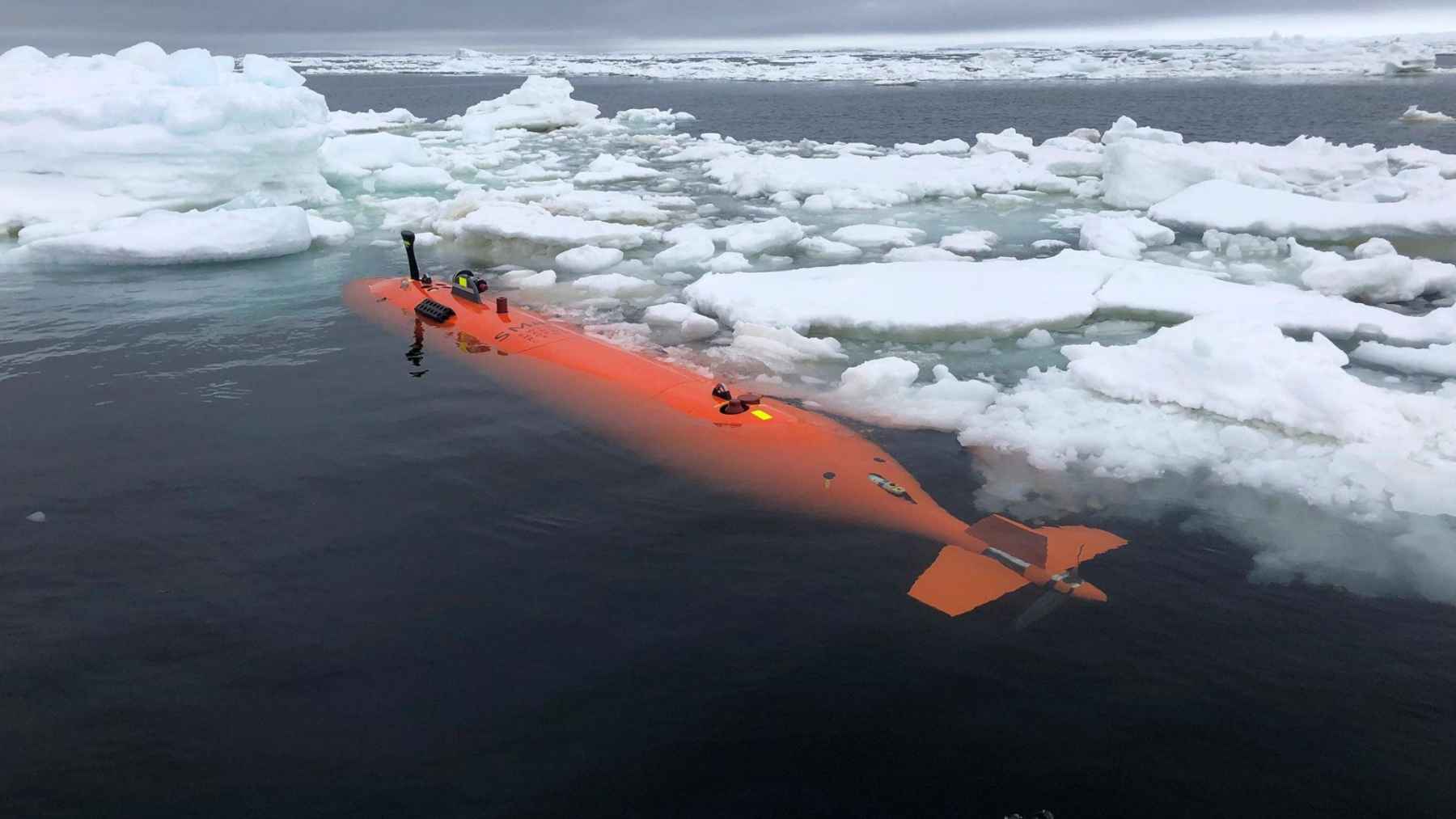
A robot submarine sent beneath West Antarctica’s Dotson Ice Shelf has revealed a strange hidden landscape carved into the ice from below, then disappeared during a return mission under the same frozen shelf. The autonomous vehicle, called Ran, mapped terraces, channels, widened fractures, and teardrop-shaped pits that satellites could not see from space.
The findings matter because the bottom of an ice shelf is where much of Antarctica’s future may be decided. Ran’s maps show that melting is not happening in one simple, even layer. Instead, warm ocean water is cutting the ice in different ways depending on currents, fractures, and hidden channels, which means some computer models may still be missing important details.
Ran’s last mission
Ran was an autonomous underwater vehicle, a bright orange robotic submarine designed to work where people and ordinary boats cannot go. During the 2022 expedition, it traveled more than 621 miles back and forth under Dotson Ice Shelf and reached about 10.6 miles into the dark cavity beneath the floating ice.
That is not a small trip. Under hundreds of feet of ice, GPS and radio signals cannot guide the vehicle in real time, so Ran had to follow preprogrammed routes and rely on acoustic navigation to find its way back. What could go wrong in a place like that? Plenty.
In January 2024, the team returned to Dotson to repeat the surveys and see how the ice had changed. Ran completed only one dive before it failed to resurface at the meeting point, and searches using acoustic instruments, helicopters, and drones found no sign of it.
A landscape under the ice
Before it vanished, Ran sent back something rare. Using upward-looking sonar, it mapped about 54 square miles of the underside of Dotson Ice Shelf, giving researchers the first detailed view across extensive areas of a glacier’s hidden base.
The ice was not smooth. In some areas, it looked like a stepped landscape, with terraces stacked one above another. In others, the submarine found smoother eroded surfaces, channels, and mysterious teardrop-shaped indentations that had been carved upward into the ice.
Anna Wåhlin, professor of oceanography at the University of Gothenburg and lead author of the study, compared the view to seeing the back of the moon for the first time. “By navigating the submersible into the cavity, we were able to get high-resolution maps of the ice underside,” she said.
Warm water does the cutting
The main culprit is not a giant crack from above, but water moving below. Around West Antarctica, relatively warm and salty deep water can reach the underside of floating ice shelves, where it slowly eats away at the ice base. Warm is a relative word here, of course. This is still polar water, but for ice, a small temperature difference can be a big deal.
Ran’s data helped explain why the western part of Dotson Ice Shelf melts faster than the eastern side. Stronger underwater currents can drive more heat against the ice, while slower areas allow different melt patterns to form over time.
Dotson is not melting like an ice cube sitting evenly in a glass of water. It is being sculpted from below, almost like a coastline battered by different tides, currents, and hidden channels.
Terraces and teardrops
The terraced parts of the ice appear to form where currents move more slowly. There, layers can be worn back in steps, leaving flat plateaus edged by steeper walls. It is a quieter kind of melting, but it still matters.
The teardrop-shaped pits are more puzzling. The scientific paper reports previously unknown features ranging from about 66 feet to 984 feet long in high-melt portions of the ice shelf. Researchers link them to rotating flow in the boundary layer, the thin zone where moving water meets the ice.
Some of these structures may sound almost artistic. They are not. They are physical clues that reveal how heat is being delivered to the ice, and those clues are exactly what scientists need when trying to predict future sea-level rise.
Fractures become hidden highways
Ran also mapped fractures cutting through the ice shelf, many of them widened and reshaped at their bases by melting. These cracks are especially important because they can guide warm water into narrow spaces where it can attack the ice more directly.
Think of it like water finding a crack in a sidewalk after a storm. Once a path opens, water keeps using it, and the damage can spread. Under Dotson, the same basic idea plays out in a much colder and more dangerous place.
That is why the new maps are so useful. They show not only where the ice is thinning, but how the ocean is shaping the underside of the shelf in ways that cannot be fully captured from satellites alone.
Why this matters for sea level
Ice shelves float, so their melting does not raise sea levels directly in the same way as land ice sliding into the sea. They act, however, like braces holding back glaciers behind them. When those braces thin or weaken, glaciers behind them can move faster toward the ocean.
Dotson is part of the West Antarctic Ice Sheet, a region scientists watch closely because of its potential impact on future sea-level rise. For coastal communities, this is not just a faraway Antarctic story. Over time, it can show up in flood maps, insurance costs, storm damage, and the seawalls cities may need to build.
Wåhlin said better models are needed to predict how fast ice shelves will melt in the future. “The driving force is in the ocean,” she said, pointing to the need for oceanographers and glaciologists to keep working together.
Ran’s legacy
Ran’s disappearance was a real loss for the research team. Wåhlin said watching the vehicle vanish into the dark, unknown depths for more than 24 hours without communication was “daunting,” even after the team’s experience with many missions below ice.
Still, the mission was not a failure. The data Ran returned has opened a new window into one of Earth’s hardest places to study. It shows that the base of an Antarctic ice shelf can hold a complicated world of terraces, fractures, channels, and carved pits, all shaped by the movement of ocean water.
At the end of the day, Ran helped scientists see what had been hidden. The trouble is, the ice is still changing, and the ocean is still doing its quiet work underneath.
The study was published in Science Advances.