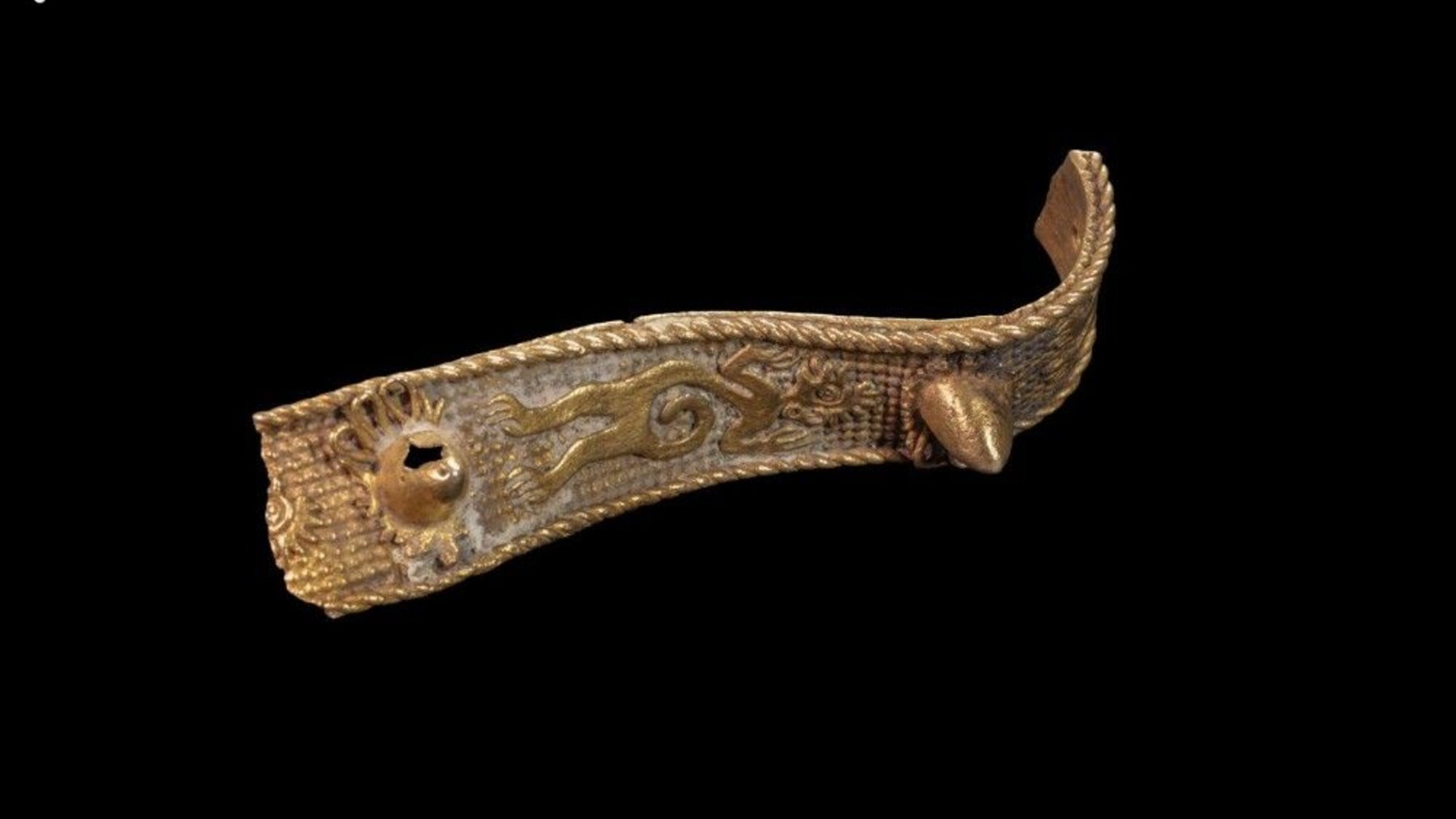
A gold-colored bracelet fragment has returned to Mexico from New York, opening an investigation into its possible connection to the “Joyas del pescador,” or “Fisherman’s Jewels.” In a September 21 announcement, Mexico’s National Institute of Anthropology and History (INAH) described the piece as Zapotec metalwork dating to the Late Postclassic period, between 1200 and 1521.
The fragment resembles bracelets in a collection recovered by an octopus diver about 50 years ago. Researchers now want to compare its metal composition with those objects to investigate whether they belong together. The return puts a potential piece of that scattered history back within reach of Mexican researchers, although the connection remains unconfirmed.
From New York to Mexican researchers
A private individual voluntarily handed the fragment to Mexico’s consulate in New York in late 2025. Mexican cultural and diplomatic authorities coordinated its return, transporting it to Mexico City by diplomatic bag after INAH specialists identified it as an archaeological object.
The announcement distinguishes that handover from the subsequent repatriation, without providing a complete account of the fragment’s earlier ownership. It also leaves open when and how the object reached the United States.
“Every piece we recover opens new possibilities to understand and reconstruct our heritage,” Culture Secretary Claudia Curiel de Icaza said, translated from Spanish. She emphasized that the bracelet’s return would allow INAH to investigate its possible relationship with the collection.
A spider monkey on a fragment of metal
The surviving band measures about 3.1 inches long and just under 0.8 inches wide (8 centimeters by almost 2 centimeters). Small enough to fit in a palm, it has a wavy, curved form decorated with a spider monkey’s profile and two cone-shaped projections.
INAH archaeologist Alejandro Bautista Valdespino attributes its manufacture to Zapotec artisans using lost-wax casting and filigree. In lost-wax casting, craftspeople create a wax model, surround it with a mold, remove the wax through heating, and fill the resulting space with molten metal.
Specialists initially assessed photographs supplied by the consulate and found similarities to roughly a dozen complete and incomplete bracelets. Those comparison pieces contain gold, silver, and copper and are held at the Museo Local Fuerte de San Juan de Ulúa in Veracruz.
The fisherman behind the collection
The collection’s modern history began with an ordinary search for food. According to the account relayed by Bautista Valdespino, Raúl Hurtado Hernández was diving for octopus among corals in the Río Medio area about half a century ago when he noticed a golden glint.
Over the following days, Hurtado recovered several metal objects and sold some of them. Local jewelers melted down a number of the pieces before authorities learned of the discovery and confiscated the objects still in his possession.
Bautista Valdespino suggests the newly returned fragment could have been among the pieces sold and later illegally taken to the United States. That remains a proposed explanation, and the announcement provides no documented chain connecting this particular object to those transactions.
A possible link to colonial looting
The collection’s earlier history reaches into another unresolved story. Edith Ortiz Díaz, a researcher at the National Autonomous University of Mexico, has examined evidence connecting such metalwork to the Sierra Norte of Oaxaca, where Indigenous communities exploited gold deposits carried by rivers.
Her historical account describes Diego de Figueroa, associated with the founding of Villa Alta around 1526 or 1527, looting the tombs of local leaders to obtain gold for a return to Spain. His ship sank after leaving Veracruz, and the “Fisherman’s Jewels” have been proposed as part of that plunder.
This possible shipwreck connection concerns the collection as a whole. Establishing that the returned fragment belongs to the collection would still leave its precise journey through those events to be demonstrated.
What the metal could reveal
Why does the mix of metals matter? Earlier chemical studies, fluorescence measurements, and microscopic examinations helped researchers identify manufacturing methods and compare the collection’s alloys with other ancient Oaxacan metalwork. Those results contributed to the hypothesis of an origin in the Sierra Norte.
Bautista Valdespino expects alloy analysis to confirm the fragment’s association with the “Fisherman’s Jewels,” but the announcement contains no results from that testing. A close match could strengthen the case when considered alongside its design and manufacture, while questions about its ownership history would require other evidence.
For now, the recovery creates an opportunity to study an object whose place in a larger collection may otherwise have remained unclear. The official press release was published on INAH’s website.
Photo: INAH