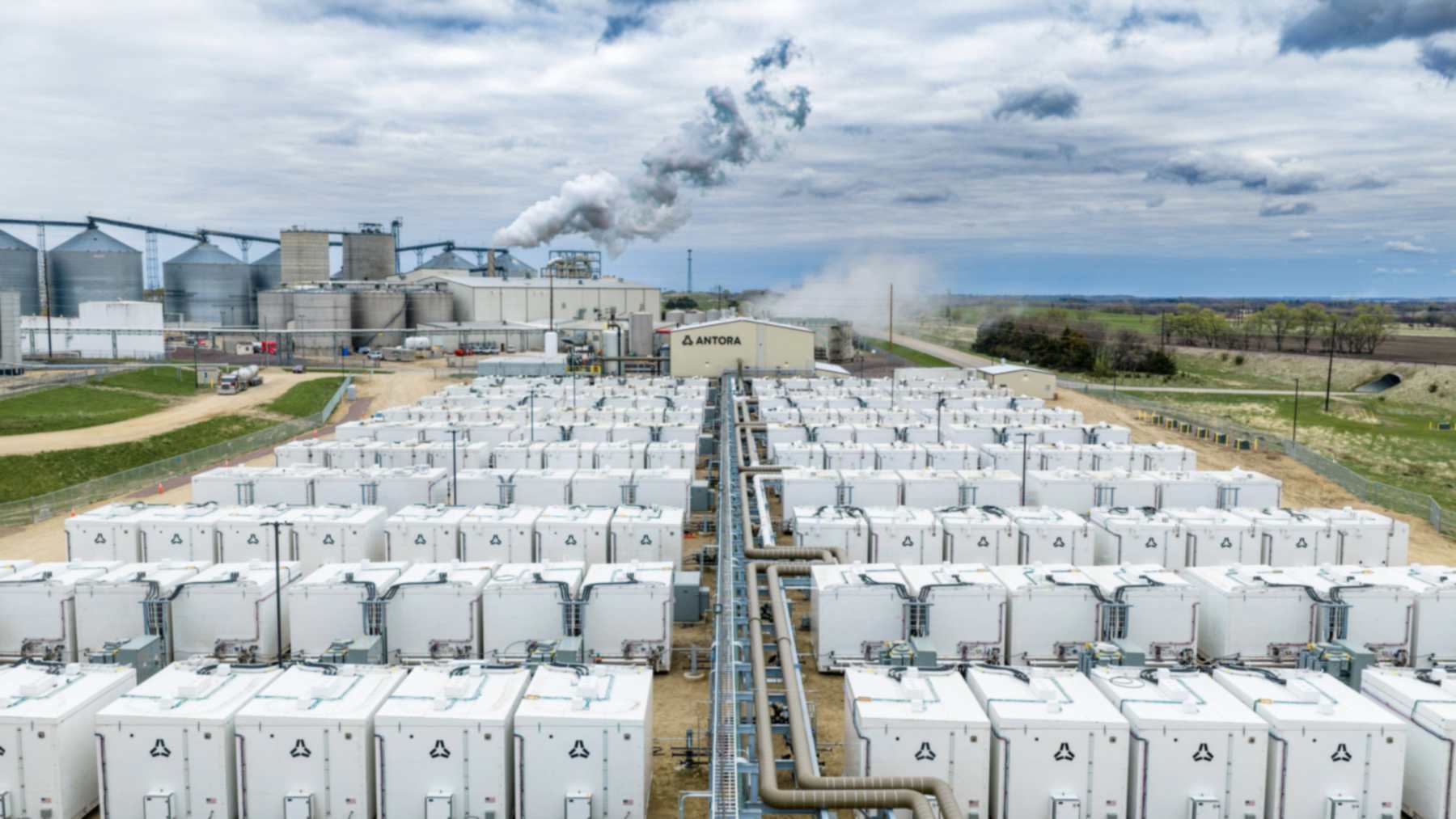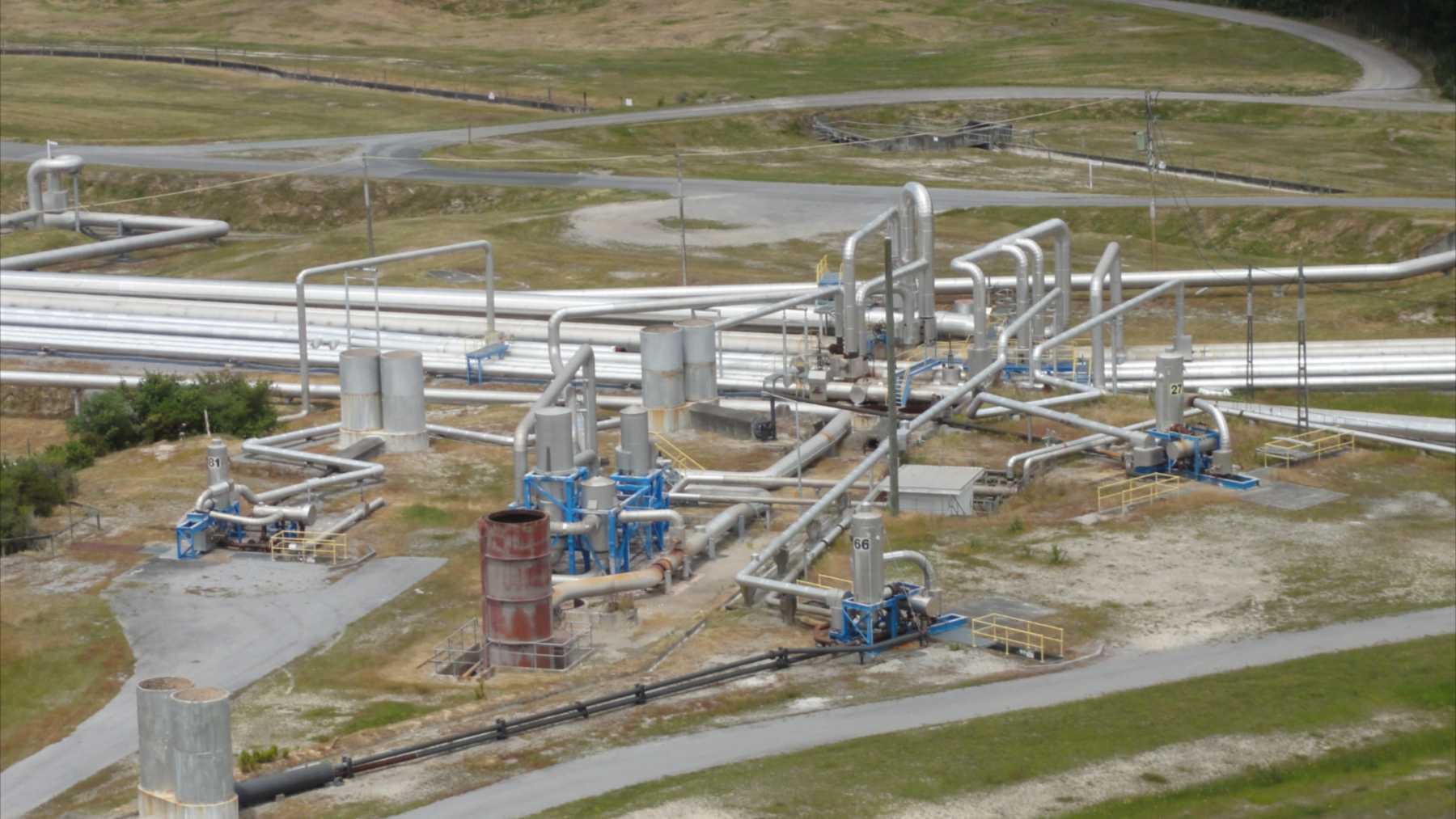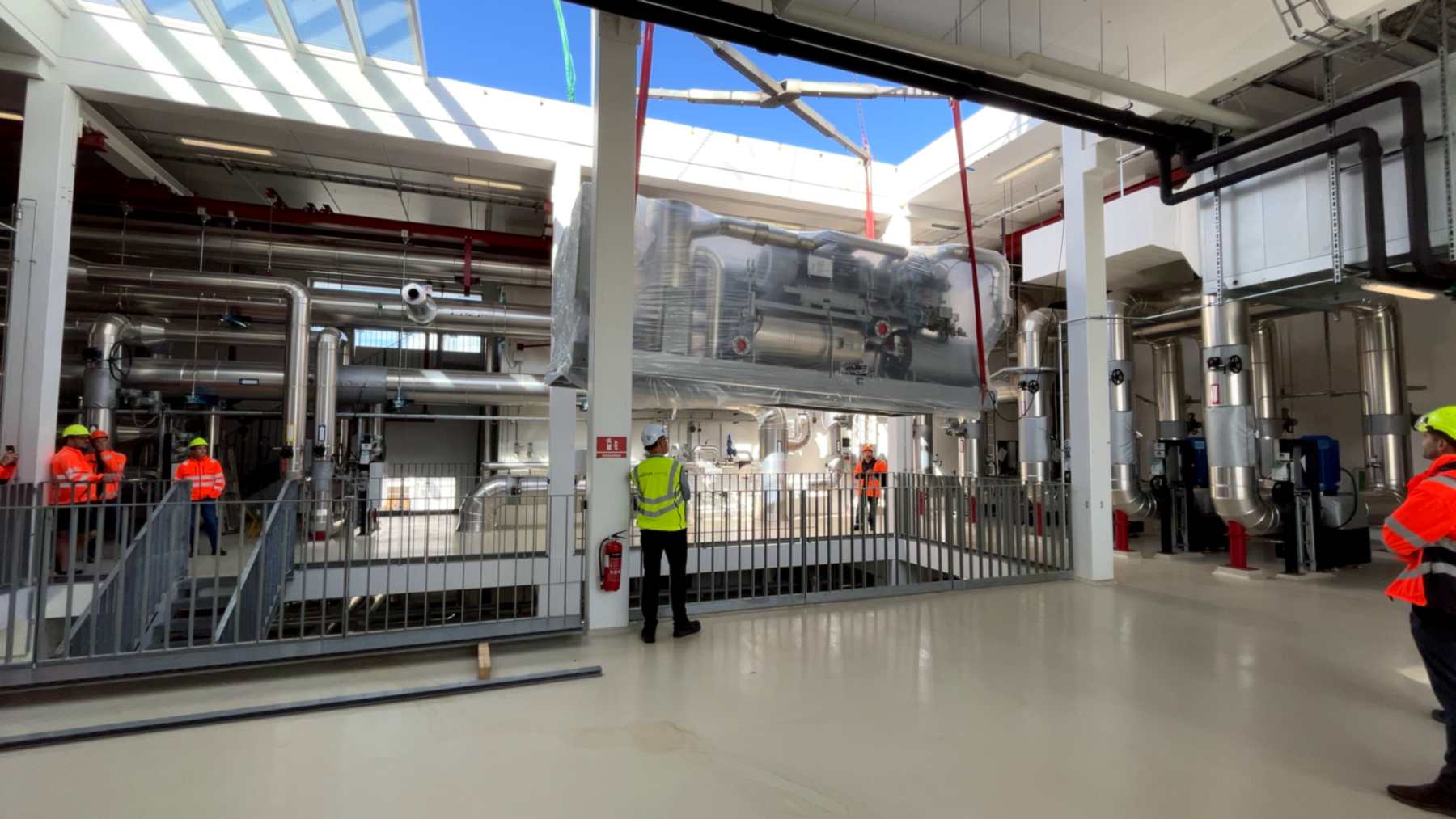
Six seawater heat pumps went into service on September 10, 2026, in a building on the Aarhus Ø harbor front that the Danish utility Kredsløb calls Maskinrummet, the Engine Room. Running flat out, they take in up to 317,000 gallons (1.2 million liters) of water from Aarhus Bay every hour.
“1.2 million liters of seawater an hour will soon heat nearly two thousand Aarhus living rooms and cool buildings in central Aarhus, but relax. You don’t need to fear a flood in your living room,” Kredsløb wrote in its Danish-language press release (we translated all the quotes in this story from Danish).
Six heat pumps in the Engine Room
The new units supply about 1,900 homes. Kredsløb says they make up to 3.5 times as much heat as the electricity they use, and they turn the energy in cold seawater into district heating water of around 158°F (70°C), which is pumped through underground pipes to radiators.
In summer they switch jobs and deliver district cooling to large buildings nearby, while the surplus heat they remove is recycled into the district heating network.
The investment is 300 million kroner (about $46 million), Kredsløb chief executive Bjarne Munk Jensen told Danish broadcaster DR. “There is actually really good economics in that,” he said.
According to Munk Jensen, the system can keep radiators warm even in a cold winter when the seawater freezes. “We take the water in from the bottom of the basins, and it doesn’t freeze there, so we can actually also produce heat in winter,” he said.
A reverse refrigerator for a whole neighborhood
Copenhagen’s utility HOFOR is building a similar machine, and in May its head of district heating, John Halkjær Christensen, explained how it works.
“It is much bigger than the ones people know from houses and summer cottages, and it looks completely different. But in principle it works the same way, only it is considerably more energy efficient. It works like a kind of reverse refrigerator that collects and amplifies heat,” he said. The home units he means are the same kind of heat pumps now replacing gas heaters in Germany and the U.S.
HOFOR’s description goes like this: even winter-cold seawater still holds some heat, which warms a refrigerant that evaporates at a very low temperature, and a compressor then puts that vapor under high pressure so it gets hot enough for district heating. The seawater goes back into the harbor a few degrees colder.
Wood pellets are on their way out
The real target in Aarhus is wood. Kredsløb’s plan, Fremtidens fjernvarme (Future District Heating), is meant to replace the heat now made by burning wood pellets and coal in block 3 of the Studstrup power station outside the city.
DR reported that the city council has voted to phase out about 661,000 tons (600,000 metric tons) of wood pellets burned every year to heat Aarhus.
“I’m pleased to see how we in Aarhus have succeeded in implementing groundbreaking technologies, and at the same time have chosen a direction that is common sense. We have chosen to phase out the use of wood pellets in heating Aarhus, and large ships that carry wood pellets to be burned for district heating are therefore soon a thing of the past,” said Nicolaj Bang, the city’s alderman for technical services and environment.
Mayor Anders Winnerskjold sounded just as keen. “We have a fantastic development of the energy system going on in Aarhus, and the new heat pumps are another important milestone toward a greener future. It is crucial that we get district heating made with renewable energy instead of wood pellets,” he said.
On paper, biomass drops from about 70 percent of the city’s district heat in 2025 to 20 percent after 2030, and in some years to 15 percent. Sweden imports other countries’ waste and burns it for heat, but Aarhus wants its leftover biomass to come mainly from locally harvested straw and then from wood chips from the surrounding area.
Heat pumps, wells and giant hot water tanks
Besides seawater, Kredsløb is counting on air-to-water heat pumps, heat from underground, heat pumps on wastewater, electric boilers, batteries and big tanks that store hot water so the plants can run on power when it’s cheap, a bit like using a water heater as a hidden battery at home.
Last year the mayor cut the ribbon on a geothermal plant in Skejby that makes district heat with hot water from underground, the kind of deep geothermal heat other European countries are drilling for too.
Brian Vad Mathiesen, a professor of energy planning at Aalborg University, told DR the seawater pumps are “a really sensible solution in connection with a larger transition of district heating in Aarhus.”
“Seawater heat pumps work most economically and efficiently when there is cheap power from sun and wind. And that is why it is important that there are many sources of renewable energy in the Danish heat supply,” he said.
“You play on several keys. When the electricity price is low, you can use the heat pumps, and when it isn’t, you have other resources available. That is how we create greater security of supply and a more stable economy in the district heating system, also for the customers,” Mathiesen said.
Eight more seawater pumps are due from 2028
Kredsløb expects eight more seawater heat pumps at the old Aarhusværket power station from 2028. All 14 together should deliver heat equal to the yearly use of about 5,000 households.
The full plan costs about 2.8 billion kroner (roughly $430 million). Kredsløb still writes in it that “Kredsløb can carry out a transition of district heating without it costing district heating customers more.”
Esbjerg and Copenhagen are going bigger
In Esbjerg, the utility DIN Forsyning switched on the first of two seawater heat pumps from MAN Energy Solutions in November 2024. The utility says that once both are running they will give 70 megawatts, so a single hour at full load equals a whole year of heat for four standard houses.
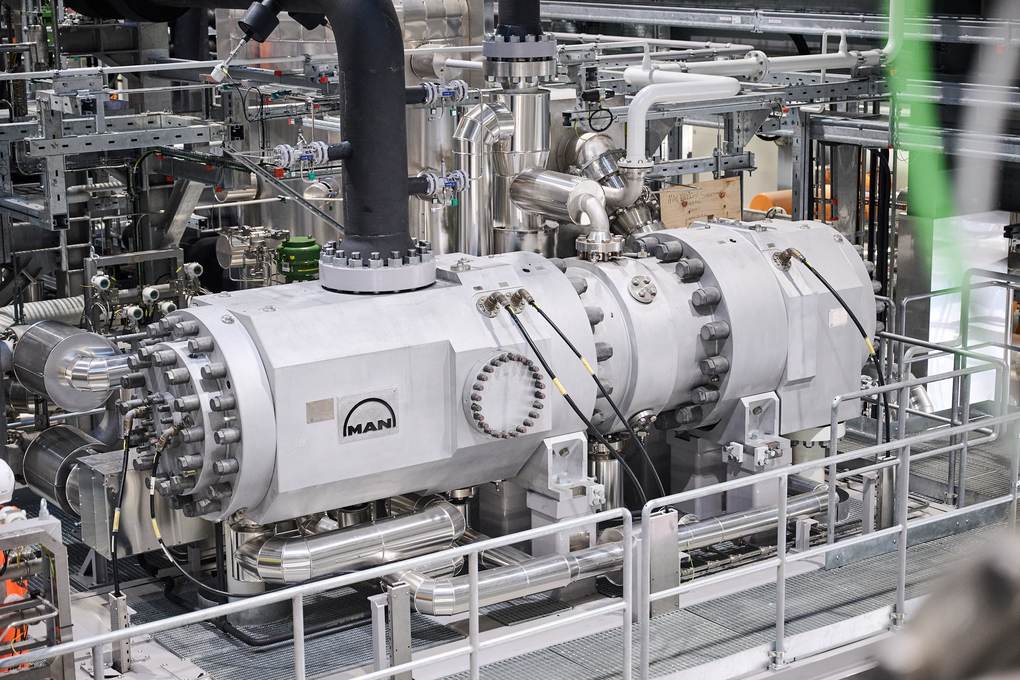
“It is of course a milestone we have looked forward to for a long time. Now all our customers in Varde and Esbjerg are getting district heating from the North Sea. It is a groundbreaking event for DIN Forsyning, but also for the climate. And even though we are out in West Jutland, I dare to call it a world premiere: The world’s largest CO2-based seawater heat pump to date is in operation,” director Helle Damm-Henrichsen said that day.
HOFOR’s 24-megawatt heat pump in Nordhavn will send water at up to 172°F (78°C) into Copenhagen’s pipes and heat about 12,500 typical apartments once it starts in early 2028. DR adds that Aalborg is on the way with a plant meant to cover a third of that city’s district heating needs.
Space and timing set the limits in Aarhus
Aarhus can’t lean on the sea as heavily as Esbjerg and Aalborg, Munk Jensen said. “It is simply because we lack the space for it. We don’t have any large harbor areas that are unused. Along our coastline there is forest or buildings, and so we don’t have that option in Aarhus.”
The price promise is a forecast, too. Kredsløb built it on current expectations for construction costs, electricity prices, raw material prices, emission allowances and taxes, and any of those can move before 2030.
Munk Jensen knows the clock is running. “Green transition starts with a green attitude. That is a mantra at Kredsløb, which Aarhus Municipality clearly supports too. I see the same among the people of Aarhus, who generally welcome the transition we are in the middle of. Now it is about keeping focus and working with purpose. We have come a good way, but there is still a fair bit of work ahead, and that requires us to stay on track toward 2030,” he said.
Kredsløb’s full Future District Heating plan proposal, updated in March 2026, is posted on the city’s public consultation site.
The next pumps are expected at Aarhusværket from 2028, and Kredsløb has set 2030 as the year the whole system should be in place.
Photo: Kredsløb