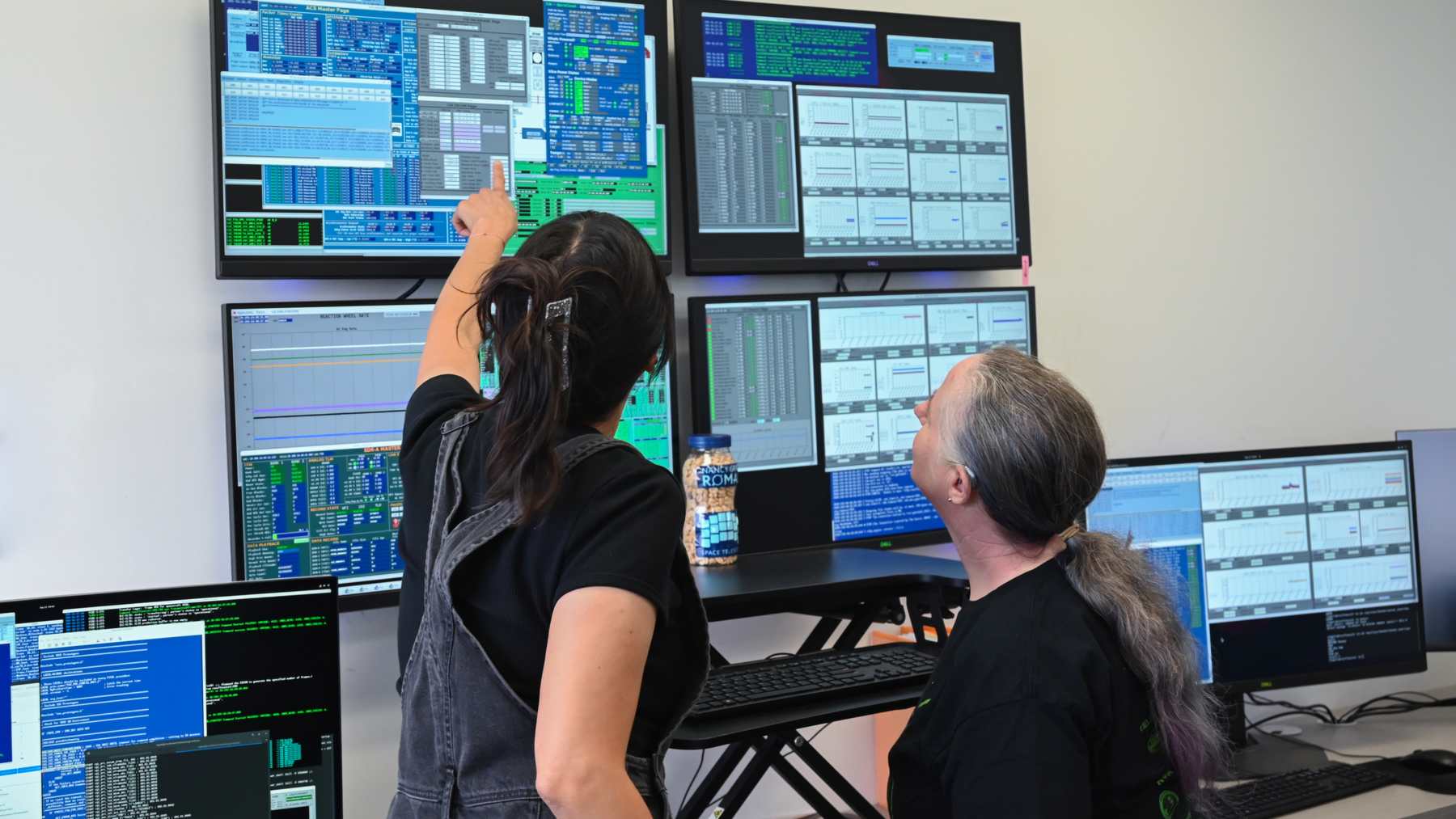
Two coronagraph operators, Amelia Nash and Judy Adler, sat in a control room at IPAC at Caltech in Pasadena on September 22, 2026, watching telemetry and waiting. Up in space, the Coronagraph Instrument on NASA’s Nancy Grace Roman Space Telescope was taking its first look at the real sky, a little over three weeks after launch, and its target was a faint star in the Large Magellanic Cloud. A week earlier, tests had shown that Roman could hold its aim to better than 1/100,000 of a degree for up to eight hours.
“We were kicking the tires, making sure light goes through the system,” said Vanessa Bailey, a Roman Coronagraph Instrument scientist at NASA’s Jet Propulsion Laboratory in Southern California.
Dominic Benford, the telescope’s program scientist, made a big claim for the hardware in a Space.com story published September 9. “The Roman Space Telescope is carrying the most advanced coronagraph that humanity has ever put into space,” he said.
The basic idea is old. “In fact, more than 100 years ago, astronomers used coronagraphs to create an artificial eclipse to study the sun’s corona,” Bailey said at a press briefing on August 29, the day before launch. “That’s the reason for the name.”
Guide stars keep Roman from drifting
None of that works if the telescope can’t sit still. “Every Roman observation relies on its ability to stay precisely pointed at the correct region of space long enough to collect an image, which can take from minutes to hours for a deep exposure,” said Begoña Vila, Roman’s guiding instrument systems lead at NASA’s Goddard Space Flight Center in Greenbelt, Maryland.
Julie McEnery, Roman’s senior project scientist at Goddard, talked about the setup on The Planetary Society’s Planetary Radio five days before launch. “If you think about say the detector in a iPhone camera, it’s almost like the wide field instrument is one part and the coronagraph is another part,” she said. “So we’re just looking at different parts of our field of view with the two instruments. And this is important because the wide field instrument provides the information needed for the observatory to do fine guiding, to precisely stay looking at exactly where we want it to look at. So it has to operate at the same time that the coronagraph is making its observations.”
A small part of each of the Wide Field Instrument’s 18 detectors is set aside to watch a separate guide star. “The fine-guidance system reports the positions of the guide stars about four times each second to the attitude control system, which can move the observatory a tiny amount to counter any drift as needed,” Vila said.
The tests ran from September 15 to 21. “Our tests confirmed that we are able to keep the observatory very stable for science operations: better than 1/100,000 of a degree for half an hour at a time for Wide Field Instrument observations or for eight hours at a time for Coronagraph Instrument observations, which take much longer,” she said. “This was a very exciting moment for the team.” NASA’s September 30 mission update says that’s like holding a laser on a U.S. dime from about 150 miles (240 kilometers) away.
Roman will try steering by spectra
“Roman doesn’t have a separate guider instrument, like other space telescopes do,” Vila said. “Instead of tracking only a star’s point-like appearance, it will guide on detailed wavelength patterns called spectra.” Spectra are what you get when a star’s light is spread out by wavelength, and Roman is already built to measure them for science. Her team was looking forward to validating that mode “in the coming weeks.”
The coronagraph found its stars
The coronagraph has its own internal stability process too, “making it much more stable even than the Wide Field Instrument,” Vila said. It needs every bit of that. Bruce Betts, chief scientist at The Planetary Society, said on the same episode that a star is often tens of billions of times brighter than an Earth-like planet circling it, a target for a future observatory rather than for Roman. “It’s basically a mosquito flying in front of a spotlight,” he said.
On September 22 the team tweaked the focus and pointed at a faint star in the Large Magellanic Cloud, a small galaxy next to ours. “This observation confirms that the instrument can produce a focused image,” Bailey said. The picture was noisy, and that was expected. Eric Cady, the JPL optical engineer leading the coronagraph’s commissioning, had said on September 15 that the team was “sitting idle with our detectors warm so anything that’s stuck to the surface, such as water or trace chemicals, will tend to leave it.”
“The second step, on Sunday, was an observation that confirmed our pointing,” Bailey said of the follow-up on September 27. “The team cooled the detectors down for better sensitivity, and we observed a new location in the Large Magellanic Cloud where we expected to see many stars in a single image. And we did! We’re breathing a sigh of relief!”
Mirrors that move less than an atom
Hubble and Webb have coronagraphs as well, but JPL notes they’re passive and can’t be changed once they’re running. Roman’s is the first active one in space. It has two deformable mirrors, each about 2 inches (5 centimeters) across, and more than 1,600 actuators push and pull on each one to cancel tiny flaws in the telescope’s optics, so planets or the dusty disks around young stars can show up beside a star’s glare.
“These deformable mirrors are a real engineering feat,” Bailey said at the briefing. “They can be commanded with the precision approaching the size of an atom, and this is what really allows us to make this transformative performance.”
Ilya Poberezhskiy, the coronagraph’s project systems engineer at JPL, told MIT Technology Review that the mirror surface moves in steps as small as roughly 10 picometers, about a tenth the diameter of a hydrogen atom, to clear a “doughnut-shaped region around the star where we suppress starlight and where we’re hoping to see exoplanets.”
Getting that right on the ground took patience. “The flaws are so small and have such a minor effect that we had to do over 100 iterations to get it right,” Feng Zhao, deputy project manager for the coronagraph at JPL, said in 2024, when the instrument shipped to Goddard.
JPL says the instrument is designed to detect planets 100 million times fainter than their stars, including one like Jupiter in size, temperature and distance from its star. “We’re not looking at the star. We’re not looking at the effect of the planet on the star,” said Meredith MacGregor, an astronomy professor at Johns Hopkins who has secured a Roman observing program. “We are actually looking at the planet, and that is super powerful.”
Split into its colors, that faint light can say something about an exoplanet’s atmosphere, and MacGregor is bracing for the workload. “I’m honestly a little terrified about how we’re all going to deal with it, because I think it’s just so much data,” she said. “I think people will legitimately still be working on Roman data for decades.”
No planets in the pictures yet
None of the September images shows a planet. Bailey called the first one “a very limited test that kicks off a methodical process of increasingly complex tasks,” and the spectral guiding mode was still waiting to be validated when NASA wrote its update. NASA also hopes more tuning will stretch the dime comparison to about 230 miles (370 kilometers).
The coronagraph is a technology demonstration with roughly three months of observing time spread across Roman’s first year and a half, and MIT Technology Review warned that even a Jupiter-like planet will probably look like a few pixels. NASA plans Roman’s first science images by early 2027, and the telescope will also look for planets through microlensing and the transit method.
NASA described the guidance tests and the first coronagraph observations in a mission update published on September 30, 2026.
Brandon Creager, the coronagraph’s lead mechanical engineer at JPL, has worked on the instrument since 2018. “Not too many people get to say, ‘I built something and it’s taking a picture of a planet that’s at a star that’s 50 light-years away or 100 light-years away,'” he told MIT Technology Review. What he hopes people remember is “that critical stepping stone for … finding Earth 2.0.”
Photo: Caltech/IPAC – SELab/Isabel Swafford