A porous material developed in Germany could harvest nearly half a gallon of water per day from air containing only 18% relative humidity. A 2.2-pound amount of the material can capture water vapor at room temperature, then release it when heated to about 158°F.
The advance does not mean a countertop water machine is ready for stores. But a team at Kiel University has improved the speed, production scale, and possible cost of a system designed for dry regions, including the increasingly water-stressed Mediterranean.
A microscopic sponge for dry air
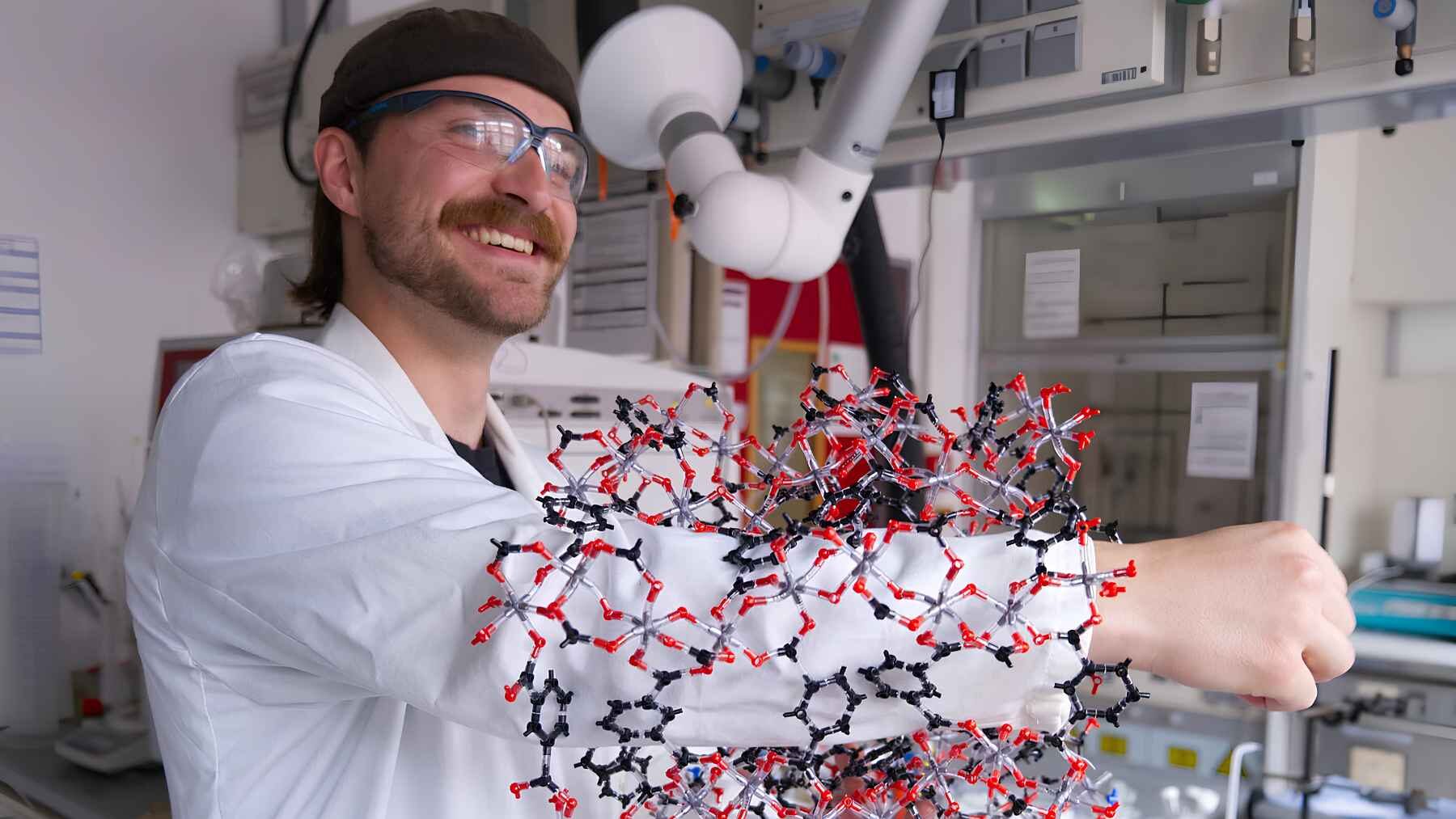
The material, called CAU-10-H, belongs to a group known as metal-organic frameworks, or MOFs. These crystalline structures contain vast networks of tiny connected pores, giving even a small amount an enormous internal surface where water molecules can collect.
The key process is adsorption. Unlike absorption, where liquid soaks into a material, adsorption makes vapor molecules cling to internal surfaces. The air does not have to be chilled below its dew point, which is how many conventional atmospheric water generators force water to condense.
Nearly half a gallon every day
Under dry test conditions, the composite held water equal to about 17% of its own weight. Because a complete capture-and-release cycle takes only a few hours, the same material can work several times in one day, potentially producing nearly half a gallon from a 2.2-pound unit.
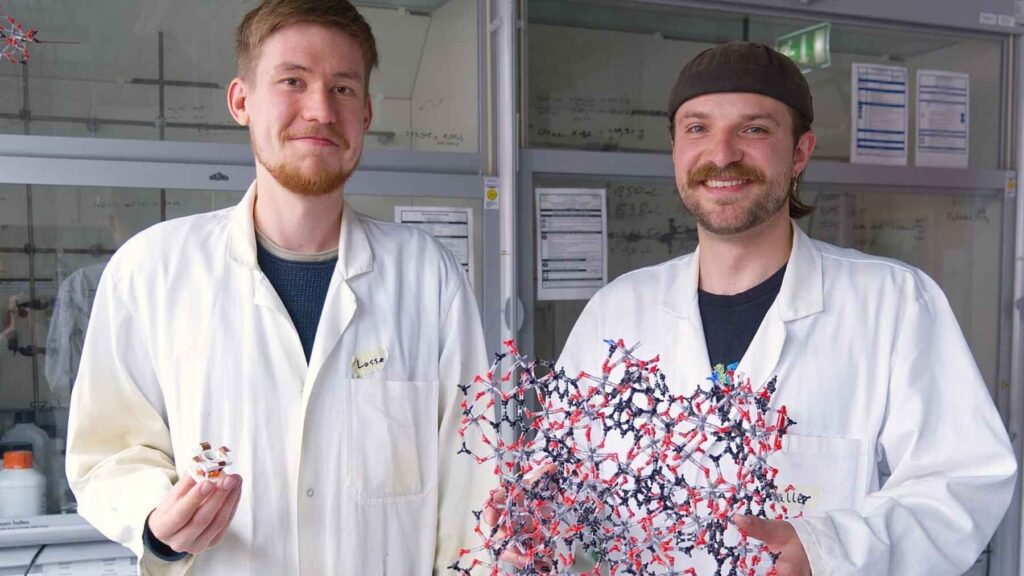
How can that work when the air feels almost empty of moisture? Even dry air still carries water vapor, and CAU-10-H is designed to catch those scattered molecules selectively. “This makes the material particularly attractive for producing drinking water, even in arid regions,” first author Lasse Wegner said.
Heat resets the material quickly
At room temperature, the pores fill with moisture. Once the material reaches roughly 158°F, it lets the stored water go, allowing it to begin another cycle. Capture, heat, release, repeat.
To speed that reset, the team combined CAU-10-H with electrically conductive carbon foam. An electric current heats the carbon from within through a process called Joule heating, while sunlight can also provide the energy needed for regeneration. Faster heating means more cycles and more water each day.
Pilot production moves beyond the lab
Materials that perform beautifully in a small sample often stumble when factories try to make them by the ton. CAU-10-H has been studied for about 15 years, but the latest scale-up work led by Kalle S. Mertin produced roughly 66 pounds, around 60 times more than earlier laboratory batches.
That pilot run gave the researchers a clearer view of raw materials, energy use, production time, and cost. Their techno-economic analysis estimated manufacturing expenses at roughly $5.50 to $6.35 per pound, although a finished water device would cost more because it would still need heat exchangers, condensers, filters, electronics, and a protected storage tank.
The harvested water is not automatically safe
Pulling moisture from the sky is only the first step. Outdoor air can carry dust, fine particles, microbes, and volatile organic compounds, while any commercial unit would also have to prove that the adsorbent does not release unwanted substances into the collected water.
A drinking-water system would therefore need air filtration, controlled condensation, hygienic storage, and likely disinfection. The final water may also contain few minerals, so treatment requirements could include remineralization depending on local health rules. The glass still needs safeguards.
Cooling may be the bigger opportunity
CAU-10-H can also work inside adsorption cooling systems, which use repeated water-vapor cycles to produce refrigeration. Tests cited by the researchers indicate that it can deliver up to three times the cooling capacity of silica gel, a common moisture-adsorbing material.
That creates an intriguing use for low-temperature waste heat from data centers, bakeries, food plants, commercial kitchens, and other industrial sites. Instead of letting that warmth drift away, operators could use it to regenerate the material and produce cooling with less electricity than conventional air conditioning may require. On a sticky summer day, that could matter for both the grid and the electric bill.
Where this technology could fit
Atmospheric water harvesting is unlikely to replace reservoirs, desalination plants, or wastewater reuse systems. Its more realistic role is decentralized, providing smaller amounts of water at isolated homes, farms, shelters, industrial facilities, emergency sites, or communities where pipes and tanker deliveries are costly.
A hybrid setup could collect moisture at night, when relative humidity often rises, then use daytime sunlight to release and condense the water. In factories or data centers, waste heat might keep the cycles running for longer periods and could support both water production and cooling.
The hard tests are still ahead
The next challenge is not making more material. Engineers must build compact devices and test how CAU-10-H handles dust, pollution, changing temperatures, direct sun, and thousands of repeated cycles without losing performance.
Durability will decide whether the numbers make commercial sense. A low-cost adsorbent that wears out quickly offers little advantage, while one that works for years with limited maintenance could become a useful tool in places where water, cooling, and energy are all under pressure. It will not solve the water crisis alone, but it may fill important gaps.
The main study was published in Journal of Materials Chemistry A.
Most read
- US scientists poured 16,500 gallons of lye into the Gulf of Maine and dyed the water bright pink to track it, the first federally approved try at reversing ocean acidity
- Soviet scientists released giant red king crabs into the Barents Sea in the 1960s to build a fishery, but decades later those invaders are still changing the seafloor
- New Orleans is collecting thousands of used Christmas trees and dropping them from helicopters to slow the loss of land, which has already exceeded 5,000 square kilometers
- Britain is dropping 20 concrete reef cubes and 44 tons of scallop shells into the sea, and the goal is to bring back oysters down more than 95% since the 1800s
- The U.S. will pay up to $65 million to leave Colorado River water in Lake Mead, and Hoover Dam explains why