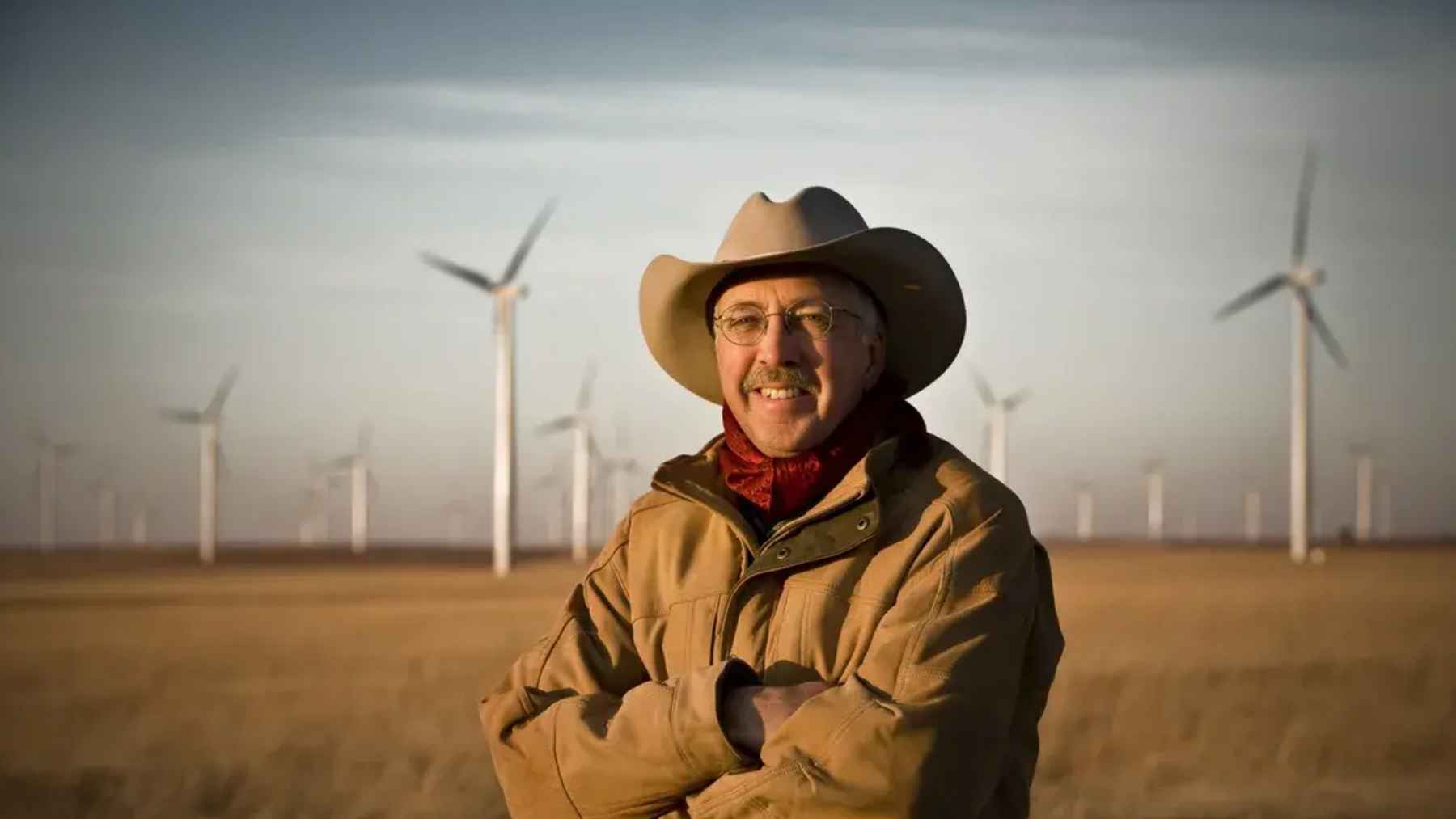
Fifty wind turbines now rise above a 7,000-acre cattle ranch in the Flint Hills of Kansas, yet the feared collision between clean energy and ranching never arrived. Two decades after the Elk River Wind Project began operating in 2005, cattle still graze beneath the towers while wind royalties provide about half of rancher Pete Ferrell’s income and help keep the land in the family.
That is the unexpected lesson from Ferrell Ranch. The turbines did not replace the cattle or swallow the prairie, and the herd reportedly found practical uses for the new structures, from following their moving shade in the summer heat to standing on firmer ground near access roads when spring mud takes over.
This Kansas ranch was using wind before it became political
Wind power is not entirely new at the Ferrell home. In 1923, Ferrell’s great-grandfather installed a small Jacobs Windjammer turbine and a glass battery, bringing electricity to the off-grid house long before modern towers appeared on the horizon.
“Renewable energy was just practical,” Ferrell told Environmental Defense Fund’s Vital Signs. Even so, when a major developer first approached him about leasing land for industrial turbines in the 1990s, his initial answer was “a pretty hard no” because he feared the project would ruin the landscape.
A visit with California ranchers changed his thinking. They were still caring for their land and livestock around turbines, which helped Ferrell see that energy production and grazing did not necessarily have to compete for the same space.
Wind became the ranch’s most reliable crop
Ranching can turn on forces no family controls. Cattle prices rise and fall, rain can disappear for months, and a severe drought can quickly shrink both grazing land and income.
The wind is different. Since Elk River launched, royalties have supplied roughly half of Ferrell’s income, giving the ranch a steadier financial base when the weather or cattle market turns against him.
Those payments have also helped position the property for another generation. Ferrell has said the wind farm will allow his two children and four grandchildren to continue the family’s connection to the ranch without inheriting the same financial burden, while the full project produces enough electricity to meet the annual needs of about 60,000 homes.
The turbines use less land than many people expected
The sight of 50 towers can make a wind project look as though it occupies everything around it. On the ground, however, most of the pasture remains open because the turbines themselves use a comparatively small footprint and cattle can continue grazing around them.
The supplied account says Ferrell calculated that foundations and access roads took up about 50 acres, or roughly one acre per turbine, within the 7,000-acre property. That math became one of his strongest answers to people who assumed an energy facility would push ranching aside.
Wildlife concerns still deserved attention. Ferrell said monitored greater prairie-chicken numbers fell during construction and then rebounded afterward, a reminder that site selection and continued monitoring matter even when a project ultimately coexists with working land.
The cows treated the towers like mechanical trees
What did the herd make of the supposed industrial invasion? Very little, apparently. Cattle do not care about renewable energy debates, tax policy, or whether a turbine looks beautiful from the highway.
They care about comfort. According to the supplied account, the animals began using the towers’ moving shadows for relief during hot Kansas days, while concrete bases and gravel access roads offered higher, drier footing during muddy periods.
In practical terms, the cows folded the equipment into their normal routine. Instead of avoiding the machines, they treated them almost like giant mechanical trees scattered across the grassland.
One ranch offers a wider lesson for rural clean energy
Ferrell’s experience does not prove that every proposed wind farm belongs in every landscape. Local ecology, migration routes, community concerns, transmission needs, and construction impacts still require careful review.
What the ranch does show is that the choice is not always cattle or turbines. With a small physical footprint and dependable lease income, wind energy can sit alongside agriculture and give families another way to survive drought, debt, and uncertain commodity prices.
Twenty years later, the cattle still graze, the prairie remains working land, and the turbines help pay the bills. The original report was published on “Vital Signs”.