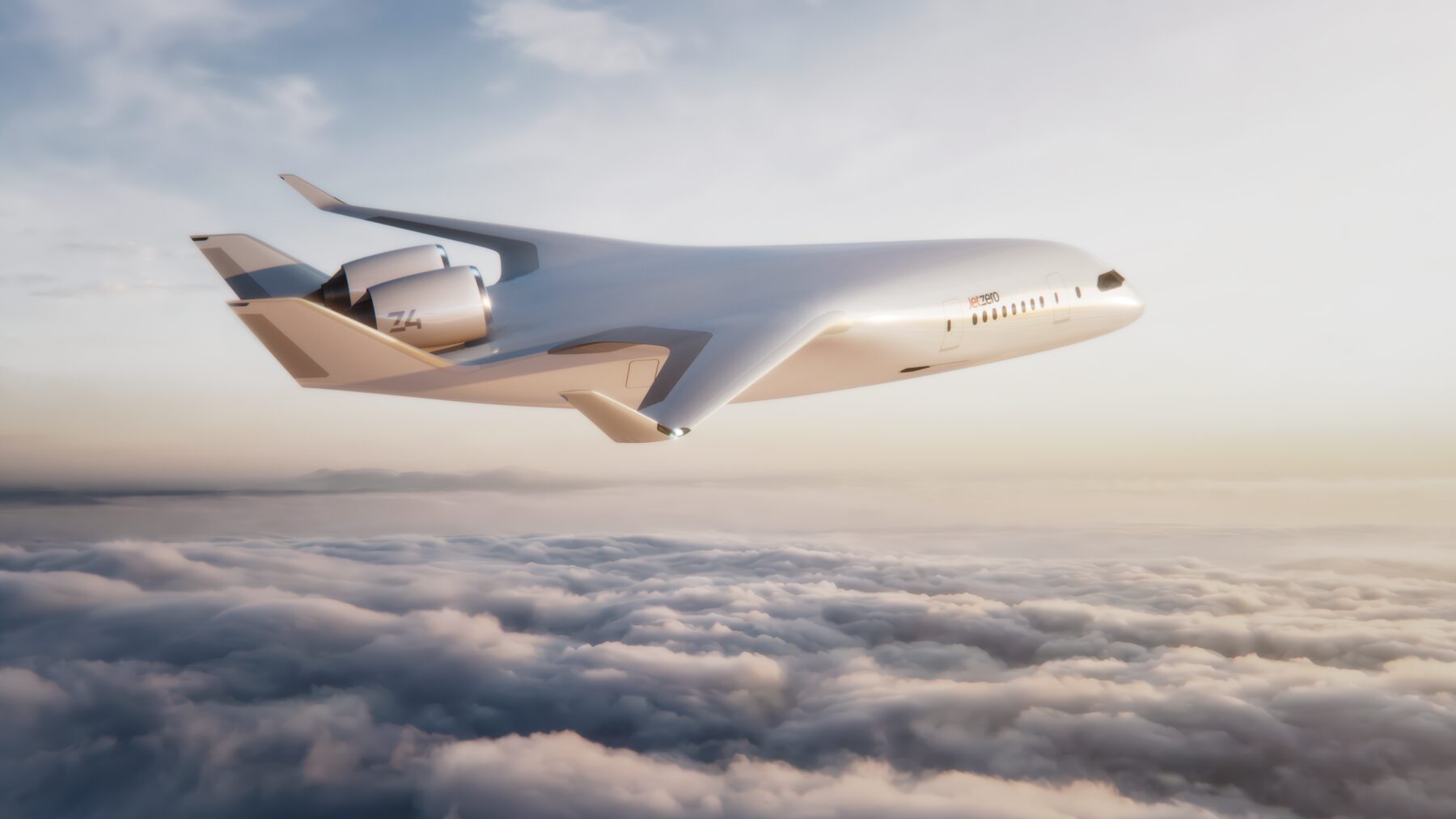
A passenger jet that looks more like a broad wing than today’s familiar airliners is moving closer to a real-world test. California-based JetZero says its planned Z4 will carry about 250 passengers, fly roughly 5,750 miles, and use 30% to 50% less fuel than aircraft in service today.
The company presented the project during the Farnborough International Airshow, held in the United Kingdom from July 20 to July 24, 2026. Japan Airlines has now joined the program to provide operational input as the developer targets commercial service in the early 2030s, but one important fact remains. A complete passenger version has not yet been built or certified.
A wider body that helps the plane fly
So how could an aircraft’s shape save that much fuel? Most commercial jets use a “tube-and-wing” layout, with passengers inside a cylindrical fuselage while two separate wings produce most of the lift that keeps the aircraft in the air.
The Z4 uses a blended-wing-body configuration. Its wide, flattened center section flows gradually into the wings, allowing much more of the structure to generate lift and creating a smoother path for air around the aircraft. Less aerodynamic drag means the engines need less energy to push the plane forward.
This is not quite the same as the flying-wing layout used by the B-2 Spirit and B-21 Raider bombers. Those aircraft are essentially built around one continuous wing, while a blended-wing design still has a recognizable central body for the cabin. Think of it as a bridge between a conventional jet and a flying wing.
Why the fuel claim matters
Jet fuel is a major operating expense, so a reduction approaching 50% would affect both environmental performance and the cost of flying each seat. For the most part, burning less conventional aviation fuel also means producing less carbon dioxide on the same trip.
Still, the number is a company target, not a result from a certified passenger aircraft. Even if the Z4 reaches it, the plane would not be emission-free, and the final savings would depend on route length, payload, weather, engine choice, and how airlines configure and operate it. That distinction matters.
The proposed capacity also fills an awkward space in today’s market. With about 250 seats, the aircraft would sit between the largest single-aisle jets and the bigger twin-aisle models used on many long-haul routes. Its projected range could cover a large share of medium- and long-distance services without forcing airlines into a much larger aircraft.
A concept tested before, but never sold
The basic idea has been studied for decades. A Boeing, NASA, and U.S. Air Force team flew the remotely piloted X-48B and X-48C demonstrators more than 100 times, examining low-speed stability, takeoffs, landings, and flight-control behavior. The tests showed that an unusual, tailless aircraft could be controlled through demanding parts of a flight.
Airbus followed another route with MAVERIC, a small remote-controlled demonstrator that first flew in June 2019. The manufacturer estimated that its blended-wing-body configuration could reduce fuel consumption by as much as 20% compared with a current single-aisle aircraft using the same engine.
Those projects helped engineers understand the shape, but neither became a commercial passenger jet. JetZero is trying to cross that gap. That is the big difference.
The 2027 flight is the real milestone

Before passengers can board a Z4, the company must prove that the architecture works at full scale. Scaled Composites, a Northrop Grumman subsidiary, is building the Jet1 demonstrator which is scheduled to make its first flight in 2027.
The U.S. Department of the Air Force backs the project, selecting the developer for a $235 million blended-wing-body prototype effort. The military sees potential for lower fuel demand, longer range, and more efficient cargo movement, while the same testing could provide useful evidence for a future civilian aircraft.
Jet1 will not be a finished commercial airliner. It is a flying laboratory intended to validate aerodynamics, stability, control systems, and the practical behavior of a large blended-wing aircraft. If the test program exposes serious problems, the Z4’s timetable or design could change.
Japan Airlines brings the airport reality check
What happens when a futuristic outline meets an ordinary airport gate? The developer says it is designing the Z4 to use existing airport infrastructure without specialized or costly changes, a crucial point for airlines that cannot rebuild terminals, taxi routes, and ground equipment around one new model.
Japan Airlines will contribute experience in flight operations, cabin service, maintenance, and ground handling. The two companies also plan to study gate management and a future maintenance, repair, and overhaul system that could support operators after entry into service.
Takao Suzuki, the airline’s executive officer for corporate strategy, said the collaboration supports its commitment to “sustainable innovation and net-zero emissions by 2050.” JetZero chief executive and co-founder Tom O’Leary said the goal of bringing the aircraft to market in the early 2030s fits the carrier’s longer-term plans.
Big promise, difficult certification
A wider cabin could offer more space and a different boarding experience, but its shape creates engineering questions that ordinary cylindrical fuselages have already solved. Engineers must show that the noncylindrical passenger compartment can withstand repeated pressurization, while regulators will examine emergency evacuation, structural strength, systems reliability, and passenger safety.
That work is slow for a reason. Commercial aircraft must perform safely every day, not just look convincing in computer images or complete a successful demonstration flight. The Z4’s fuel-saving promise is striking, but certification and routine airline operations will decide whether it truly changes aviation.
The official announcement has been published by Japan Airlines’s website.
Most read
- US scientists poured 16,500 gallons of lye into the Gulf of Maine and dyed the water bright pink to track it, the first federally approved try at reversing ocean acidity
- Britain is dropping 20 concrete reef cubes and 44 tons of scallop shells into the sea, and the goal is to bring back oysters down more than 95% since the 1800s
- Soviet scientists released giant red king crabs into the Barents Sea in the 1960s to build a fishery, but decades later those invaders are still changing the seafloor
- New Orleans is collecting thousands of used Christmas trees and dropping them from helicopters to slow the loss of land, which has already exceeded 5,000 square kilometers
- The U.S. will pay up to $65 million to leave Colorado River water in Lake Mead, and Hoover Dam explains why