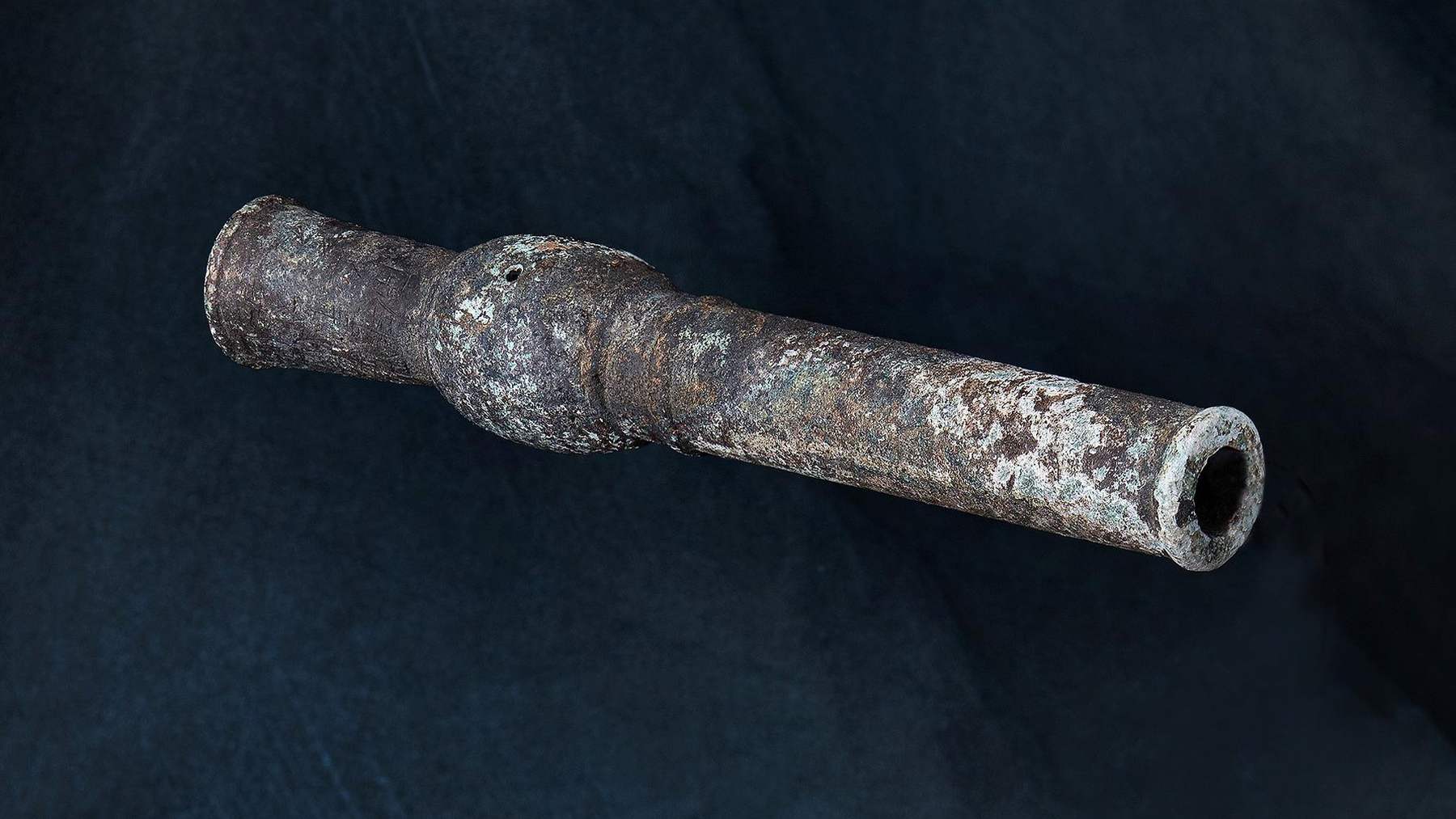
“There’s a metallic object here!” a soldier called out, according to the Chosun Ilbo, when his detector beeped against a rock face high on Geumseongsan Mountain in Naju, South Korea, in November 2023. He was hunting for land mines. What he dug up was a corroded bronze tube that the Korea Heritage Service now calls the country’s oldest gunpowder weapon.
Its name is the Hwangja Hwatong. At 9.35 inches (23.75 cm) and 2.28 pounds (1,032 grams) it is small enough for one soldier to carry, and the 28 characters engraved on it point to either 1377 or 1437.
Found under a rock below a closed summit
In the agency’s words, “This piece was discovered by chance in November 2023 during a mine-detection sweep carried out ahead of trail construction on Geumseongsan Mountain in Naju.” The public had not been allowed up to the summit since 1966, when an Air Force anti-aircraft unit moved in, and the tube lay about 4 inches (10 cm) down in the dirt under a rock, roughly nine-tenths of the way up, the institute told the Chosun Ilbo.
“This is an extraordinary discovery with immense academic, historical and cultural value,” Cho Mi-soon, director of the Naju National Research Institute of Cultural Heritage, said at a press briefing at the National Palace Museum of Korea in Seoul, as reported by The Korea Times. “It comes from a crucial transitional period between the late Goryeo and early Joseon dynasties, when physical artifacts of firearms are exceptionally rare.”
A maker’s label cut into bronze
Six short columns, 27 characters in all, wrap around the socket where a wooden handle used to fit. In the agency’s translation they read, “In the twelfth month of the Jeongsa year, the Hwangja Hwatong was made. Its weight is one geun and 14 nyang. Supervised by Noksa An Hyu-bo; made by the artisan Seok.”
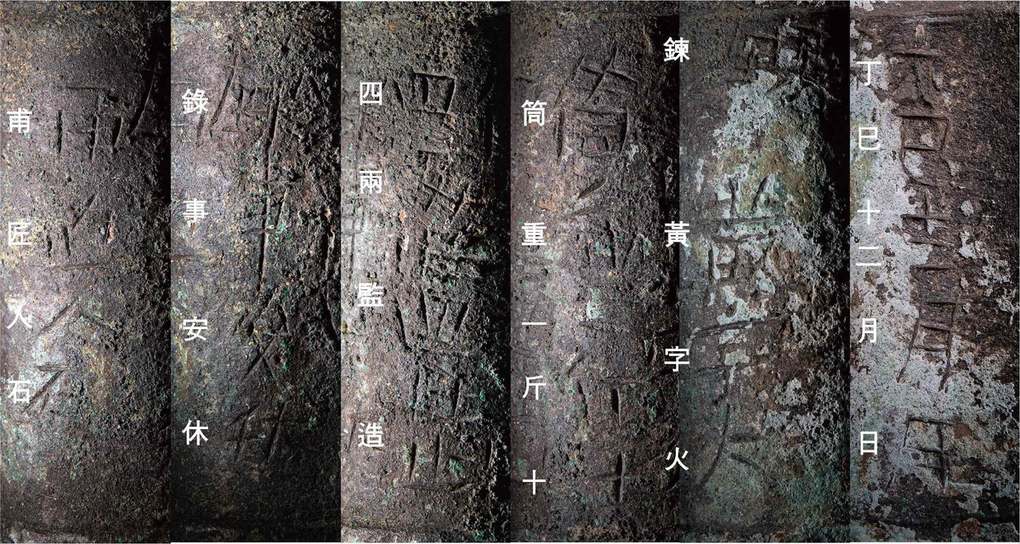
“This is the first small-scale firearm in Korea with the production date, name, weight, supervisor’s rank and name, and artisan’s name all engraved,” Eo Changsun, head of the institute’s academic research division, told the Chosun Ilbo.
“Hwangja,” or “yellow character,” is a class mark borrowed from the Thousand Character Classic, an old primer whose characters also served as cargo codes on the Sinan shipwreck. A lone 八, “eight,” on the muzzle was probably a manufacturing or inventory number, the agency says.
A Goryeo inventor and his fire tubes
“There is nothing better than gunpowder for suppressing Japanese marauders, but in our country no one knows about it.” That complaint is put in the mouth of Choe Museon by the Annals of King T’aejo, in the entry for his death in 1395, as translated into English by Choi Byonghyon and quoted by Medievalists.net in 2025.
Choe learned the recipe from a Chinese merchant he kept at his home for several weeks, the annals say. In 1377 the Goryeo court finally gave in to his lobbying and opened the Hwatong Dogam, an office for gunpowder weapons, and the gunpowder office he came to head turned out cannons, rocket arrows and a “gunpowder tube (hwat’ong).” “When these weapons were made, everyone who saw them was surprised and greatly admired them,” the entry says.
That year is one of two the inscription allows, because Jeongsa returns every 60 years. The other is 1437, under King Sejong, eight years before his court fixed new standard designs in 1445. “Either way, it is the earliest gunpowder weapon found in Korea,” the agency writes.
Pirates on the Yeongsan River
Eo has a theory about why it ended up in Naju, a town on the Yeongsan River about 174 miles (280 km) south of Seoul. “Geumsungsan was a geographical stronghold defending against Japanese pirates who sailed up the Yeongsan River to plunder the fertile plains,” he told the Chosun Ilbo. “In 1377, General Choi Museon proposed the Hwadongdogam to effectively counter Japanese invasions, and continuous pirate attacks persisted even in 1437 during King Sejong’s reign.”
The T’aejo annals describe what happened when Choe’s weapons first met a pirate fleet, in 1380. “Unaware that the Koreans possessed gunpowder weapons, the Japanese marauders clustered their ships together and fought back. However, Musŏn’s cannons devastated their fleet, completely destroying them.”
“This is the oldest confirmed cannon with a production date and location, Geumsungsan Mountain in Naju, filling a critical gap in the study of Korea’s firearm development,” Lee Sang-hoon, former deputy director of the Korea Army Museum, told the Chosun Ilbo. Until now the oldest Korean gun with a legible inscription was the Cheonja Chongtong of 1555, at least 118 years younger, which the National Museum of Korea calls “the largest gun made during the Joseon Period.” Heavy pieces like that one, or the 2,200-pound cannon builders found in Hull, England, came long after a hand-held tube like Naju’s.
Early guns resist neat labels
The release says the round interior of the powder chamber is “clearly unlike those of the improved firearms of Sejong’s reign,” and that the bronze, mostly copper, tin and lead, showed “evidence consistent with traditional casting methods.” The release stops short of picking a year. The institute told the Chosun Ilbo that “insufficient comparative data prevents confirming the exact year.”
Elsewhere in Asia, even dated early guns have been hard to classify. In a 2020 feature, Archaeology magazine described a bronze hand cannon from Kublai Khan’s summer capital at Xanadu, “Measuring just 14 inches long,” that “was stamped with a serial number and a date corresponding to A.D. 1298.”
“People often think Europeans were the first to understand the military implications of gunpowder,” Emory University historian Tonio Andrade, author of The Gunpowder Age, told the magazine for that feature. “But the Chinese understood gunpowder’s potential very early on.”
“What a gun looked like then is blurry by our standards,” Andrade said. “Even the Xanadu gun may have been more like a fire lance than what we think of as a gun.”
The spot under the rock on Geumseongsan gives no clue to who carried the Naju tube or whether it ever fired at a pirate boat, a gap familiar from chance finds like the 2,700-year-old sword a metal detectorist left standing in a Polish forest.
The findings were announced in a press release from the Korea Heritage Service on September 21, 2026.
Visitors can see the gun at the National Palace Museum of Korea in Seoul until November 22, 2026.
Photo: Korea Heritage Service / Naju National Research Institute of Cultural Heritage