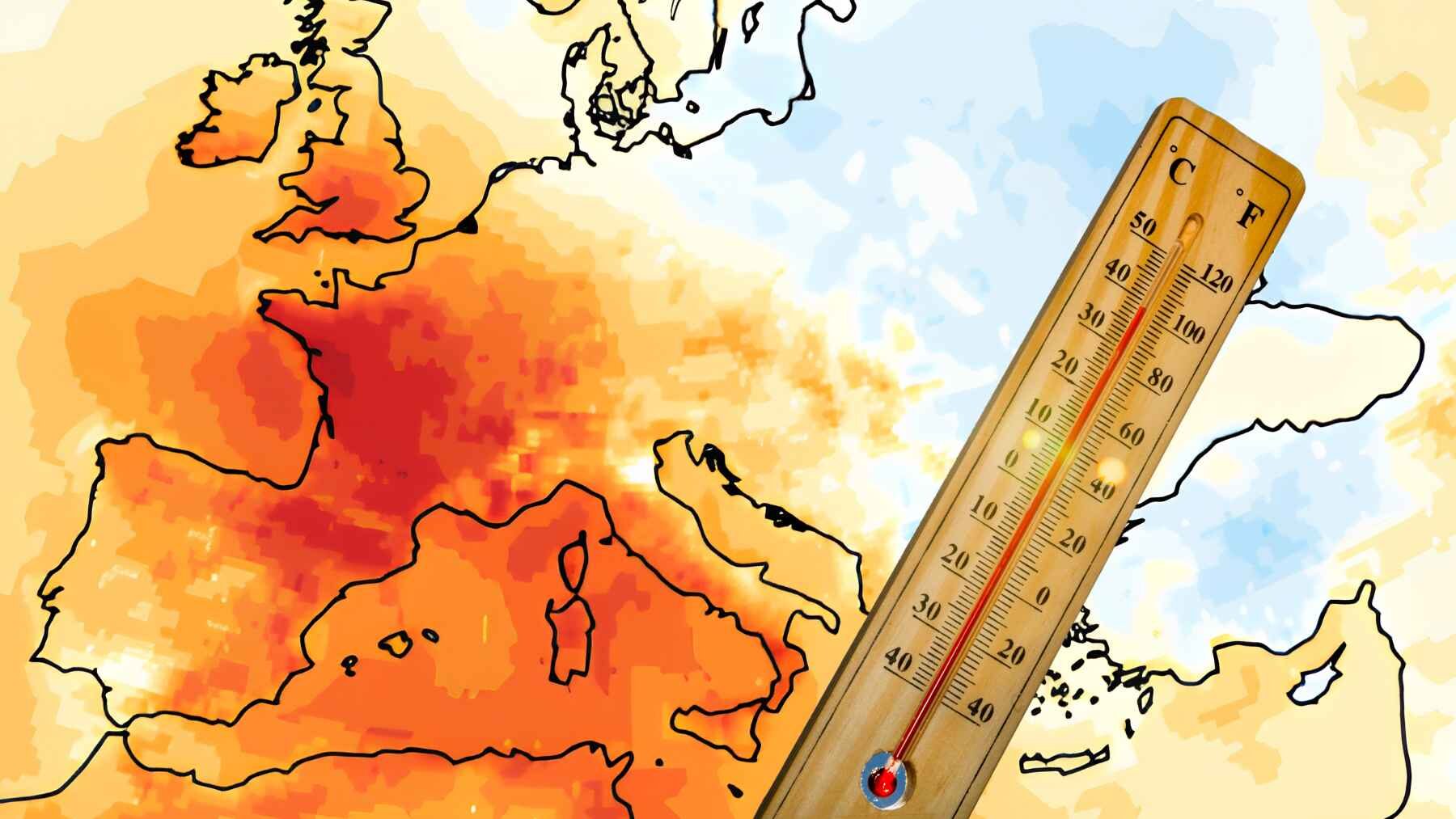
Europe’s summer green has faded with startling speed. Comparisons made with NASA’s Worldview tool show broad areas of France, the Iberian Peninsula, Italy, Britain, and Central Europe shifting toward yellow and brown within weeks, while new EU Copernicus measurements confirm exceptional heat, depleted soil moisture, and very low river flow across much of the same region.
A satellite image alone cannot diagnose drought, since harvesting, land cover, and normal seasonal aging also alter color. However, when the view from space matches rainfall, humidity, soil moisture, river flow, and drought indicators, the message becomes clear as Europe is drawing down the water stored across the landscape.
Europe changed color fast
NASA Worldview lets anyone browse, compare, and animate more than 1,200 satellite data products, many available within hours of acquisition. Its time controls make sudden landscape changes visible at a glance, much like flipping between two photos of the same backyard after weeks without rain.
The latest official imagery tells the same story. Copernicus Sentinel-3 images of France show green dominating in August 2024, more pale brown in 2025, and widespread beige and ochre by Aug. 8, 2026, when greener areas were largely confined to forests and uplands. More than 85% of France was under drought warning or alert conditions in mid-July.
Heat squeezed the land
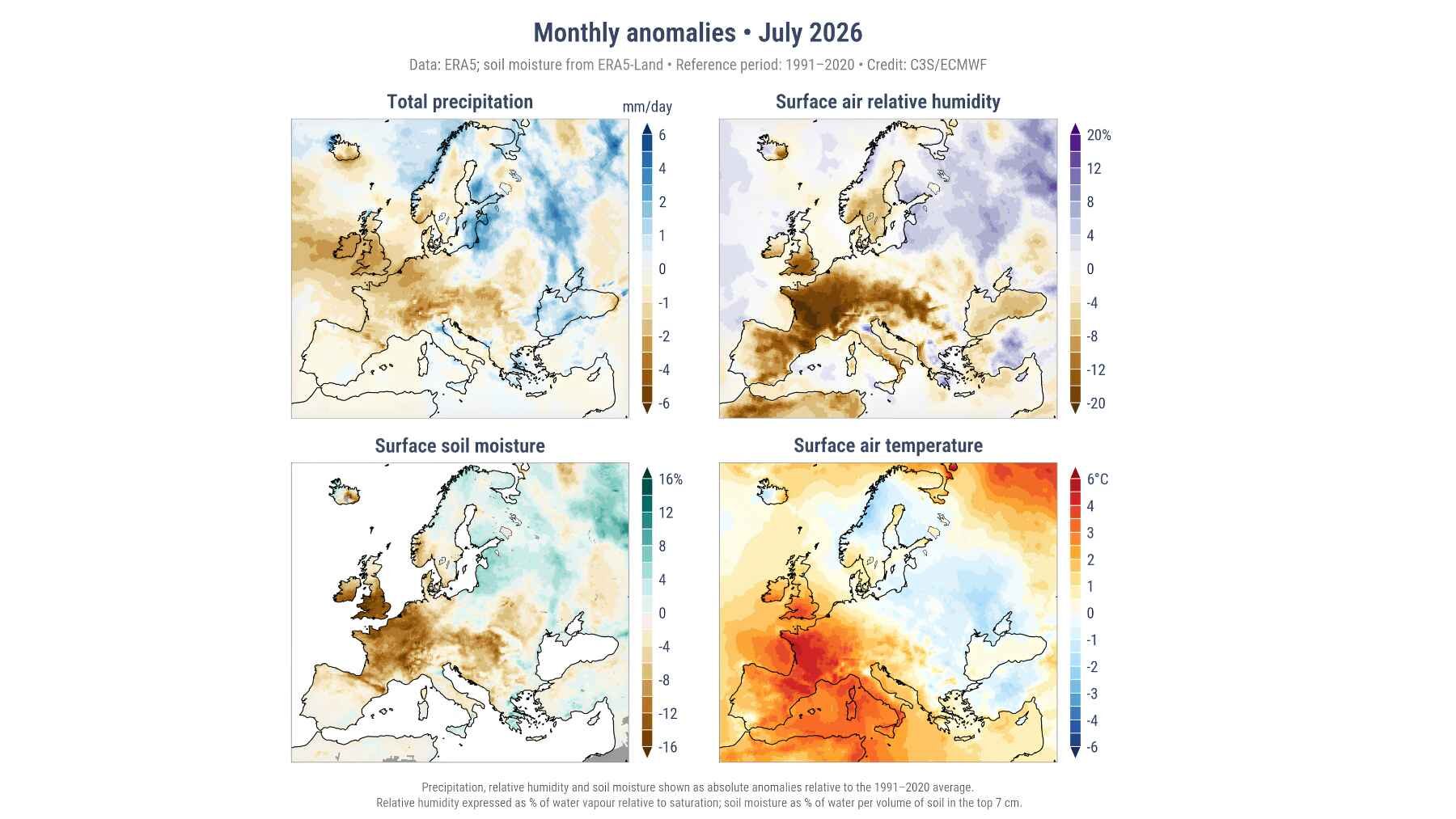
Western Europe averaged 21.62°C across June and July 2026, which was 2.79°C above the 1991 to 2020 norm and almost 0.9°C above the previous record set in 2022. Most of France, Spain, Belgium, Switzerland, England, and Wales experienced their hottest June and July period in the ERA5 record (the EU’s weather data set) beginning in 1979.
Heat does more than raise the number on a thermometer and make us sweat. It increases evapotranspiration, pulls water from soils and plants, and reduces evaporative cooling as vegetation dries. In July, surface soil moisture in parts of Iberia, France, Germany, Austria, and Hungary fell to its lowest monthly level since at least 1979.
Drought went deeper
By late July, the European Drought Observatory described conditions as stable and critical across western, central, and parts of eastern Europe, as well as the Balkans and Italy. Conditions worsened in the United Kingdom and Ireland, while warning zones persisted or expanded across France, southern Germany, the Alps, northern Italy, Belgium, and the Netherlands.
The European Commission’s Joint Research Centre found that scarce rainfall remained the main drought driver in central and eastern Europe, with severe heat compounding the damage farther west. Soil moisture and river flow were below normal, vegetation and crops were under heat and water stress, and yield impacts were expected.
Rivers carried the warning
A much below average river flow dominated across most of Europe in July. Copernicus reported exceptionally low conditions in the Seine, Rhine, and Danube systems, increasing pressure on reservoirs and water supplies while disrupting navigation, irrigation, and energy production.
That explains how a change first noticed as brown land from orbit reaches daily life. It can mean lighter cargo loads, tighter water restrictions, stressed aquatic ecosystems, and new pressure on electricity production during the relentless summer heat.
Dry growth became fuel
A wet winter can briefly hide the danger by encouraging grasses, shrubs, and other vegetation to grow. When intense heat and low rainfall arrive soon afterward, that extra biomass can dry into fuel, a sequence researchers describe as “weather whiplash.”
World Weather Attribution found that the seven-day fire weather seen in central Spain in July 2026 had become at least 20 times more likely than in a preindustrial climate, while the increase in southwestern France was at least twofold. Copernicus also reported exceptional western European wildfire activity, including nearly 104,000 acres burned in the Gironde fire and record daily French wildfire emissions for the time of year on July 24.
Climate change raised the odds
The drought analysis found that western Europe’s April to June soil moisture deficit was about five times more likely in today’s climate than in a world 1.4°C cooler. Across the eastern study region, the January to June deficit was about 11 times more likely, with rising atmospheric demand for moisture playing a central role.
Those figures describe large study regions, not every farm or forest, and they do not mean climate change started each wildfire. They do show that warming has shifted the background conditions, making severe soil drought and dangerous fire weather more likely and more intense.
Keeping rain where it falls
Europe cannot control when every storm arrives, but it can improve what happens after the rain hits the ground. Reconnecting rivers with floodplains, restoring wetlands and peatlands, protecting healthy soils, and using natural water-retention measures can slow runoff, support aquifers, and give landscapes a larger reserve before the next heatwave.
That is the real lesson inside the satellite images, since the crucial question is no longer only how much rain falls, but how much water remains in the soil, rivers, wetlands, and vegetation when the heat returns.
The official July climate bulletin was published on Oicus Climate Change Service.