Why does anything have mass? It is why a basketball feels heavy, but it is also tied to deep rules of physics. A new experiment now offers early evidence that a short-lived particle called the eta prime meson can briefly get trapped inside an atomic nucleus, forming an exotic “mesic nucleus” that had been predicted but never clearly seen.
The result suggests that the eta prime may behave differently inside nuclear matter than it does in empty space, including an effective mass change. It is not being presented as a final discovery yet, but it gives researchers a rare test of how the strong nuclear force, which binds the nucleus together, behaves in a crowded, high-density environment.
A quick guide to “mesic nuclei”
A meson is a tiny particle made from a quark and an antiquark, and it usually vanishes almost as soon as it appears. A mesic nucleus is what you get if that meson becomes a temporary “houseguest” inside the nucleus of an atom, held there only by the strong force.
The hard part is catching the moment. Mesons often decay or escape before detectors can tell whether they were ever bound, and the eta prime is a tempting target because it is unusually heavy compared with related mesons.
From a 2005 prediction to a 2026 signal
The basic roadmap for creating eta prime mesic nuclei was laid out about two decades ago. In 2005, Hideko Nagahiro and Satoru Hirenzaki described how these bound states could form and how they might show up as peaks in the kind of spectra nuclear physicists measure.
Over the years, theorists expanded those ideas into more detailed models of how strongly the eta prime might stick to a nucleus. A 2019 paper by Daisuke Jido also captured a sobering point – earlier experiments searching for similar signatures did not see a clean peak, so background “noise” was a major obstacle.
How you try to trap a particle that barely exists
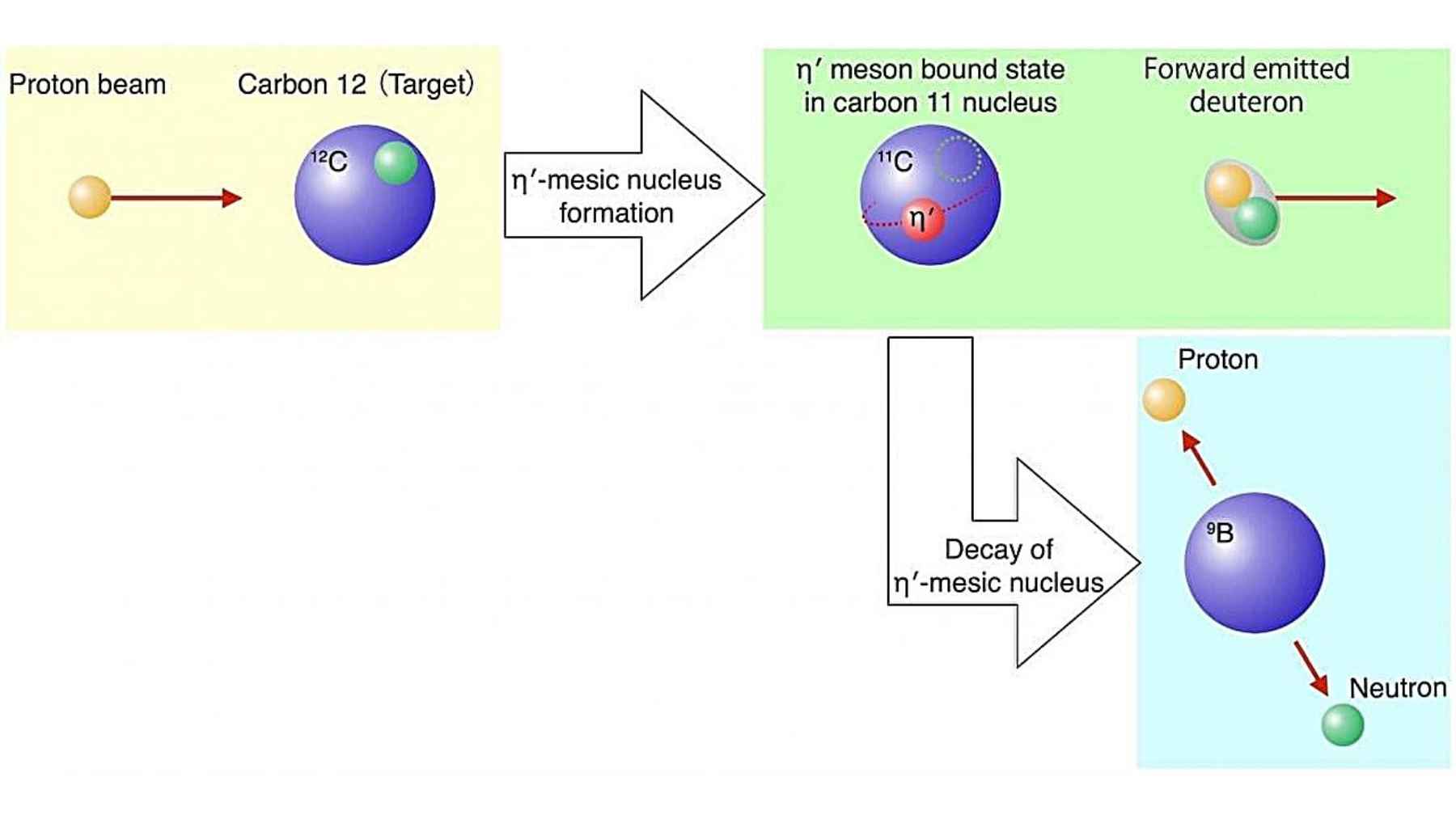
The experiment relied on a proton beam traveling at about 96% of the speed of light, roughly 179,000 miles per second. Those protons slammed into a carbon-12 target, and in some collisions the reaction produced a deuteron, the nucleus of “heavy hydrogen” made of one proton and one neutron.
By measuring the deuteron very precisely, the team could infer how much energy went into the rest of the event. In rare cases, that leftover energy can create an eta prime meson that does not immediately fly away, but instead hangs around inside the newly excited nucleus for a fleeting moment.
To sift those rare events from a mountain of ordinary collisions, the researchers worked at the GSI Helmholtzzentrum für Schwerionenforschung in Darmstadt, Germany, and combined two instruments, the Fragment Separator spectrometer and the WASA detector.
Kenta Itahashi of Osaka University said, “One particle of particular interest is the eta prime meson,” while lead author Ryohei Sekiya said the new setup means “we can identify structures in the data that match theoretical signatures of eta prime mesic nuclei.”
What the team saw in the spectrum
In practical terms, the search comes down to whether the data show bumps just below the energy needed to produce a free eta prime. The new analysis reports two such structures below that threshold, the kind of pattern you might expect if the meson can occupy more than one bound “orbit” inside the nucleus.
In a paper published April 7, 2026, the authors also put numbers on how tentative the signal still is. Using a dataset built from about 11 million recorded reactions over three days, they report about three and a half standard deviations locally, and about two after correcting for the “look-elsewhere” issue.
That adjustment matters because random bumps become more likely when you scan many energies.
This is where the nuance matters. In particle and nuclear physics, results often have to clear a higher bar before they are treated as confirmed, so independent checks and more data will be key.
Why this connects to the mystery of mass
When people hear “mass change,” it is easy to imagine something like a shrinking object. That is not what is happening here, and it would not change the number on your bathroom scale.
The deeper point is that, for many particles built from quarks, much of what we call mass comes from energy stored in the strong force fields. If the strong force behaves differently in dense nuclear matter, the effective mass of certain particles can shift, and the eta prime has long been viewed as a sensitive probe of that idea.
If the hint holds up, it would give physicists a new tool for testing how the vacuum of space, which is not truly empty in modern physics, changes inside the compact interior of nuclei. And that helps anchor big, abstract ideas in real measurements.
What comes next and why bigger beams help
The collaboration plans follow-up measurements designed to either strengthen the case or rule it out. That likely means more events, more decay channels, and tighter control of backgrounds that can mimic the same signatures.
There is also a practical reason to look ahead – more intense beams make rare processes easier to catch. The Facility for Antiproton and Ion Research, now being built in Darmstadt, is designed to deliver particle beams with higher intensity and quality, which could make future searches for exotic nuclear states far more sensitive.
For now, the safest summary is simple. Physicists have a promising new clue that an eta prime meson can briefly live inside a nucleus, and the next round of data will decide whether that clue turns into a clear detection.
The main study has been published in Physical Review Letters.