A solar-powered home can send electricity through a surprising obstacle course before it reaches the heat pump, battery, or appliance that needs it. That journey is mostly invisible. But it wastes energy.
New research suggests that shortening the route could reduce the annual electricity used by a home solar nanogrid by as much as 9.2%. The larger 16.7% figure applies to the modeled electric bill, not the amount of electricity consumed. An important difference.
Lead author Aaron Farha worked with Jonathan Ore, Elias Pergantis, Davide Ziviani, Eckhard Groll, and Kevin Kircher on the Purdue University project. Their results suggest that linking solar panels, a home battery, and a heat pump through direct current could preserve more locally generated power and reduce conversion losses.
Why electricity takes a detour
The power grid delivers alternating current, or AC, which repeatedly changes direction. Solar panels and batteries work with direct current, or DC, which moves in one direction.
Many electronics also convert AC back to DC inside the device. That is where the extra journey begins.
A solar panel may generate DC electricity, only for an inverter to change it into AC. A battery may then turn it back into DC for storage. Later, an appliance may convert it yet again.
Why all the back and forth?
Think of translating a sentence from English to Spanish and then back into English every time it enters a new room. The meaning survives, for the most part. Still, something is lost during each step.
Every electrical conversion can be highly efficient, but none is perfect. A little energy ends up as waste heat. Then it happens again.
What a nanogrid does
A nanogrid is a small electrical network inside one building. It connects local power generation, storage, and major devices.
It can remain linked to the wider power grid or, depending on its design, operate more independently. It is smaller than a microgrid, which may serve several buildings.
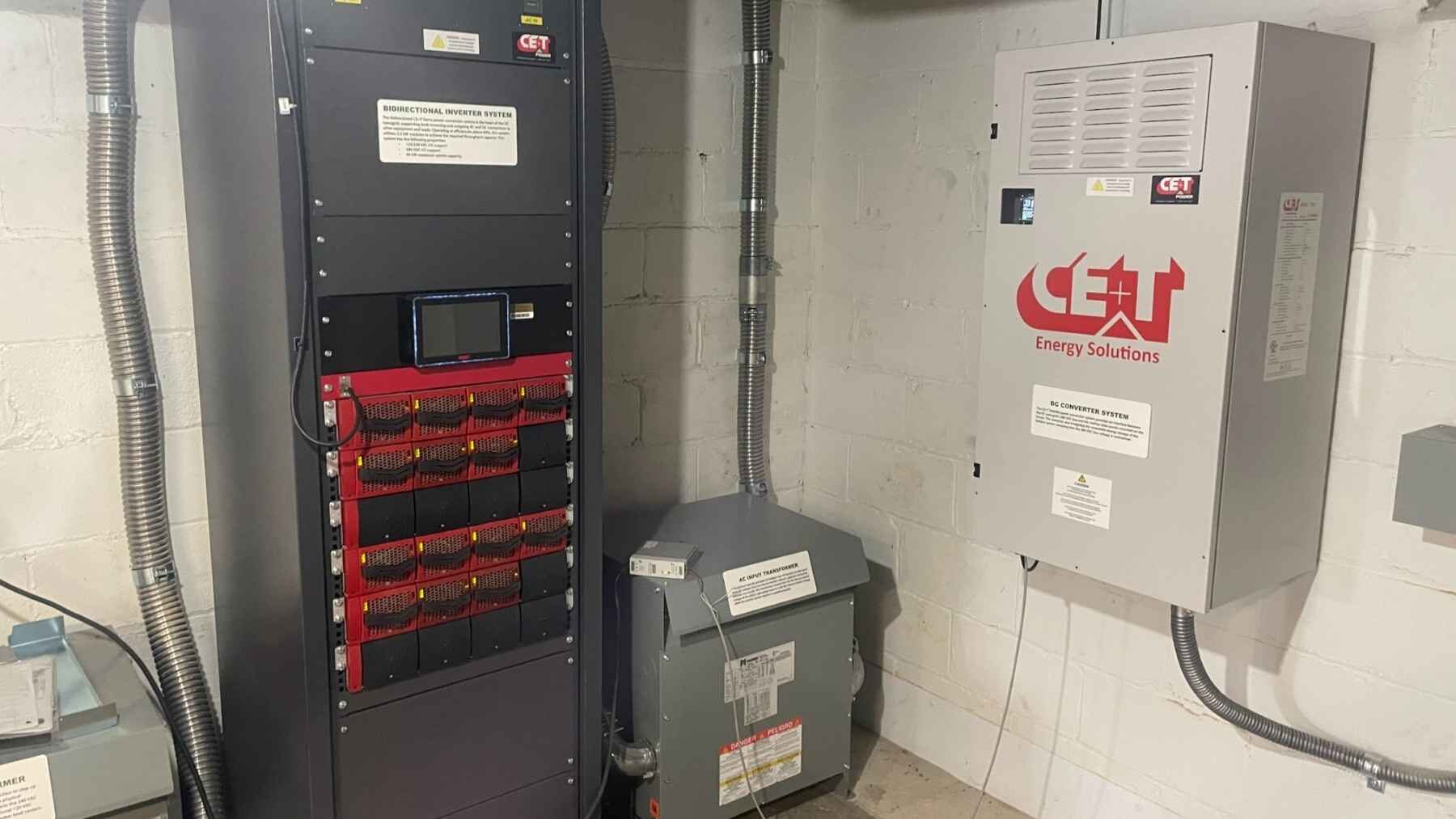
In practical terms, a DC nanogrid gives solar electricity a more direct path to a battery or compatible appliance. Fewer inverters and rectifiers mean fewer stops.
It is a bit like taking a side street that avoids several traffic lights. The destination stays the same. The route simply gets shorter.
The heat pump test
The researchers focused on a heat pump, one of the biggest electricity users in a fully electrified home. A heat pump moves heat rather than creating it from scratch.
It works a little like a refrigerator that can run in reverse. In summer, it moves heat outside. In winter, it brings heat into the home.
The team modified an off-the-shelf, variable-speed heat pump with four tons of cooling capacity so its outdoor unit could accept a 350-volt DC supply. It was not originally built for that.
First came controlled laboratory tests. The researchers tested both heating and cooling.
Then came the real-world part.
The system was installed in a roughly 2,240-square-foot house in West Lafayette, Indiana. The 1920s home serves as a living laboratory and is occupied by three graduate students.
That meant real people. Real thermostat settings. And real winter weather.
The field test ran from December 18, 2024, through January 16, 2025. Outdoor temperatures fell as low as about 16.5 degrees Fahrenheit.
The heat pump accounts for more than two-thirds of annual energy use in the house. So it was the obvious place to start.
Performance barely changed
Would running on DC make the heat pump itself perform much better?
Not really.
Laboratory performance on AC and DC was equivalent within about 6%. Weather-adjusted power use during the field test was also roughly the same within about 10%.
Those differences were comparable with the study’s measurement uncertainty. In other words, the modified heat pump worked about as well on DC as it did on conventional AC power.
That may sound underwhelming. But it is actually useful.
The main benefit did not come from a magically more efficient compressor. It came from cleaning up the route taken by electricity across the solar panels, battery, converters, and heat pump.
The plumbing of the power system was the real target.
Where the savings appeared
The researchers modeled three home energy setups using a full year of measured household demand, heat pump use, and matching solar data.
The model included a 14.3-kilowatt solar array and a 20-kilowatt-hour battery. It also prioritized sending solar electricity directly to the heat pump when possible.
In the conventional AC version, the electricity passed through more conversion stages. The two DC versions connected the major components through a shared DC system.
The first was a retrofit setup using a commercially available heat pump modified to accept DC. It reduced gross annual nanogrid energy use by 8%.
The modeled electricity bill fell by 12.5%.
The ideal setup used a heat pump designed for DC operation from the start. That version reached 9.2% in annual energy savings and 16.7% in bill savings.
Less energy used. An even larger percentage cut in the bill.
The dollar payoff was modest
Here comes the catch.
The modeled annual bill fell from $367.40 in the AC setup to $306.20 in the ideal DC design. That is a difference of $61.20 per year.
Helpful? Sure.
Enough to justify opening the walls of an existing house, replacing wiring, and installing specialized equipment? Probably not.
Using a simple ten-year payback target, the researchers calculated that no more than $612 in added retrofit costs could be justified for this particular house.
Today, specialized equipment and labor would likely cost far more. The math is tough.
Saving energy and making a renovation financially worthwhile are not always the same thing.
New buildings have a stronger case
The economics could look very different when a building is designed from the ground up.
New homes, apartment complexes, offices, and industrial sites could plan AC and DC circuits together rather than paying to remove working infrastructure later. The decision could be made before the walls are closed.
That changes things.
A hybrid system may be the practical middle ground. AC could continue serving standard outlets and connecting the building to the wider grid.
DC lines could handle solar panels, batteries, LED lighting, electronics, electric vehicle chargers, and selected heating equipment.
Each type of current would do the job it handles best.
Earlier research pointed the same way
The idea is not starting from zero.
A 2023 field study of a historic building in Cyprus found that a hybrid AC and DC system connecting solar panels, storage, and heating equipment pushed solar self-consumption above 85%.
It was a different building and a different experiment. Still, it tested the basic idea under real conditions.
A separate 2024 experiment examined Power over Ethernet lighting, which carries electricity and data through the same cable. That research also found that avoiding conversion stages could reduce energy use.
Lighting is a much smaller load than a heat pump. But the principle is familiar.
Fewer conversions. Fewer losses.
Important limits remain
This study does not prove that every home would reduce energy use by 9.2% or cut its bill by 16.7%.
The results came from one Indiana house and a model based on its equipment, solar production, energy demand, battery, and local conditions.
The model also did not fully represent voltage changes, grid interactions, system stability, fault protection, or long-term reliability.
So the percentages are case-specific. They are not a promise for every household.
Safety is another major issue.
Commercial DC heat pumps and compatible household equipment remain difficult to find. Safely disconnecting an active DC circuit can also be more challenging because the electrical arc may last longer than it does in an AC system.
Purpose-built components are needed. So are common standards, proper protections, and reliable installation cost data.
For now, rewiring an existing house solely to save $61.20 a year is unlikely to make much financial sense.
But for a new building filled with solar panels, batteries, electronics, heat pumps, and electric vehicles? That is a more interesting question.
The official study was published in Applied Energy.