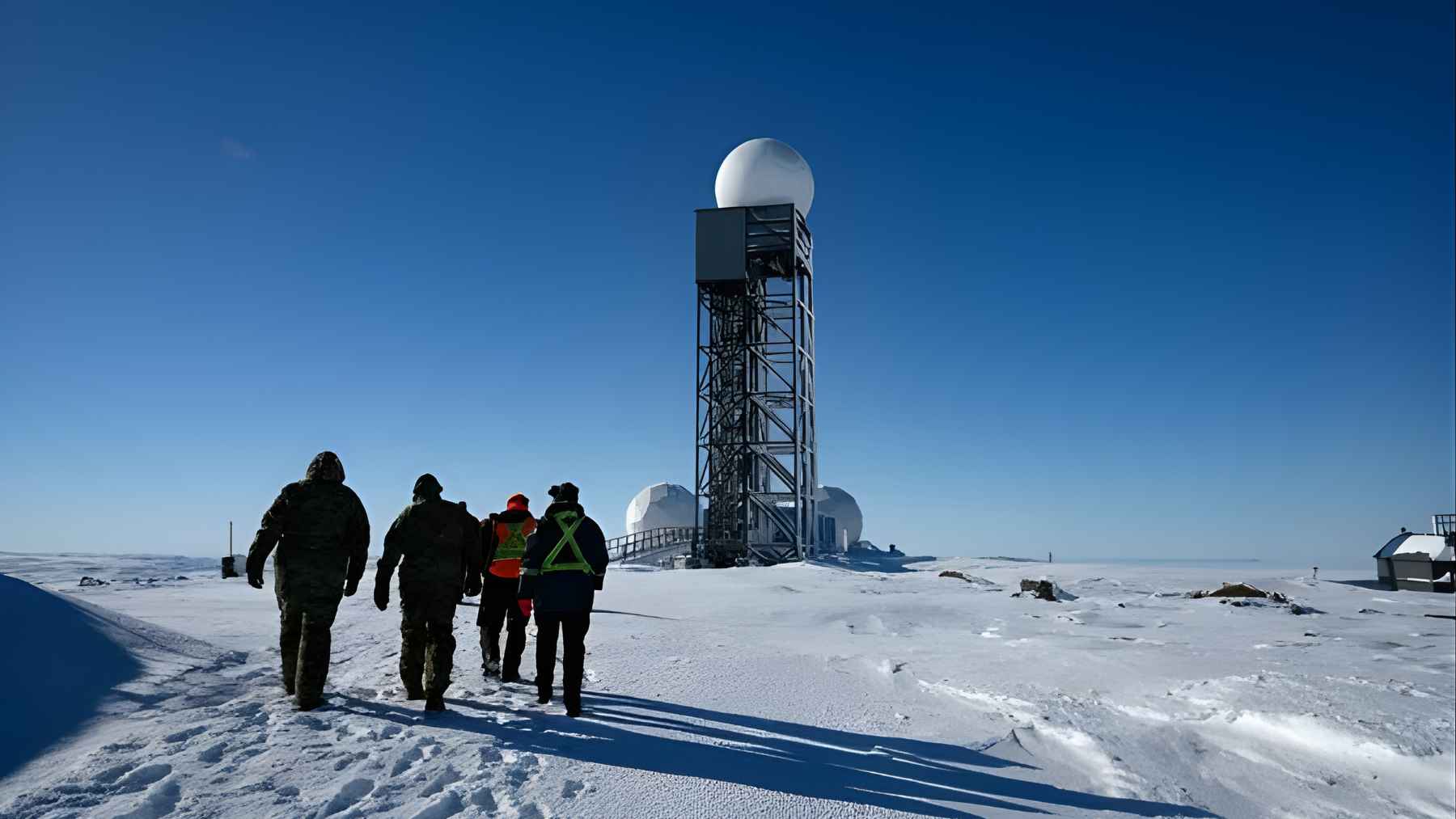
As sea ice retreats and new shipping lanes open across the top of the world, the United States is quietly racing to fix a dangerous problem in the High North. Its existing radars struggle to spot low-flying aircraft and slow ships near the pole, right where rival powers are pushing hardest for influence.
To close that gap, the Defense Advanced Research Projects Agency has launched a program called FROSTY that aims to turn Arctic electromagnetic chaos into a powerful new kind of radar. Instead of being blinded by the shimmering glow of the aurora, the system would use that noisy environment to track targets at long range, even when they hide below the horizon.
A warming Arctic and rising military tensions
The Arctic is warming about four times faster than the global average, opening seasonal sea routes where thick ice once blocked almost all traffic. That shift is already drawing more commercial ships along Russia’s Northern Sea Route and feeding Beijing’s ambition for a so-called Polar Silk Road that links Asia and Europe through the Arctic.
At the same time, Russia has rebuilt or expanded dozens of military sites across its long Arctic coastline, while China invests in ports, energy projects, and ice-capable ships that could have dual civilian and military roles. For Western planners, that means the top of the map is no longer a remote blank space but a crowded strategic theater.
Existing systems such as the North Warning System were built to watch for high-flying bombers coming over the pole, not low-flight drones or cruise missiles hugging the curvature of the Earth. Those radars send out microwave pulses that simply cannot bend far enough to see beyond the horizon.
On top of that, the ionosphere, a high layer of the atmosphere filled with charged particles, becomes wildly turbulent under the aurora. Radio waves passing through it get bent, scattered, and delayed, turning radar screens into something closer to a snow-filled old television than a crisp air traffic display.
Turning auroral noise into a usable picture
FROSTY’s core idea sounds almost upside down at first. Instead of trying to filter out all that Arctic radio noise, the program wants to use it. DARPA is asking industry teams to show they can detect airborne targets at ranges of at least 75 kilometers with more than 90 percent probability in this messy environment, a tall order even for cutting-edge sensors.
To do that, the system would lean on powerful high-frequency transmitters such as the High-frequency Active Auroral Research Program in Alaska, together with natural background radio emissions, to “light up” aircraft and ships indirectly.
Instead of listening for a clean echo from a single radar beam, FROSTY’s processors would hunt for tiny correlations hidden inside scrambled signals that have bounced through the disturbed ionosphere. Engineers compare this approach to passive sonar in the ocean, where submarines can be found by crunching the ambient noise rather than firing an obvious ping.
Test campaigns are planned in central and northern Alaska, including areas under the auroral oval where space weather effects are strongest.
Locations such as Point Barrow and the Poker Flat Research Range, a university-owned rocket site operated by the University of Alaska Fairbanks, offer both access to the Arctic Ocean and an existing network of scientific instruments that monitor the upper atmosphere in real time.
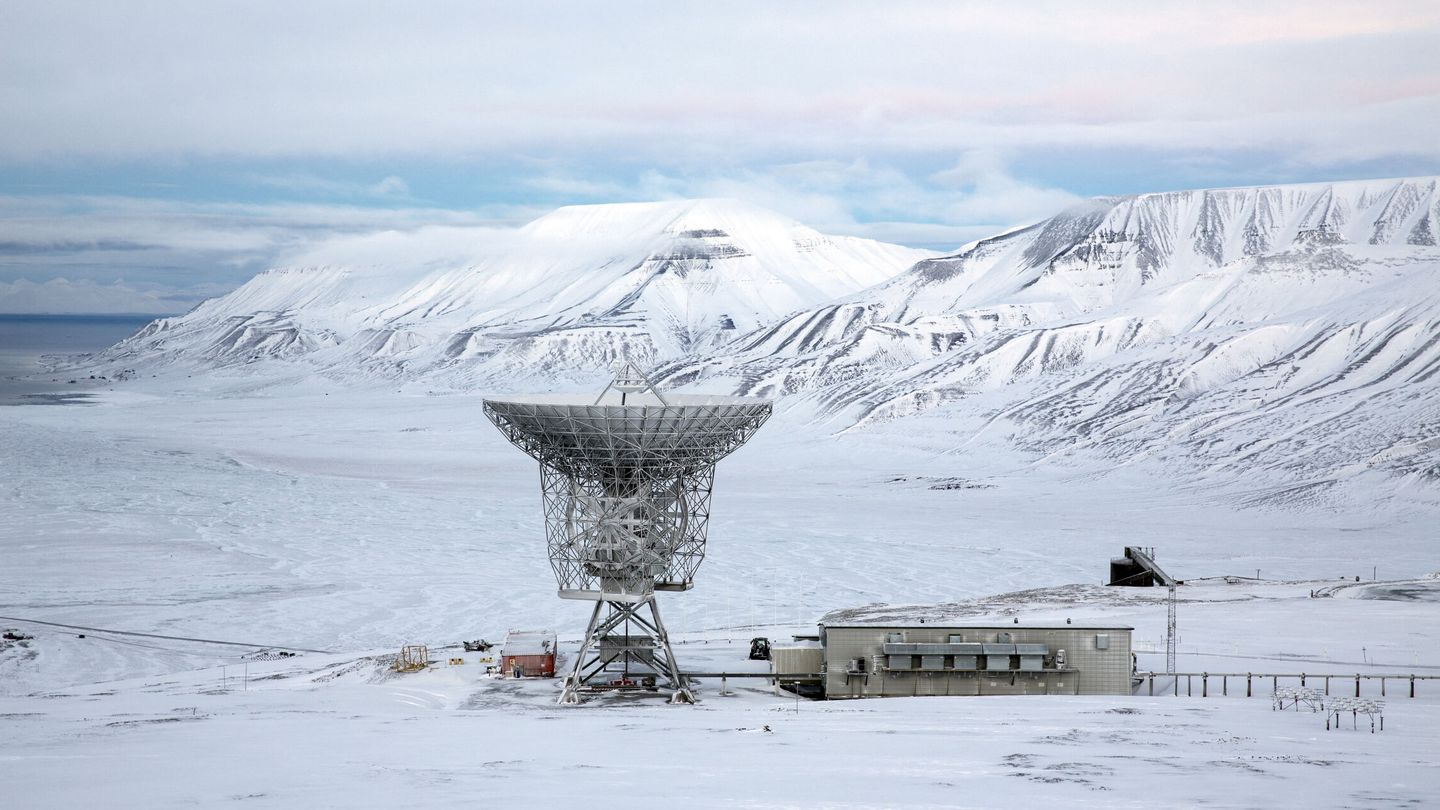
A new contest over who controls the High North
At the political level, FROSTY lands in the middle of a bigger struggle over who sets the rules in the Arctic. President Donald Trump has revived calls for the United States to acquire Greenland, alarming European leaders and pushing them to talk more openly about reducing their dependence on US protection.
The European Union still has no common army of its own, so it leans on NATO and on Nordic states that now sit inside the alliance, including Finland and Sweden, which joined in 2023 and 2024. New NATO initiatives such as the Arctic Sentry mission show that allies know the High North can no longer be treated as a quiet flank.
If FROSTY works as advertised, the same auroras that once blinded northern radars could, in time, become a kind of giant backlit screen for tracking aircraft and ships that would otherwise slip by unnoticed. For people living far from the Arctic, that might sound abstract, yet it shapes everything from the safety of undersea cables to the stability of energy routes that eventually feed into everyday electric bills.
The main program announcement has been published on the official website of the Defense Advanced Research Projects Agency.