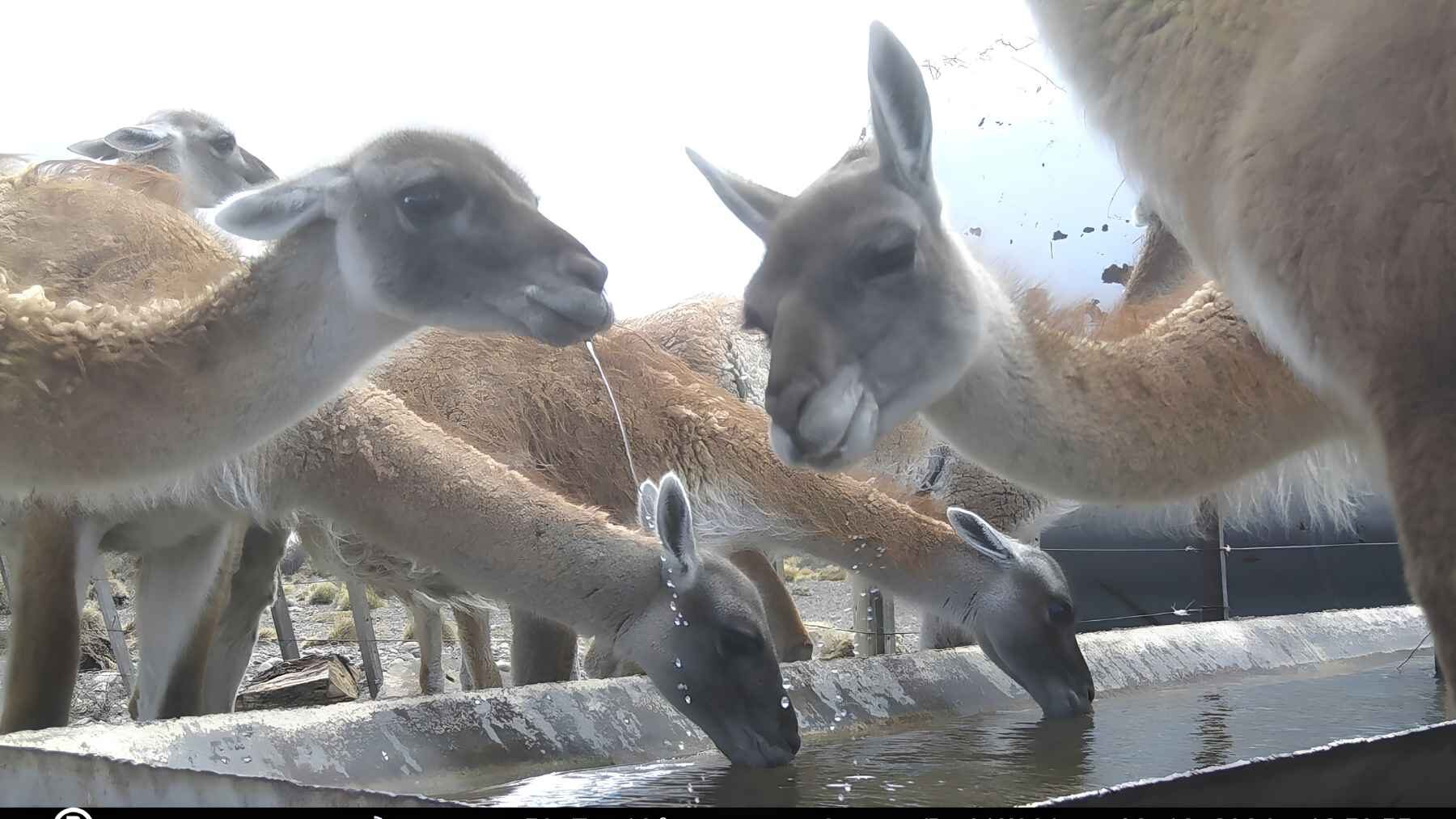
In the dry ranchlands of southern Argentina, a small group of wild guanacos can turn one livestock trough into a major bottleneck. Researchers found that 12 to 15 guanacos surrounding a watering point may be enough to keep about 100 sheep away, even though both species need the same scarce resource.
A team from Argentina’s National Agricultural Technology Institute, known as INTA, tested two simple physical barriers at four ranches in northwestern Santa Cruz. After more than a year of monitoring, the devices significantly reduced guanaco water use without preventing sheep from drinking, while also lowering the need for costly water deliveries.
Why one trough becomes a bottleneck
Water is often scarce or unevenly distributed across Patagonia’s large grazing fields. Ranchers may depend on wells, storage tanks, and tanker trucks to keep artificial troughs supplied, so every extra refill means more fuel, labor, and time on remote roads.
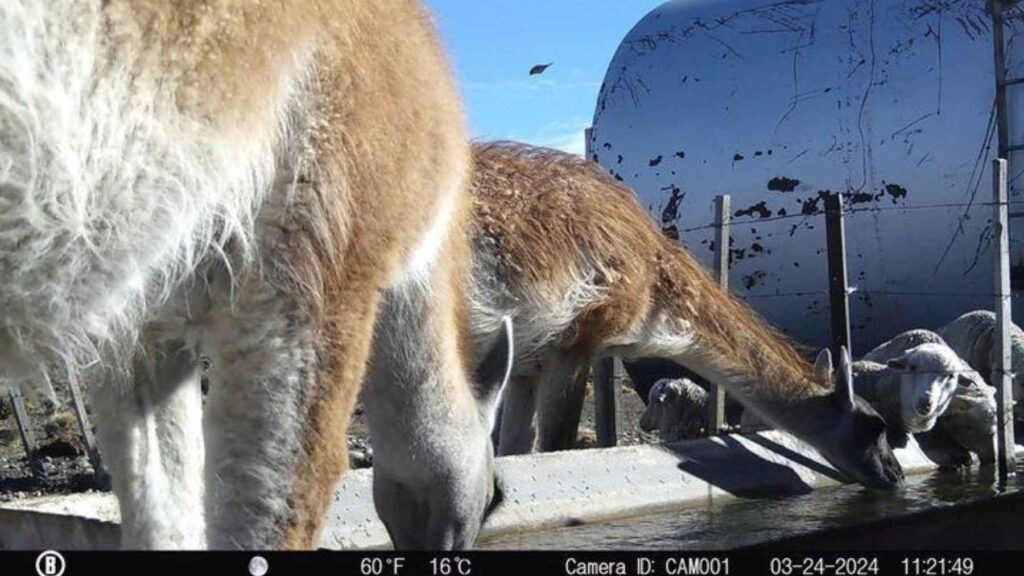
Camera records showed that guanacos stayed around the monitored troughs for an average of 3 hours and 37 minutes per day. Sheep averaged only 1 hour and 38 minutes, and direct use by both species at the same time was limited because guanacos tended to occupy and surround the water.
That difference matters. “Twelve to 15 guanacos surrounding the trough are enough to block 100 sheep,” INTA extension specialist Martín Roa told La Nación. In practical terms, a relatively small wildlife group can temporarily control a water point serving a much larger flock.
Two barriers built around body size
The first solution was a raised fence with an opening about 31.5 in. high at the bottom. An upper section added roughly 3.9 ft., bringing the complete barrier to about 6.6 ft., a height guanacos could not clear at the tested access point.
The second design placed a partial roof or overhang above the entrance to the trough. The lower-bodied sheep could pass under it, but the taller guanacos could not comfortably reach the water.
Neither idea relies on traps, chemicals, or the removal of wildlife. Instead, the designs use the physical differences between the animals, turning a few pieces of ranch infrastructure into a selective doorway. Simple, but carefully measured.
A year of camera-trap evidence
The project, titled “Validation of Strategies for Guanaco Management in Productive Fields of Southern Patagonia,” covered four ranches between National Route 40 and Provincial Route 43. Monitoring ran from March 2024 through April 2025, followed by an additional check in December 2025.
Researchers first selected troughs known to attract guanacos and used camera traps to confirm how often the animals visited. They then installed the restrictions, continued recording activity for a year, and carried out ground surveys to estimate nearby guanaco numbers.
Across the monitored trial, INTA reported a significant decline in water consumption by guanacos while sheep retained access. However, the public summary did not provide one overall percentage reduction for all four ranches. That detail will matter in future cost comparisons.
Fewer tanker trips and lower ranch costs
The most immediate benefit was practical. When guanacos consumed less water from livestock tanks, ranchers did not need to send tanker trucks as often, reducing fuel use and work hours in production systems that already operate across long distances.
Roa also said the raised-fence option could be built with materials commonly found on ranches and was cheaper than more elaborate alternatives. For producers watching diesel prices and maintenance bills, that may be the difference between an interesting experiment and a tool they can actually use.
At one monitored watering point, reduced year-round guanaco activity was followed by signs that nearby grassland began to recover and the soil received more rest during winter. It was a site-specific observation rather than proof of a region-wide restoration effect, but it points to another possible benefit worth measuring.
A coexistence tool, not a wildlife wall
The project’s value lies partly in what it does not do. It does not attempt to remove guanacos from the wider landscape, and it does not build a continuous barrier across their habitat. It changes access only at artificial watering points created primarily for sheep.
That makes the system a form of targeted coexistence. Ranchers protect a limited and expensive resource, while guanacos remain free to move around the surrounding land rather than being captured or killed.
Still, one question remains. Where do guanacos obtain water after losing access to a trough, especially during severe dry periods? The published summary focused on livestock efficiency, so longer monitoring of wildlife movement and alternative water sources would strengthen the ecological picture.
A small design with wider potential
Dryland farming often turns on modest details. A few inches of clearance, the angle of an overhang, or the height of a wire can decide which animal reaches water and how often a truck must return to refill a tank.
The INTA trial suggests that low-cost, species-specific design can ease conflict between livestock and wildlife without treating either animal as the enemy. The next step is to compare installation costs, maintenance needs, animal behavior, and water savings across more ranches and harsher drought conditions.
For now, the finding is straightforward. When water is scarce, smarter access can be just as important as finding more water.
The official statement was published on Argentina.gob.ar.
Most read
- US scientists poured 16,500 gallons of lye into the Gulf of Maine and dyed the water bright pink to track it, the first federally approved try at reversing ocean acidity
- Soviet scientists released giant red king crabs into the Barents Sea in the 1960s to build a fishery, but decades later those invaders are still changing the seafloor
- New Orleans is collecting thousands of used Christmas trees and dropping them from helicopters to slow the loss of land, which has already exceeded 5,000 square kilometers
- Britain is dropping 20 concrete reef cubes and 44 tons of scallop shells into the sea, and the goal is to bring back oysters down more than 95% since the 1800s
- The U.S. will pay up to $65 million to leave Colorado River water in Lake Mead, and Hoover Dam explains why