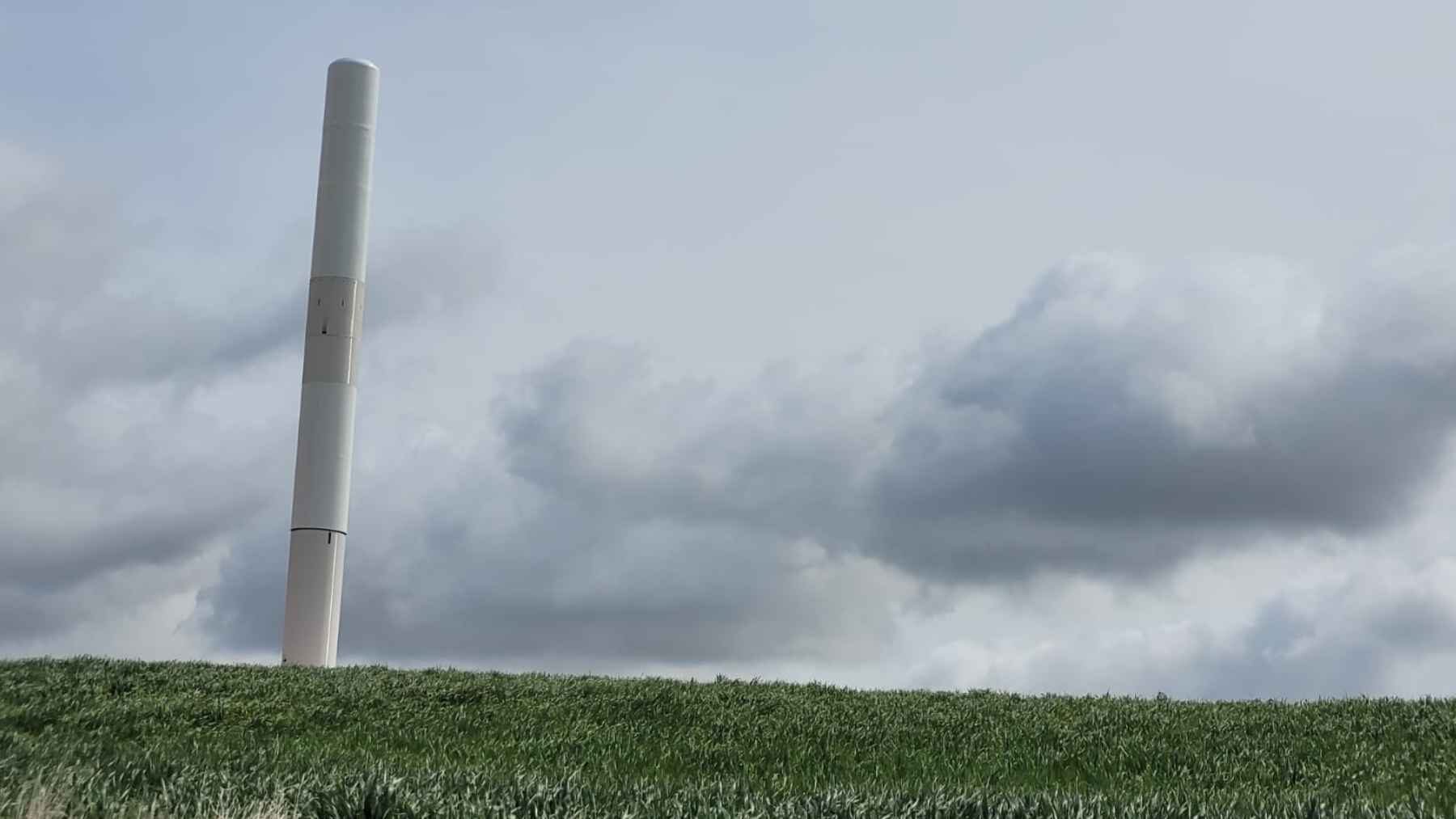
Can a wind turbine generate electricity without spinning blades? Spanish startup Vortex Bladeless is testing a very different approach, using a slender vertical mast that rocks from side to side and converts those wind-driven vibrations into electrical power.
The eye-catching design has fueled claims that blades may soon become obsolete. That is not what the available evidence shows. The company still labels the technology “under development,” while an EU-backed project described a roughly 9-foot version targeting 100W, making its near-term value more likely in low-power distributed energy than in replacing wind farms.
A mast that harvests turbulence
When wind flows around a cylinder, it can shed alternating swirls of air behind it. These repeating eddies are known as a von Kármán vortex street, and the changing pressure can push a flexible structure first one way and then the other.
Engineers normally worry about this effect because repeated oscillation can fatigue bridges, towers, and other structures. Vortex Bladeless takes the opposite approach. It shapes the mast so that the airflow encourages a controlled sway, turning a familiar engineering problem into the source of motion.
How the sway makes electricity
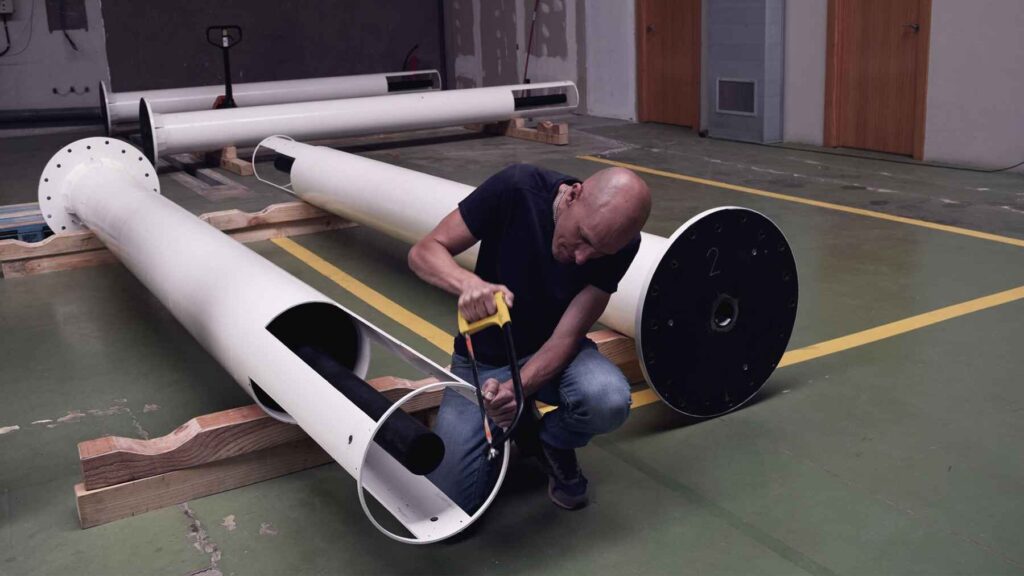
The device has a fixed base, a cylindrical mast, and an elastic carbon-fiber rod that lets the mast move across the wind. When the frequency of the air vortices comes close to the structure’s natural frequency, the two can lock together and produce stronger oscillations.
Bladeless does not mean motionless. Magnets and coils inside the system convert the swaying movement through electromagnetic induction, much like an alternator, but without a rotating shaft or gearbox. The company also uses magnetic forces as a “tuning system” intended to widen the range of wind speeds that can keep the mast resonating.
Why simpler hardware matters
Conventional turbines are proven power producers, but their rotors, bearings, controls, and other components must handle enormous loads for years. The Vortex concept removes the sweeping blades and aims to work without gears, oil, or a braking system, which could make a small unit easier to transport and maintain.
However, there is a trade-off. The flexible rod is repeatedly bent by the wind, so fatigue resistance becomes one of the central engineering questions. The company’s own technical paper treats long-term bending as a design challenge and notes that more rigorous testing is needed in several areas.
The 100W reality check
The clearest way to understand this invention is to compare scale. The European Union project described a 100W target for a mast about 9 ft. tall, while the average capacity of newly installed U.S. utility-scale turbines in 2023 was 3.4 MW, or 3.4 million W.
On nameplate capacity alone, it would take 34,000 devices rated at 100W to equal one 3.4 MW turbine. Real electricity production would also depend on wind speed, operating hours, energy losses, and placement. In other words, this is not a hidden replacement for a wind farm.
That does not make the idea useless. A small output could still suit remote sensors, agricultural monitors, telecommunications equipment, research stations, or battery charging where the load is modest. Running an entire house and noticeably shrinking the electric bill is a much bigger assignment.
Birds, bats, and noise
Wind power has major climate benefits, yet wildlife collisions can occur, particularly for certain birds and bats and at poorly chosen sites. A mast without fast-moving blades could plausibly reduce one obvious collision hazard and may produce less mechanical noise, which helps explain the environmental interest.
Still, “bird-friendly” should be treated as a claim to test, not a finished conclusion. The technology has not yet built the large operating record needed to measure wildlife effects, sound, material use, durability, and end-of-life impacts across many locations. No blades is an advantage worth studying, not an automatic ecological pass.
Where it could fit
Distributed wind means producing electricity near the place where it will be used. U.S. energy researchers already study wind systems that work alongside solar panels, batteries, and microgrids, particularly in rural or remote communities where extending power lines can be expensive.
That hybrid role may be the strongest case for a swaying generator. Solar panels go quiet after sunset, while wind can arrive at different hours, so the two sources can sometimes complement each other. A compact mast could also serve isolated equipment or monitoring networks where a spinning rotor would be awkward.
Cities are a more complicated promise. Rooftops and buildings create uneven airflow, and a small generator still needs a good wind resource, safe installation, permitting, and realistic energy estimates. The mast’s circular shape lets it respond without turning to face the wind, but clever geometry cannot create energy where usable wind is scarce.
What happens next
For Vortex Bladeless, the next milestones are not flashy. Engineers must demonstrate reliable output over a broad wind range, prove that the flexible structure survives years of cycles, complete certification, publish independent field data, and show a competitive cost for every unit of electricity produced.
The clean-energy transition will need a toolbox, not one perfect machine. Large turbines can continue feeding national grids, while smaller devices may handle specialized jobs beside solar panels and battery storage. For now, the swaying mast is a promising experiment whose future will be decided by long-term performance, not by its unusual appearance.
The official technology overview was published on Vortex Bladeless’s website.
Most read
- US scientists poured 16,500 gallons of lye into the Gulf of Maine and dyed the water bright pink to track it, the first federally approved try at reversing ocean acidity
- Soviet scientists released giant red king crabs into the Barents Sea in the 1960s to build a fishery, but decades later those invaders are still changing the seafloor
- New Orleans is collecting thousands of used Christmas trees and dropping them from helicopters to slow the loss of land, which has already exceeded 5,000 square kilometers
- Britain is dropping 20 concrete reef cubes and 44 tons of scallop shells into the sea, and the goal is to bring back oysters down more than 95% since the 1800s
- The U.S. will pay up to $65 million to leave Colorado River water in Lake Mead, and Hoover Dam explains why