What are the odds of pointing a space telescope at a comet right as it starts to fall apart? In an official report, NASA says the Hubble Space Telescope caught that moment with Comet C/2025 K1.
The images helped scientists reconstruct a breakup timeline in November 2025 and spot something odd. The comet did not brighten immediately after cracking open, and that delay could matter the next time a comet starts to unravel.
A lucky Hubble detour
The observing time was originally meant for a different comet, but new technical limits forced the team to switch targets. The backup choice was K1, and it began fragmenting while Hubble was already watching. John Noonan and Dennis Bodewits at Auburn University called it “the slimmest of slim chances.”
A report from the European Space Agency notes that researchers have tried for years to catch a breakup this early, but the timing is usually impossible to predict. Telescope schedules do not bend, and comets do not warn. This time, luck did the planning.
Meet K1 and why perihelion is rough
K1 is a long-period comet that may not return for thousands of years, if ever. Many such comets are thought to come from the Oort Cloud, a distant reservoir of icy bodies that circles the solar system. They can carry ancient material, but their outer layers are often altered by radiation and repeated heating.
K1 reached perihelion, its closest point to the Sun, on October 8, 2025. It passed inside Mercury’s orbit at about 31 million miles from the Sun. That kind of heating and stress can turn a fragile ice-and-dust body into a cracking, spinning mess.
Three nights that caught the breakup
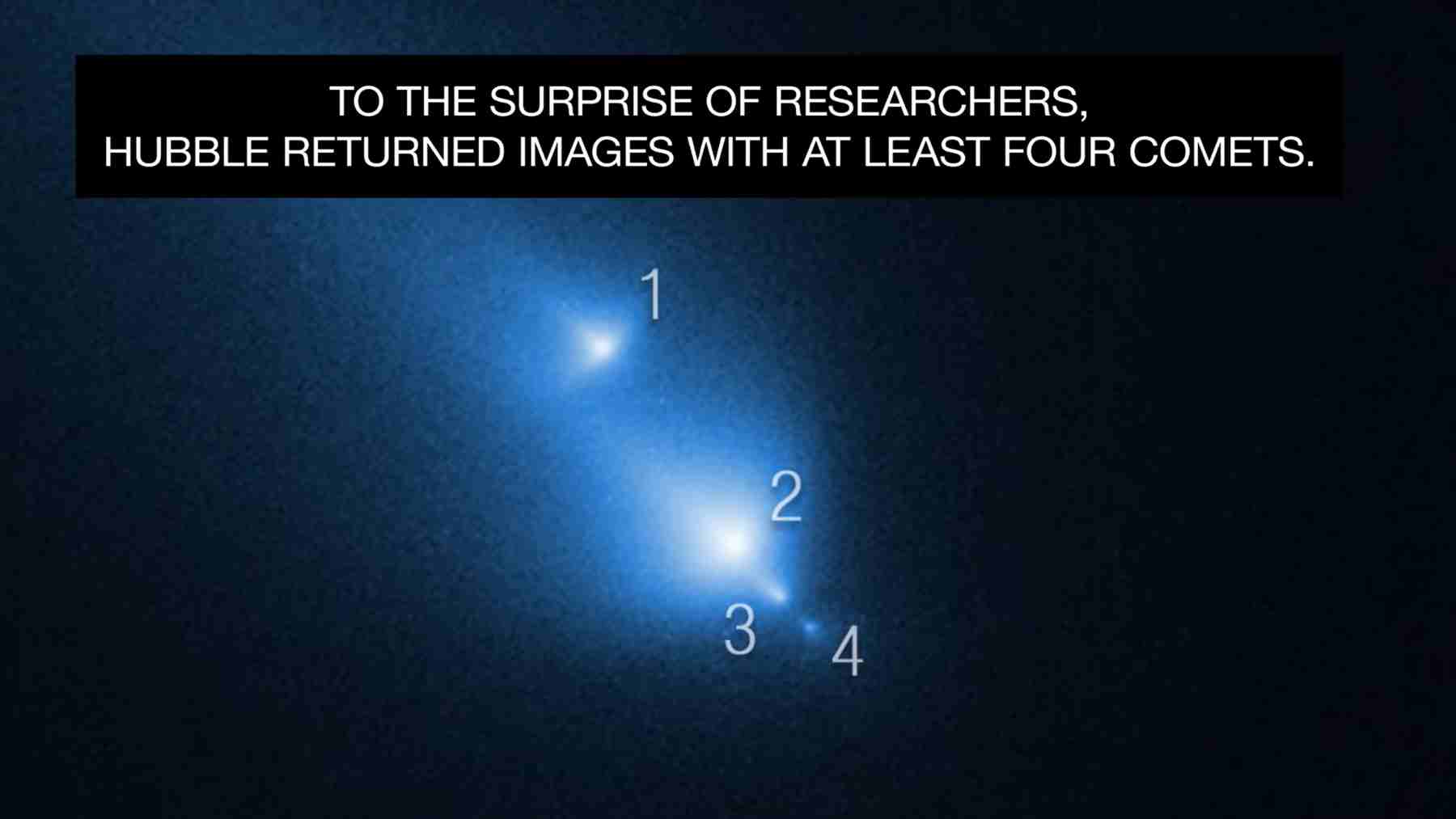
Hubble’s key images were taken on November 8, 9, and 10, 2025, with exposures lasting about 20 seconds each. The first frame already showed the comet split into four fuzzy points. By the next day, one of the larger pieces had divided again, leaving at least five fragments visible.
Each fragment was surrounded by its own coma, the cloud of gas and dust that forms when sunlight warms a comet and pushes material outward. From ground telescopes, those pieces were hard to separate and often looked like tiny blobs of light. From orbit, Hubble could resolve them and track their slow drift apart.
The mystery of the delayed brightening
If fresh ice was suddenly exposed, you might expect a fast jump in brightness. Instead, ground monitoring saw the biggest rise in activity between November 2 and November 4, even though the breakup appears to have started around November 1. That gap raised a simple question, why the lag.
The new study argues that most comet brightness comes from dust reflecting sunlight, not from clean ice alone. One explanation is that fresh surfaces needed time to build a thin dust coating that could later be blown off in a brighter burst. Another is that heat needed time to sink in, build pressure, and then kick out a larger shell of dust.
A short-lived window into the inside
When a comet is intact, the gases in its coma often come from surface layers that have been “baked” before. A breakup can briefly expose interior ice, including “volatiles,” the ices that turn into gas when warmed. That is why fragmentation events are so valuable, even when they are messy.
The researchers highlight a narrow window of roughly 1 to 3 days after fragmentation when the coma’s gas may reflect the nucleus more directly, before dust production ramps up. In everyday terms, it is a quick taste test before the whole mixture changes. Waiting too long can mean missing the cleanest chemical clues.
A comet with an unusual chemical fingerprint
Even before perihelion, ground-based spectra suggested K1 was unusually depleted in carbon-bearing gases compared with many other comets. Carbon chemistry is one of the tools scientists use to trace how the early solar system stored and moved key ingredients. A “carbon-poor” comet can hint at an unusual formation environment, or at later processing that stripped certain materials away.
A few other chemically odd comets have been discussed in past research as possible visitors from beyond our solar system, but that idea is still speculative in most cases. For K1, the safer takeaway is that it looks chemically strange and needs follow-up. The team says deeper gas analysis from Hubble instruments is still underway.
Why ground telescopes mattered too
Hubble can zoom in, but it cannot watch one object every night for weeks. Daily monitoring from the Las Cumbres Observatory network helped track the comet’s changing brightness and connect outbursts to the breakup sequence. The broader strategy behind that monitoring is described in a LOOK project paper.
By combining sharp space-based images with steady ground coverage, researchers could work backward from the fragments’ motions and reconstruct a timeline. That is how they could link the physical breakup to later brightening, instead of guessing after the fact. It is the difference between seeing the spark and only seeing the smoke.
What this rare catch could change next
Hubble has seen fragmented comets before, but scientists often arrive weeks later, when debris has spread out and the early chemistry is harder to interpret. One example is Comet C/1999 S4 (LINEAR), whose fragments were documented after breakup in a 2001 Science paper. K1 stands out because the images came just days after a major split, when cause and effect were still connected.
Nature sometimes does what missions try to do on purpose, expose fresh comet material. The closest direct example is the Stardust mission, which returned comet dust to Earth in January 2006. Next time a long-period comet shows signs of stress, researchers may try to move fast and catch that short chemical window before dust takes over, because blink and it is gone.
The main study has been published in Icarus.