Three teenagers from India have won The Earth Prize 2026 with Plas-Stick, a biodegradable magnetic powder made from discarded tamarind seeds. Mixed into water, it gathers tiny plastic particles into visible clumps that can be lifted out with a handheld magnet, without electricity or complex filtration equipment.
Vivaan Chhawchharia, Ariana Agarwal, and Avyana Mehta, all 16, became the first Indian team to take the global title on May 29 after around 23,000 people voted among seven regional winners. Their idea is strikingly simple, but it is important to describe it accurately. Plas-Stick targets microplastics, not every danger that can make water unsafe.
A rural water container sparked the idea
The project began after the students visited a rural community where families stored drinking water in shared plastic containers and had limited access to advanced treatment. Seeing a child drink from one of those containers pushed them to ask how invisible plastic contamination might be removed with something cheap and portable.
Microplastics are plastic fragments or fibers smaller than about one-fifth of an inch, and many are far too small to see. They can form when larger plastic breaks apart or be manufactured already small as pellets and microbeads.
The need for practical water tools is much wider than one village. The World Health Organization and UNICEF reported in 2025 that 2.1 billion people still lacked safely managed drinking water, meaning water available at home, when needed, and free from contamination. That does not mean all of those people face the same microplastic problem, but it shows why low-cost treatment ideas attract attention.
How Plas-Stick works
So how can a tamarind seed help clean water? The team processes seeds that would normally be discarded into a biodegradable powder designed to attract plastic particles. Once stirred into contaminated water, the material binds those particles together, much like gathering scattered crumbs into one pile.
The clumps become visible and can then be pulled out with a small magnet. That means no electric pump, replacement membrane, or large treatment unit, which could matter in places where the power supply is unreliable or the household budget is already stretched.
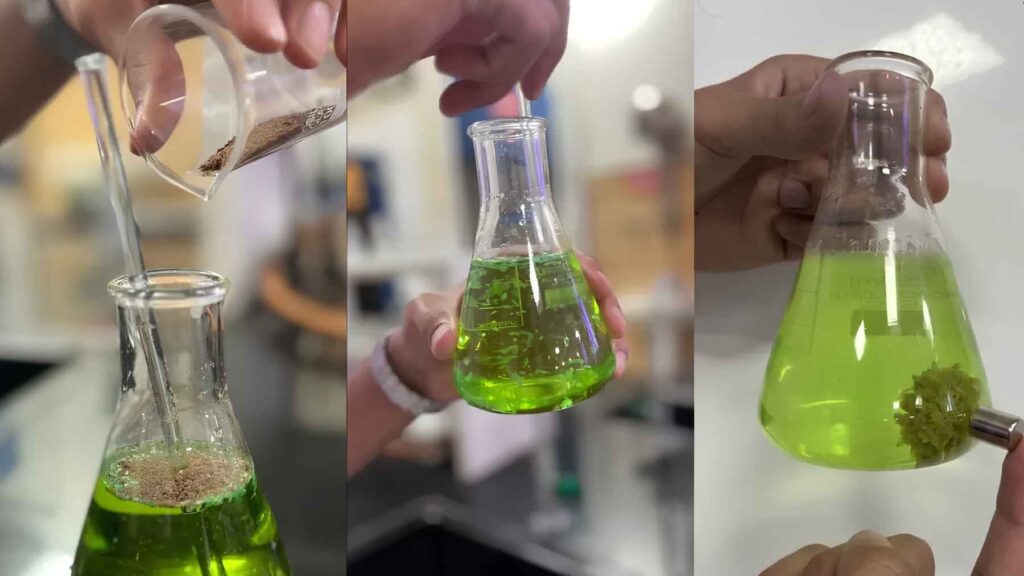
There is an important detail, though. The official description calls the material a magnetic tamarind powder but does not publish the full formulation or preparation method, so ordinary ground seeds should not be treated as a home recipe. The plastic also does not disappear but is concentrated into a material that must still be handled responsibly.
A global award and $12,500 to grow
The trio first won the Asia category, which came with $12,500 to develop the project, before the public vote selected it as the global winner. Organizers describe the contest as the world’s largest environmental competition and ideas incubator for students ages 13 to 19, with $100,000 in shared funding.
The win clearly mattered. The students said they hoped it would “help us scale Plas-Stick further” and encourage other young people to act on their ideas.
Plas-Stick has already been presented through workshops and demonstrations that reached more than 8,000 students and teachers. Dr. Rajesh Khandelwal advised the team as it strengthened testing and development, giving the project a bridge between a school innovation and more formal technical work.
Promising does not yet mean proven everywhere
Awards can open doors, but drinking-water technology has to clear a higher bar. A successful product would need independent tests showing how much plastic it removes, which particle sizes and plastic types it captures, how long treatment takes, what dose is required, and whether anything unwanted remains in the water.
Those figures are not included in the public award announcement, and no peer-reviewed performance paper is identified there. That makes Plas-Stick best understood for now as a promising youth-developed treatment concept rather than a certified household purifier.
Public-health guidance also calls for caution. A dedicated review of microplastics in drinking water identified major research gaps, while official drinking-water guidance says fecal contamination remains the greatest established safety risk. Removing microplastics could be useful, but it cannot replace treatment for bacteria, viruses, or other pollutants.
From agricultural waste to rural treatment
The team plans to create decentralized production hubs and expand into rural communities across India. That could keep manufacturing closer to the people using the material, reduce transportation needs, and turn an agricultural residue into something with practical value. Peter McGarry, founder of The Earth Foundation, praised the approach as “scientifically grounded, environmentally responsible and accessible.”
Still, the next chapter will depend less on applause and more on repeatable evidence, safety checks, cost studies, and field trials under real household conditions. If those tests confirm that Plas-Stick works consistently and safely, it could complement broader water treatment rather than replace it. Three students saw a familiar seed as waste, then asked whether it could become part of the solution.
The announcement was published by The Earth Prize Newsroom.
Most read
- US scientists poured 16,500 gallons of lye into the Gulf of Maine and dyed the water bright pink to track it, the first federally approved try at reversing ocean acidity
- Soviet scientists released giant red king crabs into the Barents Sea in the 1960s to build a fishery, but decades later those invaders are still changing the seafloor
- New Orleans is collecting thousands of used Christmas trees and dropping them from helicopters to slow the loss of land, which has already exceeded 5,000 square kilometers
- Britain is dropping 20 concrete reef cubes and 44 tons of scallop shells into the sea, and the goal is to bring back oysters down more than 95% since the 1800s
- The U.S. will pay up to $65 million to leave Colorado River water in Lake Mead, and Hoover Dam explains why