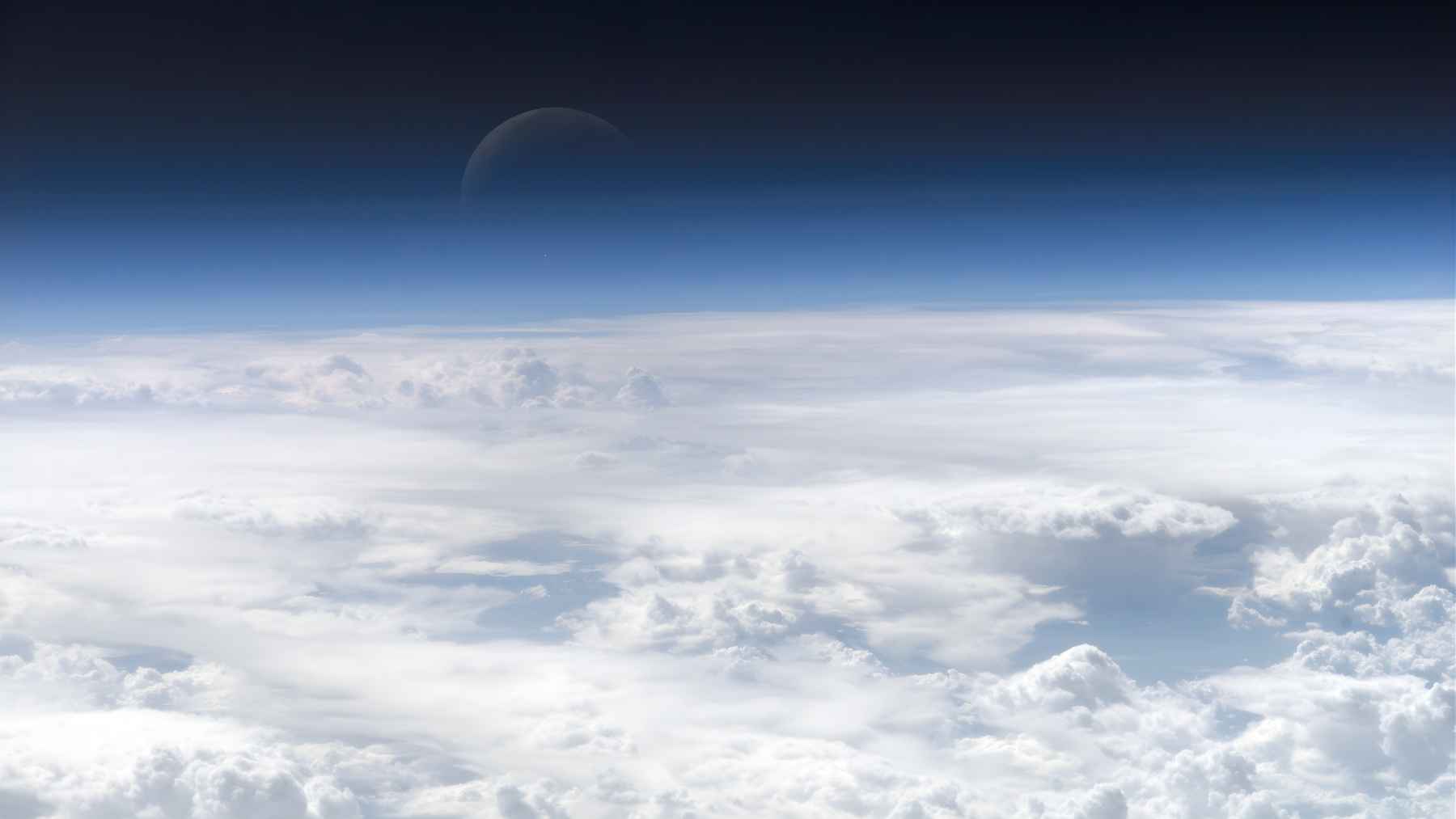
Every easy breath you take depends on a fragile balance between our planet, its living organisms, and the Sun above. But how long can this familiar, oxygen-rich atmosphere really last? According to detailed simulations, the breathable air surrounding Earth is only a temporary chapter in a much longer planetary story.
Geoscientist Kazumi Ozaki at Toho University and researcher Christopher T. Reinhard at Georgia Institute of Technology used a combined climate and carbon cycle model to estimate how long high oxygen levels can persist.
Their results point to a mean future lifespan of about 1.08 billion years before oxygen in the air falls below one percent of today’s level, with the change happening in a relatively sudden drop rather than a slow fade. The work, supported in part by the NASA Astrobiology Program, appears in the journal Nature Geoscience.
How scientists forecast the future of Earth’s air
To reach those numbers, the team built what is known as an Earth system model, which connects the atmosphere, oceans, rocks, and living things in one virtual planet. They varied dozens of uncertain factors, such as how fast volcanoes release gases and how quickly rocks on land break down, then watched how the simulated world evolved.
In total, they explored nearly 400,000 different futures and kept several thousand that matched past climate and chemistry records.
Across that large collection of experiments, one pattern stood out. In most runs, oxygen stayed relatively stable for a long time, then dropped sharply once certain thresholds in sunlight and carbon dioxide were crossed.
On average, the atmosphere kept more than one percent of modern oxygen for a bit more than one billion years, and in almost every case the oxygen-rich phase ended in less than one and a half billion years.
The researchers also tested how sensitive the timeline is to different assumptions about biology on land and in the sea. Even when they removed land plants from the model or changed how marine life responds to temperature and nutrients, the basic story stayed the same. Oxygen-rich air appears to be, to a large extent, a transient feature of a rocky planet that orbits a star like the Sun.
Why more sunlight can mean less oxygen
At the heart of the story sits the slow brightening of the Sun as it ages. A brighter star gently warms the surface, which speeds up chemical reactions between rainwater and exposed rock. Those reactions pull carbon dioxide out of the air, which might sound like a natural climate benefit at first.
But this long-term drawdown of carbon dioxide has a catch. Plants and many kinds of microscopic algae need a minimum level of carbon dioxide to carry out photosynthesis and release oxygen. In the simulations, once carbon dioxide falls below that threshold, global plant productivity collapses and the main source of oxygen to the atmosphere nearly disappears.
At the same time, processes that consume oxygen, such as reactions with volcanic gases and minerals, continue. When the supply from photosynthesis weakens enough, oxygen levels in the air crash to values similar to those on the early Earth more than two billion years ago, while methane from microbes rises. According to the model, this deoxygenation happens before extreme greenhouse conditions set in and before the planet loses most of its surface water.
What this means for life and the search for aliens
For life on our own world, the timeline may sound both comforting and humbling. Comforting, because a billion years is far beyond the scale of your electric bill, human history, or even the lifespan of our species. Humbling, because it means that complex organisms which depend on plentiful oxygen occupy only a relatively short slice of Earth’s history as an inhabited planet.
By comparing the model results with earlier work in astrobiology, Ozaki and Reinhard argue that oxygen alone may be a misleading sign of life on distant planets. For years, studies led by researchers such as Victoria Meadows and Edward Schwieterman have treated oxygen and ozone as powerful atmospheric markers for an active biosphere.
This new work suggests that many inhabited worlds could spend long stretches of time with little detectable oxygen, which raises the risk of so-called “false negatives” when telescopes search for life beyond the solar system.
In the far future atmosphere sketched by the model, very low oxygen combines with high methane and low carbon dioxide, creating conditions where a thick organic haze could form high in the sky, a bit like an extreme version of urban smog.
That hazy shroud would cool the surface, alter the planet’s color, and might itself become a detectable sign of biology for a distant observer, which is why the authors say that atmospheric oxygenation is “not a permanent condition on habitable worlds”.
The main study has been published in Nature Geoscience.