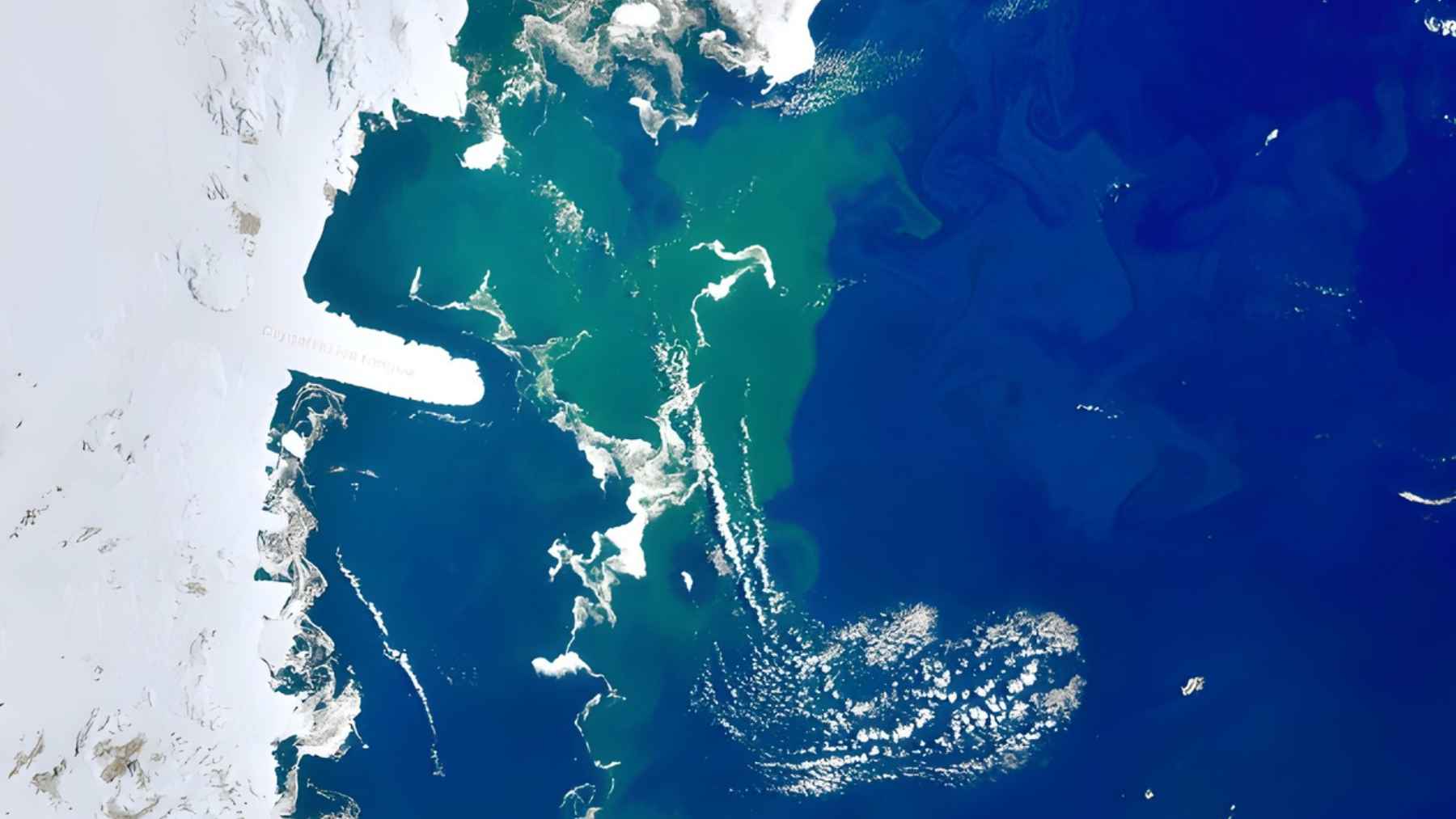
Deep under the icy waters of Antarctica, earthquakes rumble along a chain of underwater volcanoes. No light reaches these depths. Yet new research shows that the shaking below can help paint the ocean surface above with vast swirls of green, powered by microscopic life.
The study, published in Nature Geoscience, links deep seafloor quakes in the Southern Ocean with huge blooms of phytoplankton that appear months later at the surface. In simple terms, more earthquakes often mean more plantlike plankton, more food for marine animals, and more carbon dioxide pulled out of the atmosphere.
So what does a quake thousands of meters below have to do with the air we breathe?
How shaking the seafloor frees up iron
The key players are hydrothermal vents on the Australian Antarctic Ridge, a rugged stretch of the global mid ocean ridge system. These vents release hot, mineral-rich water into the deep sea, including iron, which is a vital micronutrient for phytoplankton. In the Southern Ocean, iron is often the ingredient in the shortest supply, so even a small extra dose can turbocharge growth.
Previous work showed that a recurring bloom forms every austral summer in surface waters downstream of this ridge and that it is fueled by iron of hydrothermal origin. The new study asked a simple question: why is this bloom sometimes as large as the state of California and other years closer to the size of Delaware?
To find out, lead author Casey Schine and colleagues compared more than two decades of satellite-based estimates of net primary production, which measure how fast phytoplankton build new biomass, with catalogs of earthquakes that struck near the vents between 1997 and 2019.
They also used computer models that follow virtual particles in surface currents to see how vent-fed water spreads out as it drifts away from the ridge. That made it possible to tease apart two things at once: how much iron might be injected by extra seismic activity and how fast that iron gets diluted as currents stir it into the wider Southern Ocean.
From quake to bloom in just a few months
The pattern that emerged was striking. Years with more powerful earthquakes, magnitude 5 or higher, in the months before the growing season tended to produce denser and more productive phytoplankton blooms at the surface right above the vents.
Earthquakes can jolt the internal plumbing of hydrothermal systems, opening new cracks and clearing clogged pathways so that more hot fluid and dissolved metals escape. That extra iron appears to reach the sunlit layer much faster than scientists once thought.
The team found that the vent-sourced water must travel roughly 6,000 feet upward and arrive at the surface within a few weeks to a few months in order to match the observed timing of the blooms. Earlier estimates suggested a journey that could take a decade or more and over far larger distances.
Farther downstream, however, the story changes. Where the iron-rich plume spreads out over a broader area, the added nutrient becomes more diluted, and net primary production actually drops compared with years when the plume remains more compact.
Schine describes the earthquakes as a kind of natural volume knob for the bloom. In her words, the work shows that “the main factor controlling the size of this annual phytoplankton bloom was the amount of seismic activity” in the months before peak growth.
Senior author Kevin Arrigo calls it “the first ever study to document a direct relationship between earthquake activity at the bottom of the ocean and phytoplankton growth at the surface.”
Why this matters for whales, climate and future models
These blooms are not just pretty swirls on satellite images. Phytoplankton form the base of the Southern Ocean food web, feeding krill and small crustaceans that in turn support penguins, seals, and whales. The team has even documented humpback whales visiting this particular bloom south of the Antarctic ice edge.
When conditions line up, the bloom can grow into a seasonal buffet the size of a large country. In years with fewer quakes, that buffet shrinks and so does the amount of carbon the local ecosystem can lock away in sinking organic matter.
For people far from Antarctica, that influences how effectively the Southern Ocean acts as a carbon sink that helps buffer greenhouse gas emissions from cars, power plants, and everything else that drives our modern energy use.
At the same time, the researchers stress that many pieces of the puzzle remain unsolved. The exact physical process that brings hydrothermal iron from the deep ridge to the surface so rapidly is still unknown, and a recent expedition to the area aims to gather crucial measurements.
It is also not yet clear how often similar quake-powered nutrient pulses occur at other vent systems around the world.
For now, the findings are a reminder that Earth’s climate engine is influenced by some very unexpected players. A tremor in the dark along the seafloor can eventually ripple up into the light, feeding whales, shaping regional carbon uptake, and quietly nudging the balance of the global atmosphere.