Could you really pack a whole encyclopedia onto the head of a pin? It sounds like a party trick, but it points to a serious question we still wrestle with every time a phone gets more storage in the same slim shape.
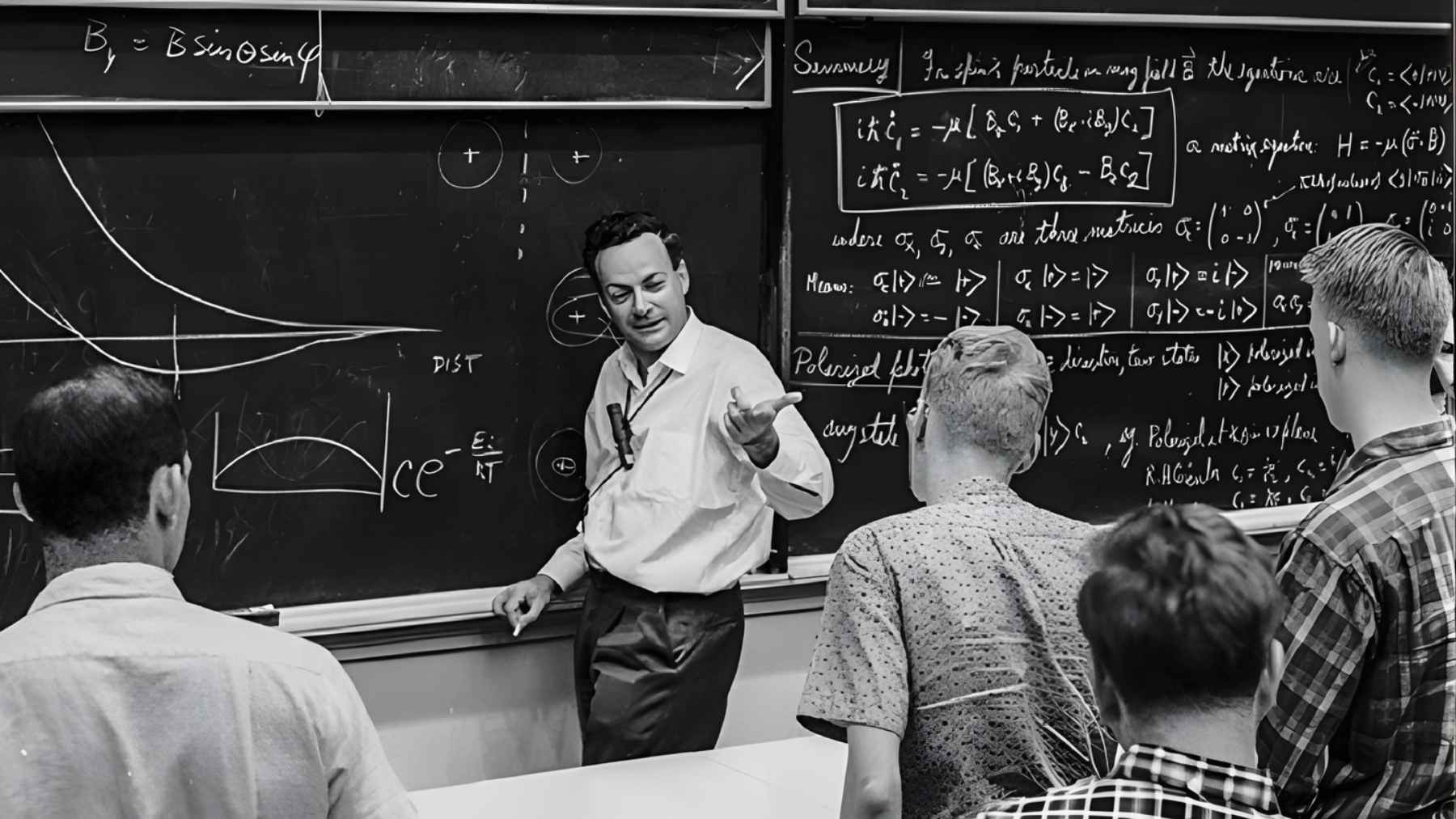
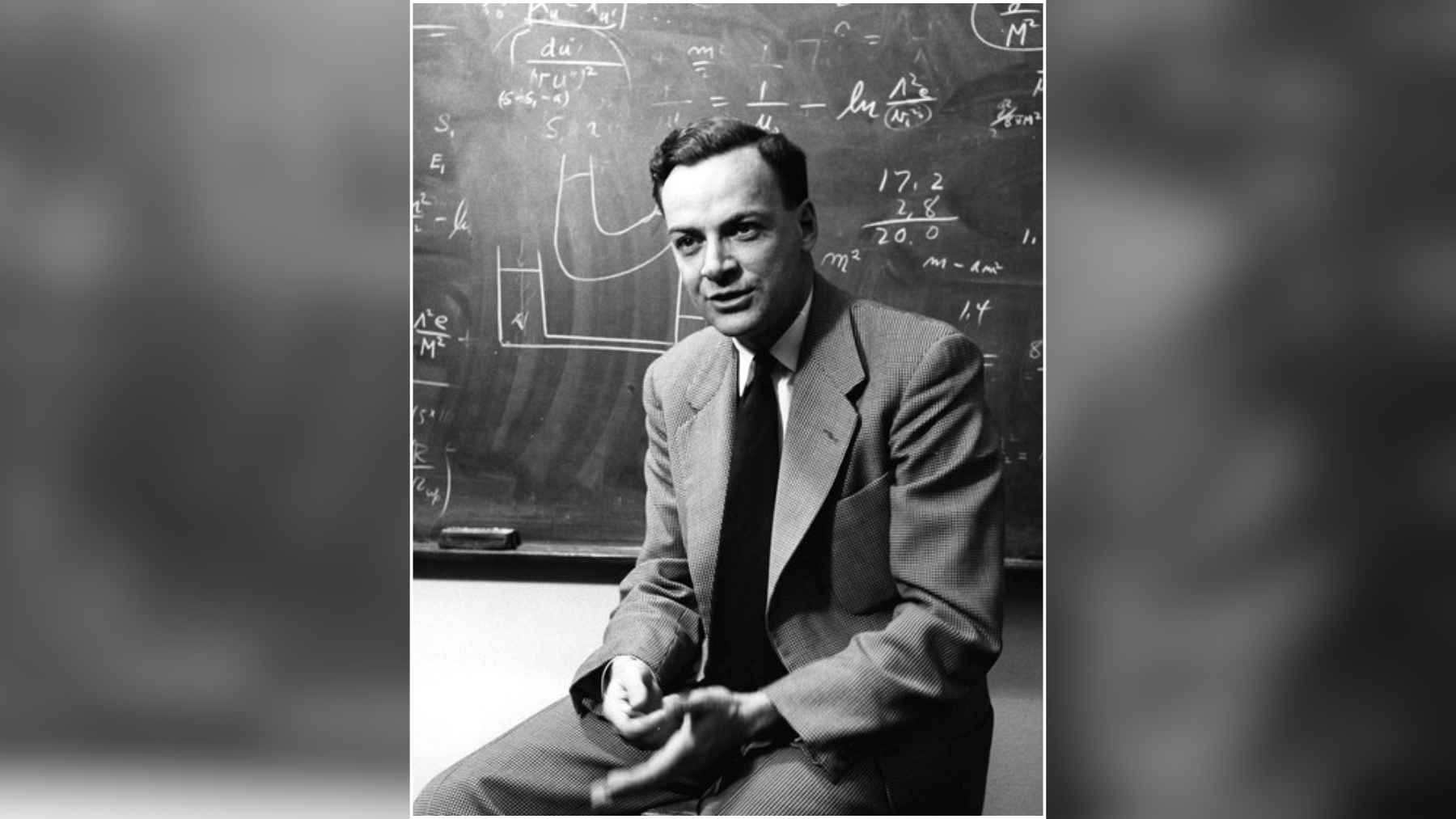
In 1959, physicist Richard Feynman used a talk at the California Institute of Technology (Caltech) to argue that shrinking information and machines down toward the scale of atoms was physically possible. So what was his main message? The hard limit was not nature – it was whether engineers could build the tools to do it.
A pinhead library
Speaking at the annual meeting of the American Physical Society, he asked, “Why cannot we write the entire 24 volumes of the Encyclopaedia Britannica on the head of a pin?”
A pinhead, he said, is about one-sixteenth of an inch across, and he estimated that reducing the writing by about 25,000 times could make it fit and still be readable with an electron microscope. The official transcript can be read in “There’s Plenty of Room at the Bottom”.
Then he scaled up from one encyclopedia to all the books people care about. Using rough counts from the Library of Congress, the British Museum Library, and the National Library in France, he guessed about 24 million “volumes of interest” and argued the whole pile could fit on roughly a million pinheads. In his back-of-the-envelope math, that would take only a few square yards, small enough to be carried around like a pamphlet.
Physics says yes
A big part of the talk was a reality check about limits. “We are not doing it simply because we have not yet gotten around to it,” he told the audience, adding that he was not inventing new laws of nature. In other words, the door was open, we just were not walking through it yet.
This mindset later became known as nanotechnology, the study and engineering of matter at extremely tiny scales. A nanometer is one-billionth of a meter, which is about forty billionths of an inch, and that is the neighborhood where modern materials start behaving differently. The U.S. Department of Energy notes that the term was coined in 1974 by Norio Taniguchi, years after the 1959 talk put the idea on the map.
Two $1,000 bets
To make the vision concrete, he offered cash prizes instead of just applause. “It is my intention to offer a prize of $1,000 to the first guy who can take the information on the page of a book,” he said, and he also promised another $1,000 for a working motor that could fit inside a cube one sixty-fourth of an inch on each side. It was playful, but it also set clear engineering targets.
The motor challenge was claimed in 1960 by William McLellan, who built it with the help of a microscope, a watchmaker’s lathe, and a toothpick for handling parts. The story is a reminder that miniaturization is not always about brand-new science. Sometimes it is careful workmanship pushed to the edge.
The writing challenge took longer and was finally met in November 1985. Tom Newman, then a Stanford University graduate student, used electron-beam lithography, basically writing with a focused beam of electrons, to shrink a book page to a square about 0.00023 inches on each side that could be read under an electron microscope.
His adviser R. Fabian Pease called it a tough technology exercise, and the prize note included the line, “Congratulations to you and your colleagues,” as described in “Tiny Tale Gets Grand”.
Seeing and moving atoms
He kept coming back to one missing ingredient: better ways to see what we are doing. “What you should do in order for us to make more rapid progress is to make the electron microscope 100 times better,” he said, because building smaller only works if you can reliably inspect the results. That is the kind of line that hits differently now that tiny devices sit inside everything from cars to earbuds.
Tools did improve, and some of the biggest leaps were rewarded publicly. The Nobel Prize in Physics for 1986 recognized the scanning tunneling microscope, a technique that can map surfaces at the level of individual atoms, along with earlier breakthroughs in electron optics and the first electron microscope.
That award helps explain why the “room at the bottom” idea did not stay a thought experiment forever.
Why it still matters
The talk also leaned on biology, pointing out that DNA stores huge amounts of information in a tiny space. It even entertained a medical thought experiment from Albert R. Hibbs about swallowing a “mechanical surgeon” that could travel through blood vessels to fix a heart valve. Far-fetched or not, the point was that small machines could be useful, not just impressive.
Researchers still chase denser storage, and sometimes they do it one atom at a time. In 2016, Floris Kalff and Adriaan Otte at Delft University of Technology described a rewritable “atomic memory” that stored one kilobyte, or 8,000 bits, at a density of 502 terabits (trillions of bits) per square inch, and they reported stability up to 77 kelvin, about minus 321 degrees Fahrenheit.
The work is listed by the university and was published in Nature Nanotechnology in “A kilobyte rewritable atomic memory”.
None of this means you will soon back up your entire life onto a speck of metal at home. But the direction is clear, and it matches what the 1959 talk was really about. If there is “plenty of room,” the next question becomes who can build reliably in that room.
The official transcript of the talk was published in the February 1960 issue of Engineering & Science.